








Trezor Safe 3 review: the USD 59 wallet carries the same EAL6 plus secure element, 50-digit PIN, passphrase, Tor and FIDO2 as the USD 249 Safe 7. Here is what the extra money buys.
Reviews
The Trezor Safe 3 is the cheapest current wallet in the Trezor line (logo from trezor.io)
The Trezor Safe 3 is the cheapest hardware wallet Trezor currently sells, and at USD 59 it sits a long way below the USD 129 Safe 5 and the USD 249 Safe 7. The interesting question is not whether the Trezor Safe 3 is secure enough. It is what the other two models give you for the extra money, because Trezor publishes that answer itself on a comparison page most buyers never scroll to the bottom of.
This review works through that page row by row, then checks the claim against three other parts of trezor.io: the coin directory, the third-party wallet app directory, and the store. Every number below comes from Trezor’s own pages, read on 3 November 2026 with delivery set outside the EU and prices shown in US dollars. Where two Trezor pages disagree with each other, both versions are quoted rather than averaged.
If you want to look at the device alongside this review, the Trezor Safe 3 product page is where the specification list and the colour options live.
What the Trezor Safe 3 is, and what USD 59 buys
The Trezor Safe 3 is a USB-C hardware wallet with a 0.96-inch monochrome OLED screen running at 128 x 64 pixels and a two-button pad instead of a touchscreen. Trezor describes it on the product page as “Simple, reliable crypto security with a two-button pad”. The body is PMMA plastic with a tamper-evident case, anodised aluminium backplates and laser engraving, and the whole device weighs 14 grams at 59 x 32 x 7.4 mm. Boxed with its accessories it comes to 66 grams.
Inside is a 180 MHz embedded ARM processor (Cortex-M4) paired with a Secure Element that Trezor lists as a Certified Chip at EAL6+. Operating range is quoted as -20 C to +60 C, and Trezor states that all its devices are CE and RoHS certified, X-ray safe and suitable for air travel.
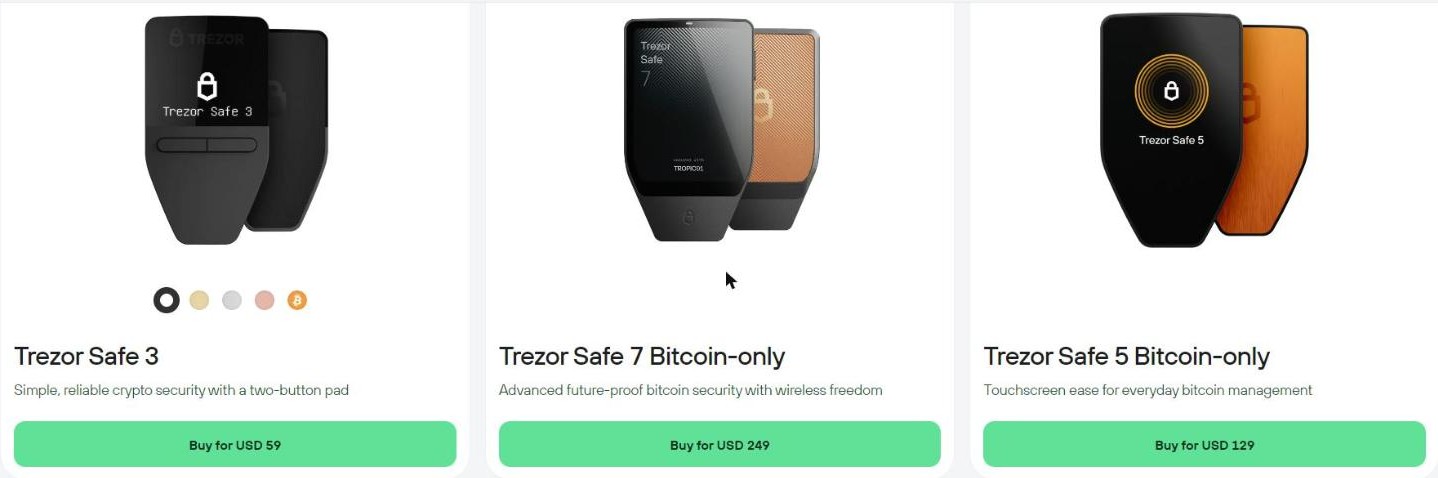
The three current models in the Trezor store, with the Bitcoin-only editions at the same price as the standard ones (screenshot from trezor.io)
Two versions of the Trezor Safe 3 exist: a universal edition that Trezor says manages “1000s of coins and tokens”, and a Bitcoin-only edition. Both cost USD 59. The same pattern holds further up the range, where the Safe 7 Bitcoin-only is USD 249 and the Safe 5 Bitcoin-only is USD 129 – choosing Bitcoin-only is a firmware decision, not a price decision.
Trezor Safe 3 security: identical to the USD 249 model
Trezor’s comparison page groups the specification into blocks, and near the bottom there is a block headed “Standard features of all three models”. Everything in that block is present on the USD 59 device and on the USD 249 device alike.
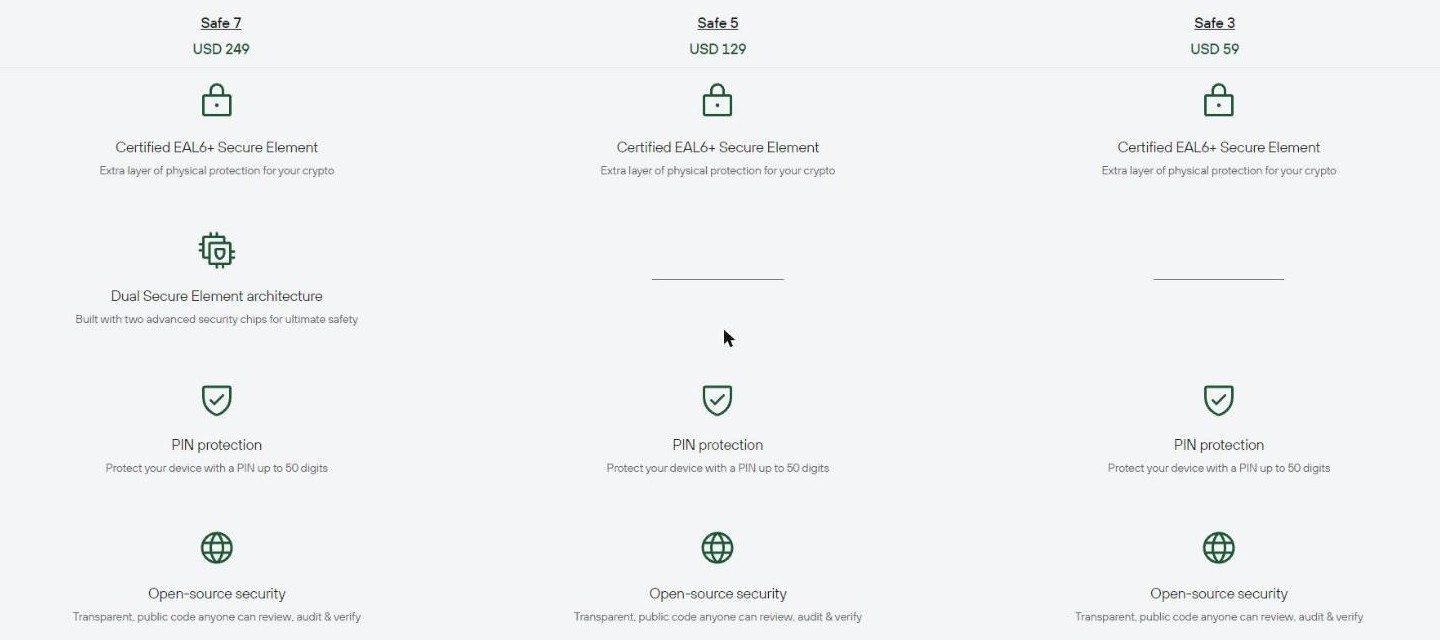
The security block on the Trezor comparison page: the same certified secure element, the same 50-digit PIN and the same open-source code in all three columns (screenshot from trezor.io)
- Certified EAL6+ Secure Element – listed identically in the Safe 7, Safe 5 and Trezor Safe 3 columns
- PIN protection – “Protect your device with a PIN up to 50 digits” on all three
- Open-source security – “Transparent, public code anyone can review, audit and verify” on all three
- Passphrase protection, Tor identity protection and coin control for privacy
- 12-, 20- and 24-word wallet backup plus Advanced Multi-share Backup
- Compatible with third-party apps, send and receive, and use as a 2FA device on the FIDO2 standard
- 1 000s of supported coins and tokens, with Trezor noting “a few exceptions”
That is the entire privacy and backup stack, plus the certified chip, plus the authenticator function, on the cheapest model. The FIDO2 part is worth pausing on: the Trezor Safe 3 doubles as a security key for ordinary website logins, and the specification it implements is published openly by the FIDO Alliance. A USD 59 device that is both a crypto wallet and a FIDO2 authenticator is doing two jobs for one price.
What the extra USD 190 buys over the Trezor Safe 3
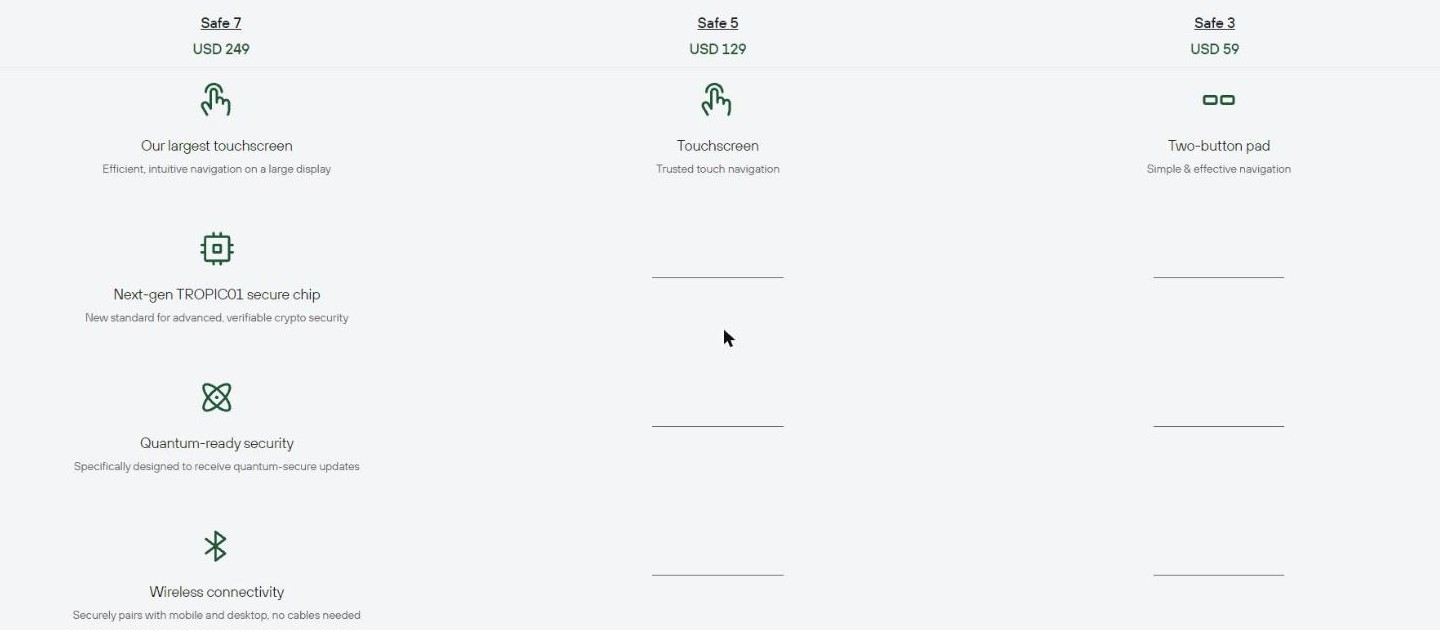
Rows where the Safe 7 column is filled and the Trezor Safe 3 column is blank – a touchscreen, the TROPIC01 chip, quantum-ready updates and wireless (screenshot from trezor.io)
Reading the same page from the top, the rows where the Safe 7 is filled in and the Trezor Safe 3 is blank are these:
| Feature | Safe 7 (USD 249) | Safe 5 (USD 129) | Trezor Safe 3 (USD 59) |
|---|---|---|---|
| Display | 2.5″ colour, 520 x 380 | 1.54″ colour, 240 x 240 | 0.96″ mono, 128 x 64 |
| Input | Largest touchscreen | Touchscreen | Two-button pad |
| Next-gen TROPIC01 secure chip | Yes | – | – |
| Quantum-ready security | Yes | – | – |
| Dual Secure Element architecture | Yes | – | – |
| Wireless connectivity (Bluetooth 5.0+) | Yes | – | – |
| LiFePO4 battery and Qi2 wireless charging | Yes | – | – |
| Haptic feedback | Yes | Yes | – |
| Body | Premium aluminium unibody | Extra-durable PC-ABS | Strong PMMA plastic |
| Full iOS compatibility | Yes | Limited | Limited |
Grouped differently, the USD 190 gap between the Trezor Safe 3 and the Safe 7 buys a bigger colour touchscreen, a second secure chip with quantum-ready firmware updates, a metal body, a battery, wireless charging, Bluetooth, haptics and full iPhone support. It does not buy a stronger PIN, a different backup standard, more supported coins, or a privacy feature the cheaper device lacks.
One row behaves differently from the rest. In the Durability block the Safe 7 lists IP54 protection, a Gorilla Glass 3 display and a reinforced glass backplate; the Safe 5 lists the Gorilla Glass 3 display; the Trezor Safe 3 column is empty. The product page for the Trezor Safe 3 does describe its materials – “Durable PMMA plastic with hidden-tilt effect, tamper-evident casing, anodized aluminum backplates” – so the device is not undescribed, but the comparison table claims no durability rating for it. If water resistance or drop protection matters to you, that blank is the honest answer.
“Some Trezor models” sounds worse than it is
Trezor’s coin directory tags each asset with the models that support it. Most of the top fifty read “All Trezor models”, but six of them read “Some Trezor models”: XRP, Solana, TRON, Monero, Cardano and PUMP. On a page where you are deciding whether to save USD 70, that label looks like a warning about the cheap device.
It is not. Each of those six assets has its own page on trezor.io with a block headed “Trezor hardware wallets that support …”, and all six list the same three devices:
| Asset | Directory label | Devices named on the asset’s own page |
|---|---|---|
| XRP | Some Trezor models | Safe 7, Safe 5, Trezor Safe 3 |
| Solana (SOL) | Some Trezor models | Safe 7, Safe 5, Trezor Safe 3 |
| TRON | Some Trezor models | Safe 7, Safe 5, Trezor Safe 3 |
| Monero (XMR) | Some Trezor models | Safe 7, Safe 5, Trezor Safe 3 |
| Cardano (ADA) | Some Trezor models | Safe 7, Safe 5, Trezor Safe 3 |
| Bitcoin and Ethereum (for comparison) | All Trezor models | Safe 7, Safe 5, Trezor Safe 3 |
The “some” is excluding the discontinued Model One and Model T, not the Trezor Safe 3. That matters for staking in particular: Trezor says staking is available for Ethereum, Cardano and Solana, and two of those three carry the “some models” tag. A buyer could reasonably conclude that the cheapest wallet cannot stake. Checked asset by asset, it can. The Trezor Safe 3 listing names the universal edition as the one that handles the full token set.
Trezor Safe 3 app support is wider than the flagship model
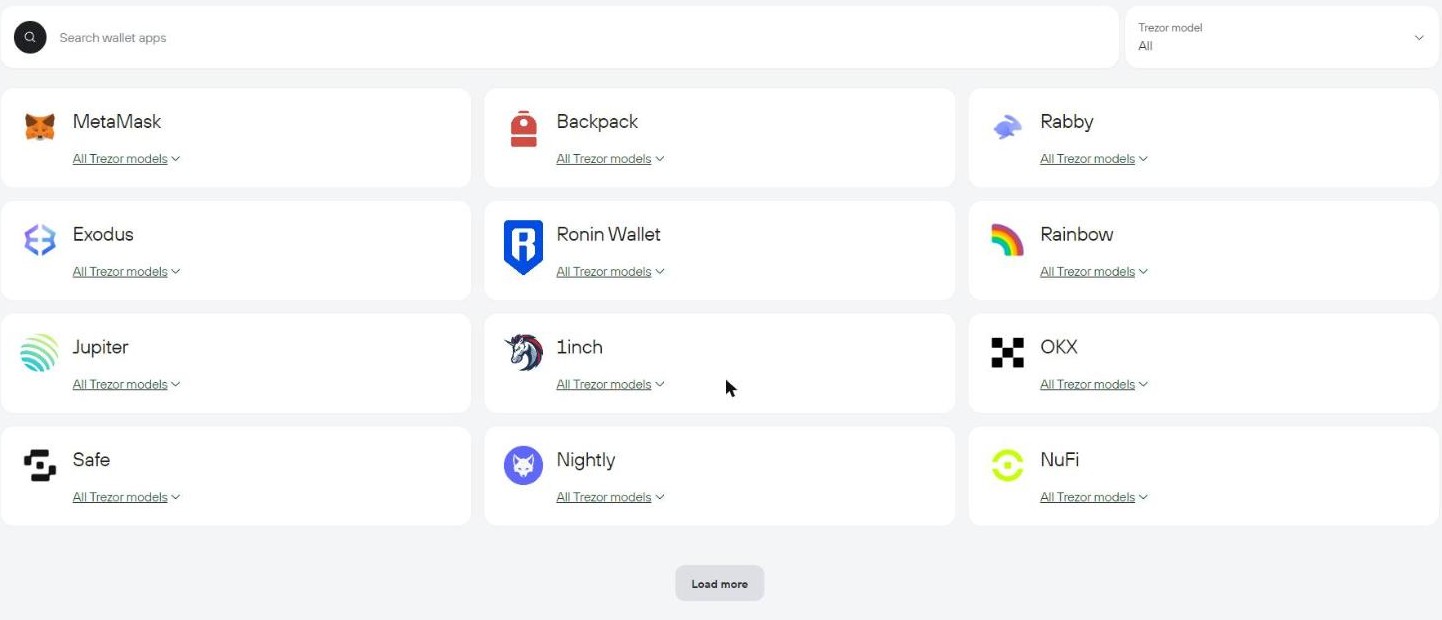
The third-party wallet app directory, where most entries read “All Trezor models” (screenshot from trezor.io)
Trezor’s third-party wallet app directory lists 43 apps once every “Load more” has been clicked. Each card names the devices it supports. Counting them:
- 43 of 43 apps list the Trezor Safe 3.
- 37 of 43 list the Safe 7. The six that do not are Wasabi Wallet, MyEtherWallet, Monero CLI/GUI, BlockWallet, Stellarport and Bitcoin Safe.
- All six of those apps do list the Safe 5 and the Trezor Safe 3.
This is the one place where the USD 59 device is measurably ahead of the USD 249 one, and it is a timing effect rather than a capability gap – the Safe 7 is the newest model and six developers have not shipped support for it yet. Still, if Wasabi or a Monero client is part of your setup today, the Trezor Safe 3 works with it and the flagship does not.
Separately, the Trezor Suite page advertises “30+ wallet apps” while the directory behind it holds 43. The marketing number is the conservative one, which is an unusual direction for a marketing number to err in.
Where the Trezor Safe 3 genuinely stops: the iPhone
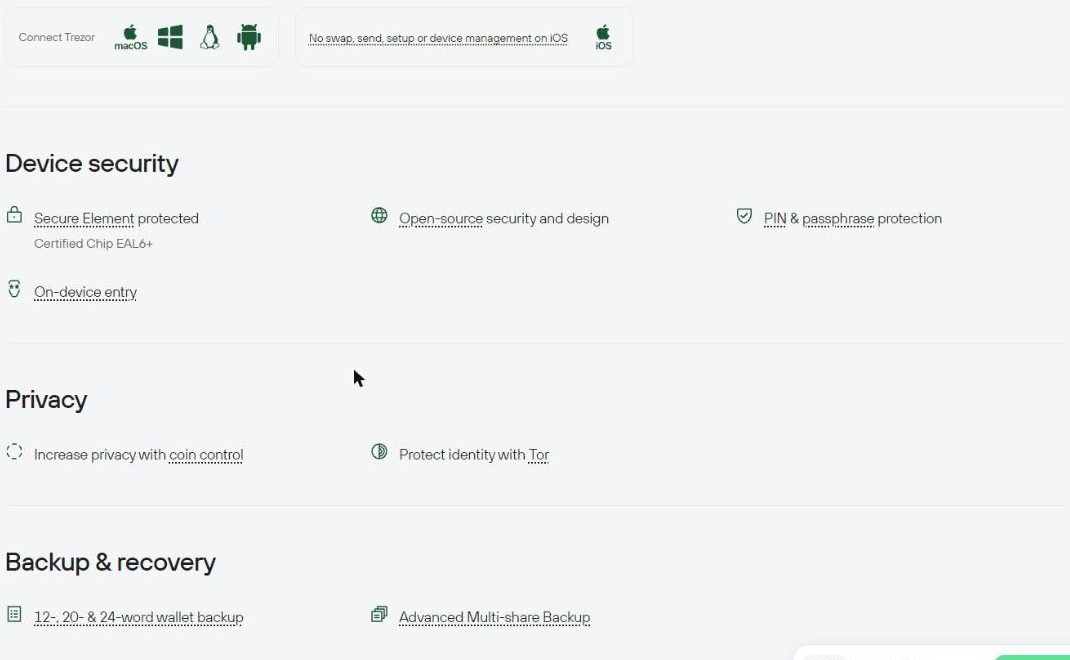
The Trezor Safe 3 specification panel, including the iOS line and the 12-, 20- and 24-word backup entry (screenshot from trezor.io)
The product page carries a short line in the connectivity row that decides the purchase for a lot of people: “No swap, send, setup or device management on iOS.” The comparison page phrases the same limit as “Limited iOS compatibility – Check balances, buy and receive crypto”, against “Full iOS compatibility” for the Safe 7.
Read together, the Trezor Safe 3 on an iPhone is a read-and-receive device. You cannot initialise it, you cannot send from it, and you cannot manage the device itself. Setup requires a Mac, Windows, Linux machine or an Android phone. Trezor connects this to hardware rather than software: only the Safe 7 has Bluetooth, and the company has said elsewhere that wired accessories on iOS need a separate Apple licence.
If your only computer is an iPhone or an iPad, this is the row that pushes you to the Safe 7 – not the chip, not the screen. If you own any desktop or any Android device, the limit never comes up.
Backup: three pages, three different word counts
The Trezor Safe 3 supports several backup lengths, and Trezor states the set differently in three places:
| Page | What it says |
|---|---|
| /compare | “12-, 20- and 24-word wallet backup” plus Advanced Multi-share Backup |
| /store (backup solutions) | “Protect your 20-word or 24-word wallet backup … All Trezor hardware wallets are 20-word compatible” |
| /returns FAQ | refers to “the 12 or 24 words” |
None of these is wrong in isolation – the device handles 12, 20 and 24 – but the store copy and the returns copy each drop one of the three. Nowhere is the difference more practical than in the box: the Trezor Safe 3 ships with 2x 20-word wallet backup cards, a USB-C to USB-C cable, a start-up guide and stickers. The cards are printed for one format out of the three the device supports.
The practical consequence is a buying order. Decide the backup length first, then buy the metal plate, because metal backup products have a fixed number of slots. Working the other way round is how people end up with a 24-word seed and a 20-word plate.
The backup plate costs more than the Trezor Safe 3
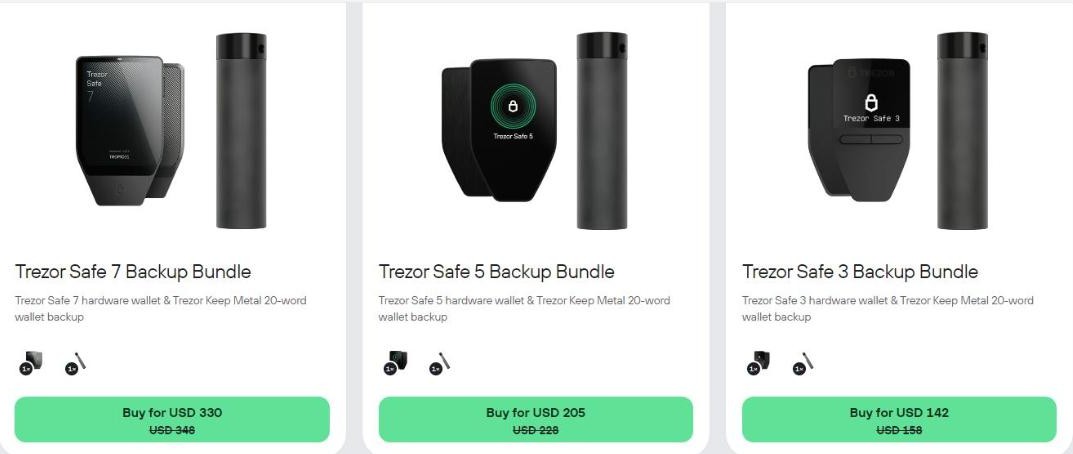
The three backup bundles, each pairing a wallet with the Keep Metal 20-word plate (screenshot from trezor.io)
Trezor Keep Metal sells for USD 99 in both the 20-word and 24-word versions. Set against a USD 59 wallet, that is 1.68 times the price of the device it protects. Both plates are listed as working with all three current models.
Trezor also sells bundles, and prints the bundle price next to a struck-through total rather than a percentage. Doing the arithmetic:
| Bundle | Bundle price | Parts bought separately | Saving | Saving % |
|---|---|---|---|---|
| Trezor Safe 3 + Keep Metal 20-word | USD 142 | USD 158 (59 + 99) | USD 16 | 10.13% |
| Safe 5 + Keep Metal 20-word | USD 205 | USD 228 (129 + 99) | USD 23 | 10.09% |
| Safe 7 + Keep Metal 20-word | USD 330 | USD 348 (249 + 99) | USD 18 | 5.17% |
Every struck-through figure matches the component prices exactly, which is more than can be said for a lot of bundle pricing. The pattern underneath is worth noticing: the most expensive bundle discounts the least, at 5.17% against roughly 10% for the other two, and in cash terms the Safe 5 bundle saves USD 5 more than the Safe 7 bundle despite costing USD 125 less. The Trezor Safe 3 bundle has the best percentage of the three.
You do not have to buy a metal plate at all. The two paper cards in the box are a working backup. The plate is fire and water insurance, and at USD 99 it is worth sizing against what you are actually storing. If you do want the pairing, the Trezor store lists the bundles alongside the individual products.
Returns: fifteen days, and two sentences that disagree
Trezor runs returns through a form rather than an email thread, and gives you 15 calendar days from delivery. The conditions box at the top of the page states:
“Trezor wallets can only be returned if the box is unopened and all seals are intact.”
The FAQ further down the same page answers the question “What condition does the item need to be in?” like this:
“Items should be returned in their original condition where possible. The outer shipping box may be opened, but the device box should ideally be intact and sealed. If the device box has been opened, you can still return it – please describe the condition in the notes field.”
Those two passages point in opposite directions, and only one of them is a rule. The safe reading is the stricter one: if you are unsure whether you want the Trezor Safe 3, do not break the device seal. The FAQ suggests a conversation is possible, not that it is guaranteed.
Three other details from the same page are worth knowing. Partial returns are allowed by selecting “Partial” in the form. Refunds are processed after the return is received and inspected. And Trezor anonymises order data after processing as part of its privacy policy, so an older order may need extra information before support can find it – a privacy practice that cuts against you in exactly this situation.
The company behind the Trezor Safe 3
Trezor states on its company page that it was founded in 2013, built the first hardware wallet with the Model One in 2014, and has run as a team of “110+ like-minded individuals” that is “100% self-owned”. The engineering happens at its Prague offices, and the broader group is presented as SatoshiLabs. The published milestone list includes BIP39 and BIP44 in 2013-2014, Shamir Backup and SLIP39 in 2019, and Trezor Suite for desktop in 2021 – standards work that is now used well beyond Trezor’s own products.
Two consumer-facing numbers come from the company itself and should be read as such: Trezor says it serves over 2 million customers, and the Trezor Safe 3 product page shows a 4.6 out of 5 rating from 82 verified-buyer reviews. The star breakdown on that page adds up to 82, which is the sort of small consistency check worth doing on any rating widget.
What self-custody means for your money
A hardware wallet is not a regulated financial product, and there is no deposit insurance, no regulator and no support line that can restore your funds. Trezor is explicit about this in a way that is easy to miss, because its anti-phishing notice is also a statement of how the system works: support will never ask for your wallet backup or your recovery words, and anyone who does is not Trezor.
The consequence runs in both directions. Nobody can freeze your coins, and nobody can recover them either. If the Trezor Safe 3 is lost, destroyed or stolen, your backup is what rebuilds the wallet – the device is replaceable, the words are not. If the backup is lost as well, the funds are gone permanently. That is the trade self-custody asks you to accept, and the USD 99 metal plate exists because of it.
This article is not investment advice and does not recommend holding any particular asset. It describes a device and the terms attached to buying one.
Who the Trezor Safe 3 fits
It fits someone who wants certified-chip cold storage with passphrase, Tor and coin control, who owns a laptop or an Android phone, and who would rather put the saved USD 70 to USD 190 into a metal backup or simply not spend it. It fits anyone whose setup involves Wasabi, a Monero client or MyEtherWallet, since those have not added the Safe 7 yet. It also fits someone who wants a FIDO2 security key and a crypto wallet in one object.
It fits less well if the iPhone is your only computer, because you cannot set the device up there. It fits less well if you want a colour touchscreen for confirming long addresses, if you want the TROPIC01 chip and quantum-ready update path, or if you want a metal body with an IP rating – the comparison table lists no durability rating for the Trezor Safe 3 at all. Those are real differences, and they are what the higher prices are for.
How this review was done
This is a desk review. Nobody on this site bought, opened or set up a Trezor Safe 3, and no claim here describes hands-on use. Everything above was read from trezor.io on 3 November 2026: the Trezor Safe 3 product page, the comparison page, the store with its hardware, backup and bundle sections, the coin directory plus six individual asset pages, the third-party wallet app directory, the returns page with its FAQ entries expanded, and the company page.
Prices were read with delivery set outside the EU so that figures appear in US dollars; Trezor shows local currency and local shipping costs depending on destination, so your checkout total may differ. Percentages in the bundle table were calculated from the prices Trezor prints, not taken from the site. Where two Trezor pages disagree – the backup word counts, the returns conditions – both wordings are quoted above rather than reconciled. Customer reviews and named testimonials on trezor.io were deliberately not used.
The short version
The Trezor Safe 3 is a USD 59 hardware wallet that carries the same certified secure element, the same 50-digit PIN, the same passphrase, Tor and coin control, the same 12/20/24-word and multi-share backup options and the same FIDO2 function as Trezor’s USD 249 flagship. Every one of the six assets flagged “some models” works on it, and all 43 third-party wallet apps in Trezor’s directory list it – six more than list the Safe 7.
The honest limits are a small monochrome screen, two buttons instead of touch, no Bluetooth or battery, no durability rating in the comparison table, and an iPhone that can receive but cannot set up or send. If none of those is a dealbreaker, the cheapest model is carrying the full security stack and the money saved can go into the backup instead.
Overall: 4.4 / 5. Points come off for the iOS setup limit and for three Trezor pages giving three different backup word counts, not for anything missing from the security list. Current pricing, colours and bundle options are on the official Trezor Safe 3 page.


