








The SafePal S1 is a fully air-gapped hardware wallet featuring an EAL6+ security chip, supporting QR code-based signing and over 200 blockchains, priced at $49.99. Here is what you get for that price.
Reviews


Previously, cold storage meant choosing between two bad options: a cheap device that cut costs on the chip, or a properly certified device that cost as much as the cryptocurrency a newcomer wanted to protect. SafePal S1 is neither. It is a completely air-gapped hardware wallet built around a CC EAL6+ secure element, storing keys for more than 200 blockchains and sold for $49.99 .
Price is why most people find it, but that is not why it is worth considering. What is interesting about SafePal S1 is what it does not have: no Bluetooth, no WiFi, no NFC, and absolutely no USB data connection. Every transaction leaving the device is just like one entering it — as a QR code scanned through the camera. This review will examine what that design delivers, what the S1 can hold, and how it compares with the two larger models in the same product line.
What exactly is the SafePal S1?
The S1 is a credit-card-sized cold wallet that stores your private keys offline and signs transactions on the device itself. It pairs with the SafePal app on your phone, which handles everything that needs an internet connection — checking balances, creating transactions, browsing decentralized applications (DApps) — while the keys themselves never leave the hardware.
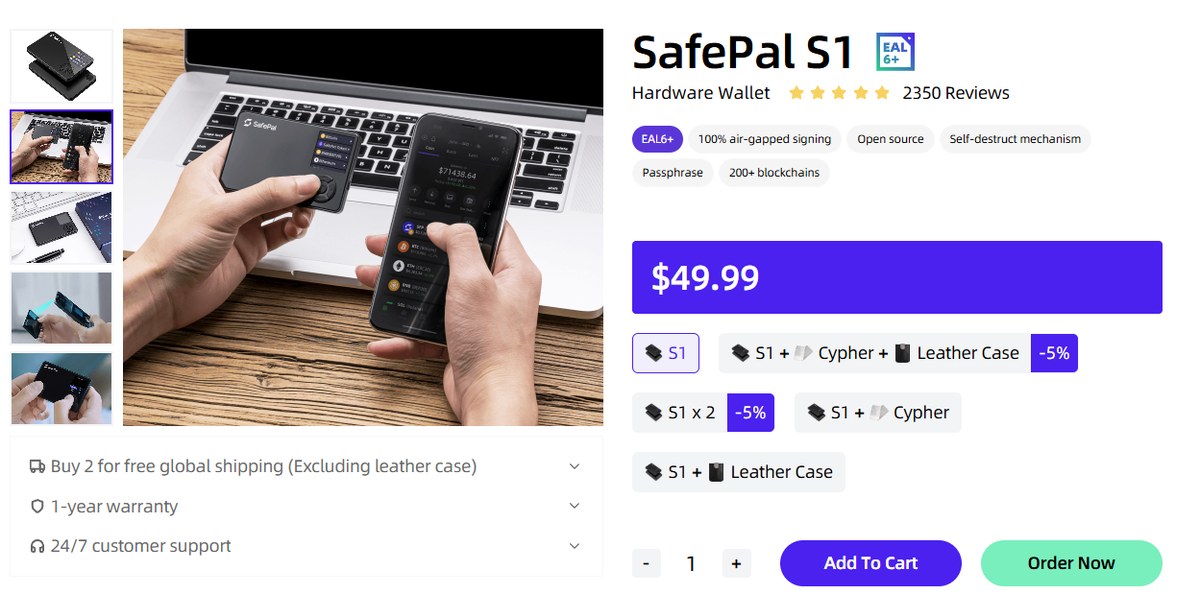
SafePal lists six specifications on the product page, and each one is a specific statement rather than a slogan:
- EAL6+ — the assurance level of the secure element chip
- Completely air-gapped signing — no wired or wireless data connection required.
- Open source — the code used to generate private keys has been published.
- Self-destruct mechanism — anti-tampering response
- Passphrase — an optional word added after the recovery phrase.
- 200+ blockchains — the range of networks supported by this device.
The product page also states a 1-year warranty, 24/7 customer support and free global shipping when purchasing two products. At the time of writing, the product page has 2,350 customer reviews.
Why does the SafePal S1 have no Bluetooth, WiFi, or USB?
Most hardware wallets connect to a phone or computer through USB or Bluetooth. That connection is convenient, but it is also the part of the system an attacker has to reach. SafePal removed that connection entirely.
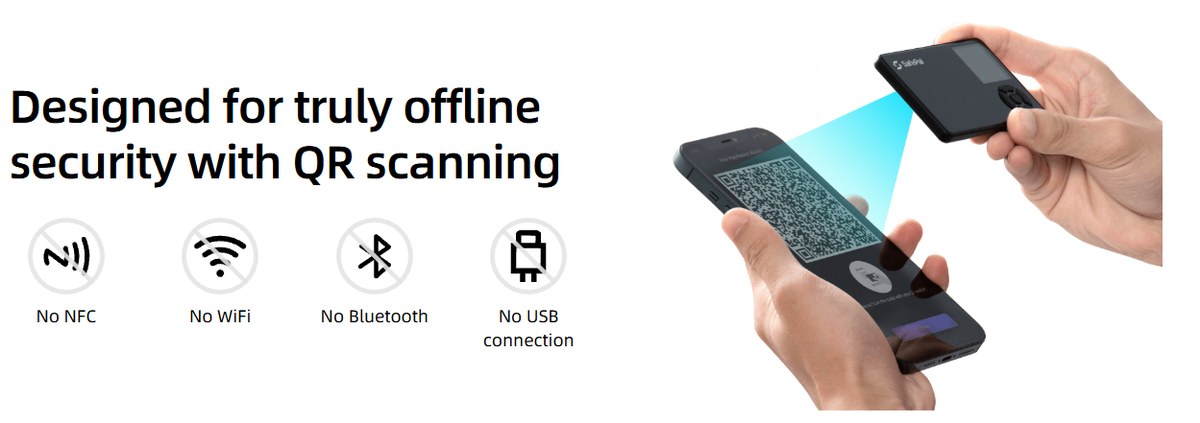
The page states it plainly: No NFC. No WiFi. No Bluetooth. No USB connection. The device charges over a cable, but there is no data path in or out of it. To send a transaction, the app displays a QR code, the S1 camera reads it, you approve it on the device screen, and the S1 displays a second QR code carrying the signature for the phone to read back.
The practical effect is that the S1 never joins a network of any kind. A compromised phone can show you a transaction, but it cannot pull a key out of a device that has no channel to hand one over. This is the same reasoning behind an offline signing machine, packaged into something that fits in a wallet.
Inside the SafePal S1: the EAL6+ secure element
Air-gapping protects the data path. The chip protects the key itself, and this is where the S1 is unusually well specified for its price.
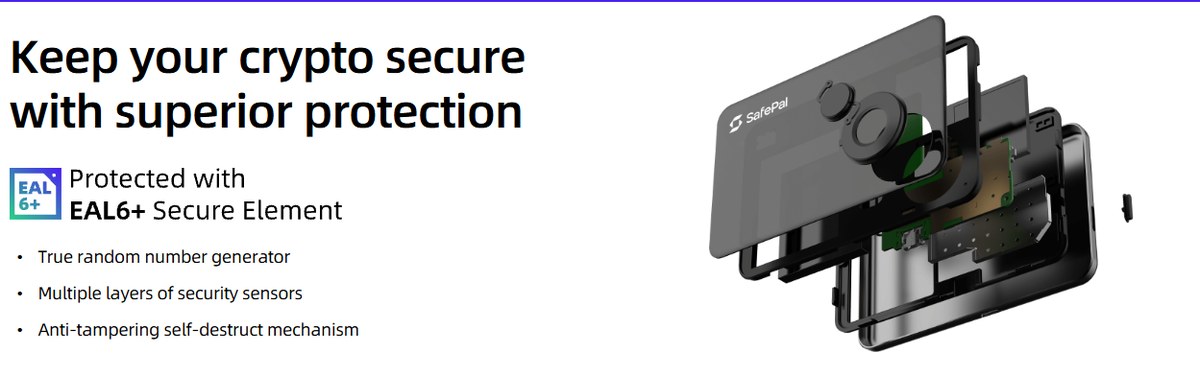
EAL stands for Evaluation Assurance Level, a rating defined under the Common Criteria for Information Technology Security Evaluation, an international standard under which products are tested by independent licensed laboratories. The scale runs from EAL1 to EAL7, and higher numbers mean a more rigorous evaluation of the design, not simply a stronger marketing word. SafePal records the upgrade of its hardware wallet line to an EAL6+ secure element in its own company timeline, dated April 2026.
Around that chip sit three more measures the product page names:
- True random number generator — so the recovery phrase is generated from real entropy on the device rather than from a predictable software source
- Multiple layers of security sensors
- Anti-tampering self-destruct mechanism — the device wipes itself if it detects physical intrusion
Code you can check yourself
A secure chip you cannot inspect is a promise. SafePal publishes the part of the code that matters most.
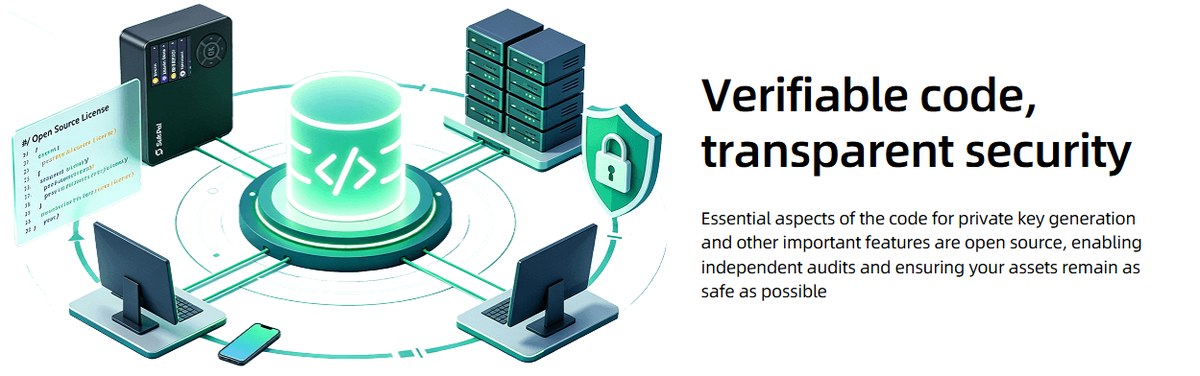
In its own words: “Essential aspects of the code for private key generation and other important features are open source, enabling independent audits and ensuring your assets remain as safe as possible.” The company timeline goes further, recording that it open-sourced the mobile app code for essential functions in September 2024, alongside the launch of the open-source X1.
This matters more than it sounds. The single question that decides whether a hardware wallet is trustworthy is whether the recovery phrase it generates is genuinely random and genuinely private. Publishing that code is what lets somebody other than the manufacturer answer it.
What the SafePal S1 can hold
Cold storage is only useful if it covers the assets you own. The S1 supports 200+ blockchains, and the SafePal App manages 10,000+ cryptocurrencies on top of them.
The public asset directory lists the networks individually, and the breadth is the point. Alongside Bitcoin, Ethereum and Solana sit Cardano, Polkadot, Cosmos, Tron, Ripple, Stellar, Litecoin, Kaspa, Sui, Aptos, TON, Hedera, Injective, MultiversX, Monad and a long tail of EVM chains including Arbitrum, Base, Optimism, Polygon, Mantle, Scroll, Linea, Blast and Taiko. Custom RPC support, added in March 2024, means a network SafePal has not listed can still be added by hand.
For most people the practical reading is simple: one SafePal S1 is very unlikely to leave part of a portfolio stranded on a chain it cannot see.
From cold storage to daily use: the SafePal App
A wallet that only stores is a drawer device. The reason people keep reaching for the S1 is that the app turns the same keys into something usable without ever exposing them.
Through the SafePal App, a key held on the S1 can be used to:
- Swap and bridge across chains — in-app swap plus trading mini-programs, including a Binance integration for spot trading
- Stake and earn — access to staking and DeFi protocols from inside the wallet
- Reach DApps — a built-in gateway to Web3 applications, NFT marketplaces and DeFi projects
- Move between crypto and cash — integrated banking gateways and fiat on- and off-ramps; SafePal launched a CeDeFi banking gateway and a Mastercard with Fiat24 in March 2025
- Track the market — real-time K-line charts inside the wallet
There is also a browser extension for Chrome, Firefox and Microsoft Edge. SafePal describes the pairing as scanning to log in while private keys stay fully isolated, with every transaction hardware-authorised. In other words, the convenience layer sits on top of the device rather than replacing it.
SafePal S1, X1 or S1 Pro: which one to buy
The S1 is the entry model in a three-device line, and the differences are easier to read side by side than to describe.
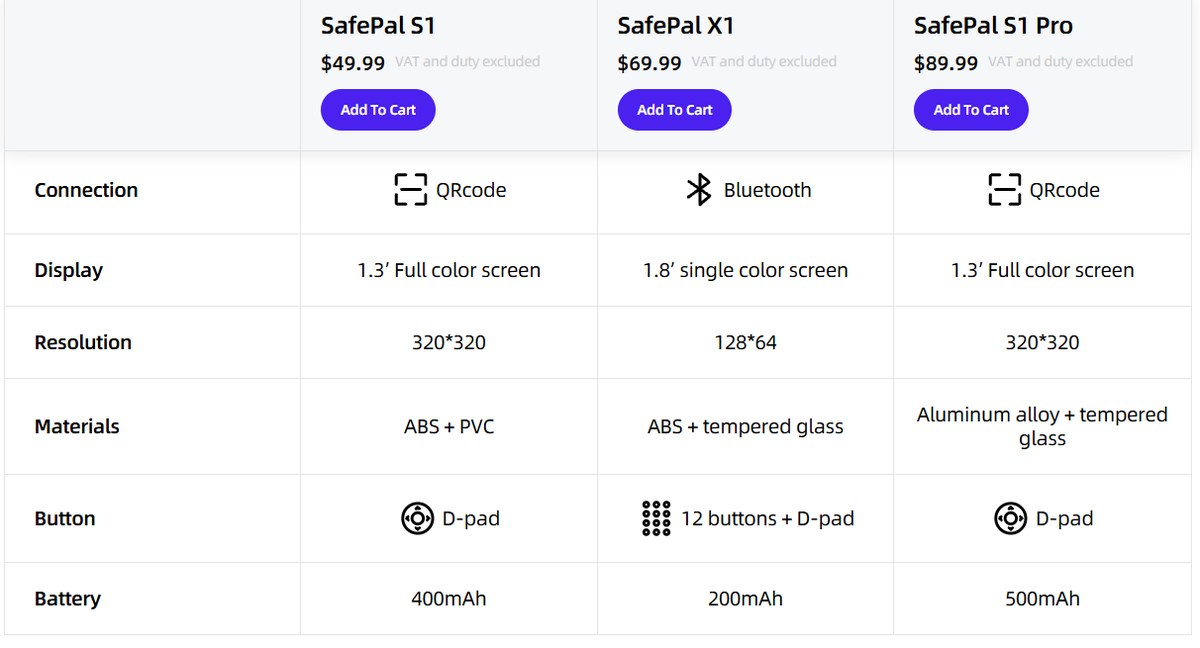
| SafePal S1 | SafePal X1 | SafePal S1 Pro | |
| Price | $49.99 | $69.99 | $89.99 |
| Connection | QR code | Bluetooth | QR code |
| Display | 1.3″ full colour | 1.8″ single colour | 1.3″ full colour |
| Resolution | 320×320 | 128×64 | 320×320 |
| Materials | ABS + PVC | ABS + tempered glass | Aluminium alloy + tempered glass |
| Button | D-pad | 12 buttons + D-pad | D-pad |
| Battery | 400mAh | 200mAh | 500mAh |
| CC EAL6+ chip | Yes | Yes | Yes |
| PIN & passphrase | Yes | Yes | Yes |
| Self-destruct mechanism | Yes | Yes | Yes |
| 200+ blockchains | Yes | Yes | Yes |
Read down the security rows and the three devices are identical: same chip, same PIN and passphrase, same self-destruct mechanism, same network coverage. You are not buying weaker protection by taking the cheapest one.
What the extra money buys is materials and convenience. The S1 Pro adds an aluminium alloy body, a larger battery and a higher price; the X1 trades QR scanning for Bluetooth and a numeric keypad. If a completely air-gapped device is what you came for, the $49.99 S1 and the $89.99 S1 Pro are the two that qualify, and the S1 is the one that costs less.
Bundles, shipping and warranty
The S1 is sold on its own or in bundles with two accessories: the SafePal Cypher ($44.99), a metal plate for engraving a recovery phrase, and a leather case ($9.99). The Classic Bundle pairs all three at $99.72 instead of $104.97, with free shipping included.
Other terms listed on the product page: a 1-year warranty, 24/7 customer support, and free global shipping on orders of two units, excluding the leather case. Prices are shown excluding VAT and duty, which is worth remembering if you are ordering across a border.
A company with a paper trail
SafePal was founded in January 2018 by Veronica Wong and two co-founders. In October 2018 it received strategic investment from Binance Labs, and the first S1 shipped in May 2019. That makes this device line older than most of the crypto apps competing with it.
The company publishes a dated timeline, and the milestones are specific rather than vague:
- April 2023 — 5 million users
- June 2023 — browser extension wallet completes the suite
- March 2024 — 10 million users; 100+ blockchains with custom RPC
- September 2024 — S1 Pro launch, open-source X1 launch, mobile app code open-sourced
- December 2024 — official distribution and resellers across 200+ regions
- December 2025 — 20 million users; Debit Mastercard launch
- April 2026 — hardware wallet line upgraded to the EAL6+ secure element
- August 2026 — 25 million users
SafePal states it now has customers in more than 200 countries and regions, with a reseller network in more than 40 of them.
How SafePal handles security communication
Buying a hardware wallet is partly a bet on the company behind it, so it is worth looking at how that company behaves when something goes wrong rather than only at what it claims when everything is fine.
SafePal runs a public scam-protection page. It discloses that the company identified and fixed a verification defect in the plug-in customers use to track order progress, and states the consequence directly: “Your hardware wallets, private keys, seed phrases, and crypto assets are safe and unaffected. Cold storage architecture operates in an isolated environment, entirely separated from e-commerce servers.” A full incident report is linked from the same page.
The design point underneath that sentence is the one worth keeping: a storefront and a signing device are separate systems, and nothing that happens to an order database can reach a key held on an offline chip.
The same page carries a standing rule stated in capital letters: SafePal will NEVER ask for your 12/24-word recovery phrase, PIN, or private keys under any circumstances. It adds that SafePal employees never initiate phone calls to customers, and that official contact happens only through its social channels, community channels and support ticket system. There is a form for submitting suspicious links and case studies showing what current scams look like.
A company that publishes the incident, names the boundary that contained it, and hands users a reporting channel is giving buyers something they can verify. That is a more useful signal than a page of security adjectives.
What self-custody means in practice
A cold wallet moves control to you, and control includes the part nobody can take back on your behalf. SafePal states this in its terms: “You shall be solely responsible for properly configuring and using the Service, in particularly your Wallets, and taking appropriate action to secure, protect and backup your Wallets.”
Three practical consequences follow, and they apply to every self-custody device, not only this one:
- The 12 or 24 words generated when you set up the device are the wallet. Written down and stored offline, they survive a lost or broken device. Lost, they cannot be reissued by anyone.
- The optional passphrase adds a word only you know on top of the recovery phrase. It raises the bar considerably, and it is equally unrecoverable if forgotten.
- Air-gapping stops a key being extracted. It does not stop a transaction you approved yourself, so reading the address and amount on the device screen before confirming remains the last line of defence.
None of this is an argument against the device. It is the trade you accept in exchange for holding your own keys, and the S1 gives you the tools — a true random number generator, a passphrase, a self-destruct mechanism and an engravable metal backup plate — to hold up your end of it.
Who the SafePal S1 suits
The S1 suits a specific group of people. It suits people moving their portfolio off an exchange for the first time who do not want to spend hundreds of dollars to do it. It suits holders of multiple cryptocurrencies across multiple chains, because more than 200 networks in one device removes the common problem of wallets that support Bitcoin and Ethereum and then stop there. And it suits anyone who wants complete separation from transmission networks – no radio signals, no cables, no exceptions.
It also suits people who want to keep using their cryptocurrency rather than simply leaving it there. The app layer allows staking, swapping, and DApp access to remain available while the keys never leave the device.
SafePal S1 Review
At $49.99, the SafePal S1 delivers a combination that normally costs significantly more: an EAL6+ secure element, complete air-gapping with QR-only signing, publicly available key-generation code, an optional passphrase, and support for more than 200 blockchains. Its security specifications are identical to the $89.99 S1 Pro — the price difference buys an aluminium body and a larger battery, not a stronger chip.
Add a company that has offered this device line since 2019, publishes a dated history of key milestones, clearly states that it will never ask for a recovery phrase, and supports the device with a 1-year warranty and 24/7 support, and the reason to choose SafePal S1 is completely clear: this is the cheapest way to own a properly certified hardware wallet that genuinely operates offline with broad network coverage.
| Category | Score |
| Security architecture | 4.8 / 5 |
| Value for money | 4.8 / 5 |
| Asset and network coverage | 4,7 / 5 |
| App and everyday usability | 4.4 / 5 |
| Transparency and track record | 4,6 / 5 |
| Build and presentation | 4.3 / 5 |
| Overall | 4,7 / 5 |
Disclaimer
This article is for informational purposes only and is not financial, investment, or legal advice. Cryptocurrency assets are highly volatile and you may lose money. Self-custody means only you control your private keys and recovery phrase; no one can recover them for you if they are lost. Prices, specifications, warranty terms, and shipping conditions are published by SafePal at the time of writing and may change — please check the official product page before ordering. This page contains affiliate links, which means we may earn a commission if you make a purchase, at no additional cost to you.


