








A desk review of JustMarkets: four account types with every parameter published, leverage and spreads listed per instrument, five licensed entities, and three pieces of arithmetic the broker does not do for you.
Reviews

How this review was done. This is a desk review. No account was opened, funded or traded. Every figure below was read from the broker’s own public pages on 23 October 2026 – the account specification tables, the homepage instrument table, the regulations page, the client protection page, the deposit and withdrawal page and the site footer. Where two of the company’s own pages state the same thing differently, both versions are printed here rather than reconciled.
Most broker reviews start with the headline leverage number, and most JustMarkets reviews do too. This one starts with the published tables, because that is where JustMarkets is unusually specific: four account types with every parameter listed side by side, a per-instrument leverage and spread table on the homepage, and a regulations page that names each legal entity, its registration number and its licence number.
That specificity is what makes the broker worth reading carefully. It also makes three pieces of arithmetic possible that JustMarkets does not do for you – one about commission, one about swaps and one about how many licences actually appear in each place. All three are below, and all three can be checked in a browser in a couple of minutes. The broker’s own pages are the source for every number quoted here.
Trading CFDs carries a high risk of losing money rapidly because of leverage, and the majority of retail investor accounts lose money when trading these products. Nothing in this review is investment advice.
What JustMarkets is, and who holds the licences
JustMarkets is a multi-asset retail broker offering forex, indices, commodities, stocks and crypto CFDs on MetaTrader 4 and MetaTrader 5. The company states it serves more than three million traders across more than 160 countries, lists over 250 instruments, and claims more than fifty industry awards. Those are the company’s own figures about itself rather than independently audited numbers, and they are repeated here as claims.
The part that is checkable is the corporate structure. JustMarkets is not one company but a group, and the regulations page names each member with its registration number and licence number. That is worth more than any award count, because it tells a prospective client which regulator would be relevant to their account. The full list appears in the licensing section further down.
One structural note before the numbers: the entity serving a client determines the rules that apply to them, including leverage caps and complaint routes. JustMarkets does not publish a public table mapping country of residence to entity, so a prospective client should confirm which company their account sits under during registration rather than assuming it from the licence list.
Four JustMarkets accounts, two pricing models
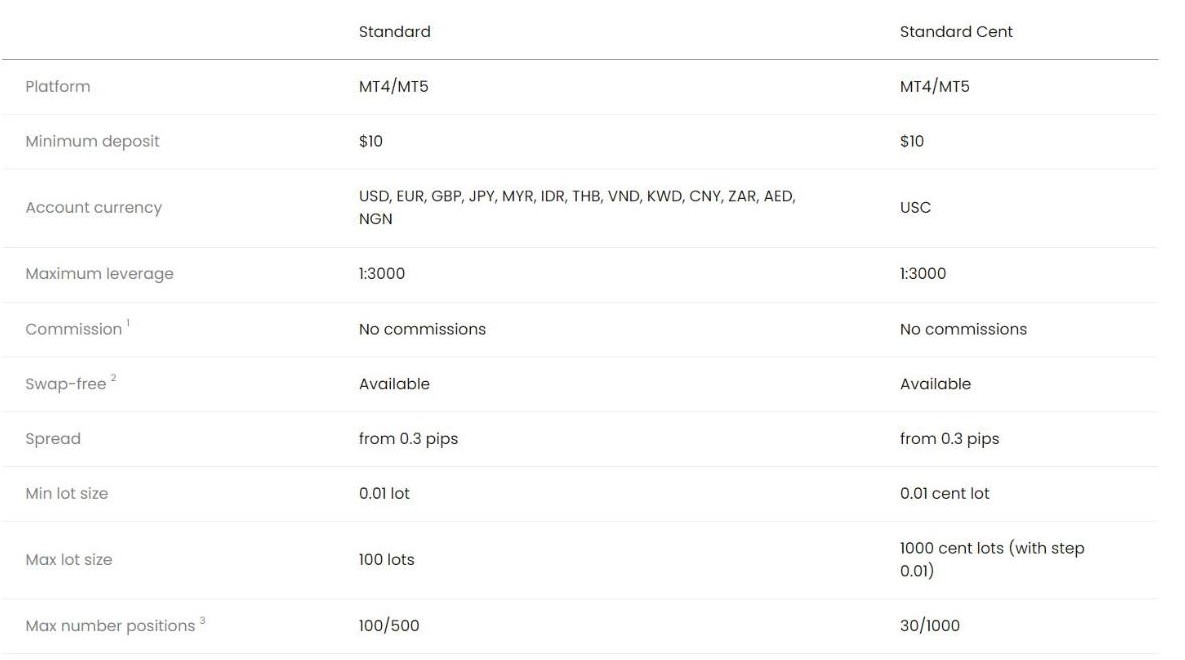
The JustMarkets entry tier is two accounts rather than one. Standard opens from a 10 USD minimum deposit, quotes spreads from 0.3 pips, charges no commission, and covers all five asset classes. Standard Cent has the same deposit floor and the same spread floor but trades in cent lots, is denominated in USC, and is limited to forex and commodities – it is the practice account that still uses real money.
A JustMarkets detail that matters for traders in Asia: the Standard account can be denominated in thirteen currencies, including VND, THB, IDR, MYR, CNY and ZAR alongside the usual USD, EUR, GBP and JPY. Holding the account in local currency removes one conversion step on both deposit and withdrawal.
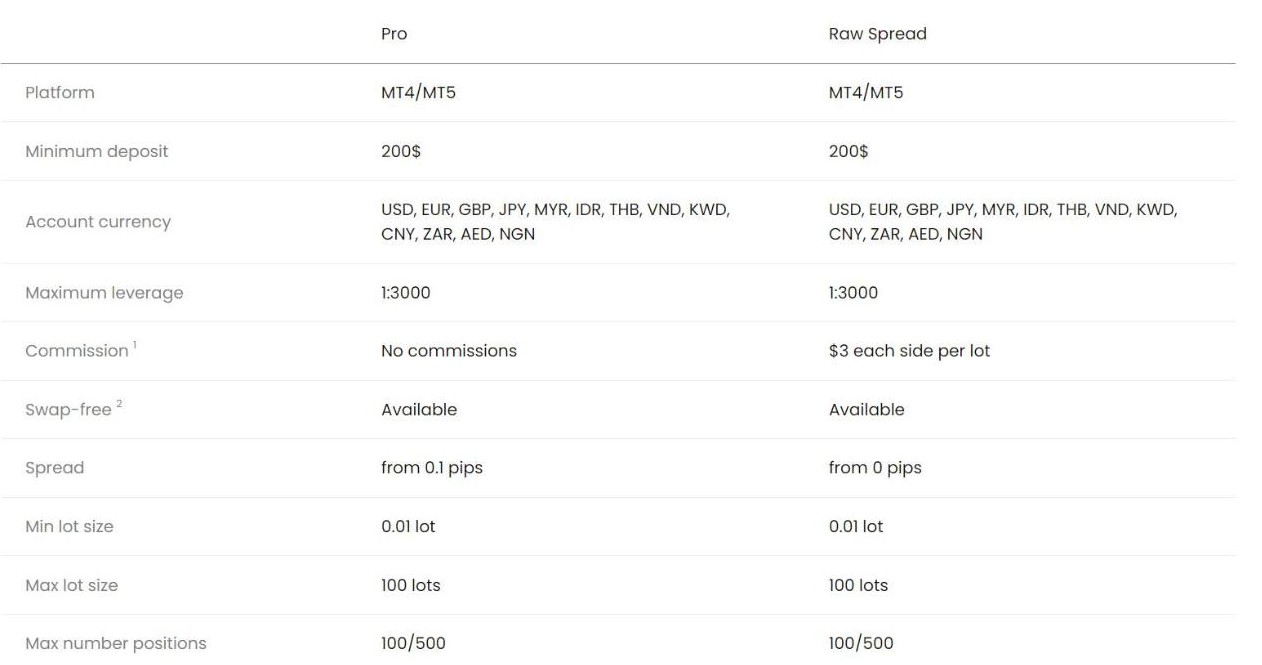
The JustMarkets professional tier raises the deposit floor to 200 USD and splits into the two standard industry pricing models. Pro quotes spreads from 0.1 pips with no commission – the cost is inside the spread. Raw Spread quotes from 0 pips and charges 3 USD each side per lot – the cost is separated out. Both carry the same instrument range and the same maximum leverage as Standard.
What a JustMarkets trade actually costs
Four parameters are identical across every JustMarkets account type and are worth noting because they are the ones that decide whether a position survives a bad hour: maximum leverage of 1:3000, a margin call at 40 percent, a stop out at 20 percent, and market execution throughout. Minimum lot size is 0.01 on every account.
Position limits differ slightly between JustMarkets accounts. Standard, Pro and Raw Spread allow a maximum of 100 lots per order and 100/500 open positions; Standard Cent allows 1,000 cent lots in steps of 0.01 and 30/1000 positions. Swap-free status is listed as available on all four account types – with one qualification covered below.
Put side by side, the published floors look like this:
| Account | Minimum deposit | Spread from | Commission | Max leverage |
| Standard | 10 USD | 0.3 pips | None | 1:3000 |
| Standard Cent | 10 USD | 0.3 pips | None | 1:3000 |
| Pro | 200 USD | 0.1 pips | None | 1:3000 |
| Raw Spread | 200 USD | 0 pips | 3 USD per side, per lot | 1:3000 |
Finding one: the Raw Spread commission is worth 0.6 pips
Three dollars each side per lot on the JustMarkets Raw Spread account means six dollars per round turn on one standard lot. On a standard lot of EURUSD one pip is worth ten dollars, so that commission is the exact equivalent of 0.6 of a pip. That single conversion is the only thing needed to compare the two professional accounts, and the broker does not publish it anywhere.
Apply it to the published floors and the comparison inverts the usual assumption. Raw Spread’s effective floor is 0 pips plus 0.6 pips of commission, or 0.6 pips all in. Pro’s floor is 0.1 pips with nothing added. At the numbers JustMarkets prints on its own specification pages, Pro is the cheaper account, and Raw Spread only overtakes it if the live Pro spread on a given instrument runs more than 0.6 pips above the live Raw spread.
The honest caveat belongs in the same breath: both figures are floors, not averages, and the gap between a raw feed and a marked-up feed usually widens in live conditions and widens further on less liquid instruments. The arithmetic does not say Pro is always cheaper. It says the break-even point is 0.6 pips, which is a number a trader can watch for themselves in the terminal rather than guess at.
Leverage at JustMarkets is published per instrument, not as one number
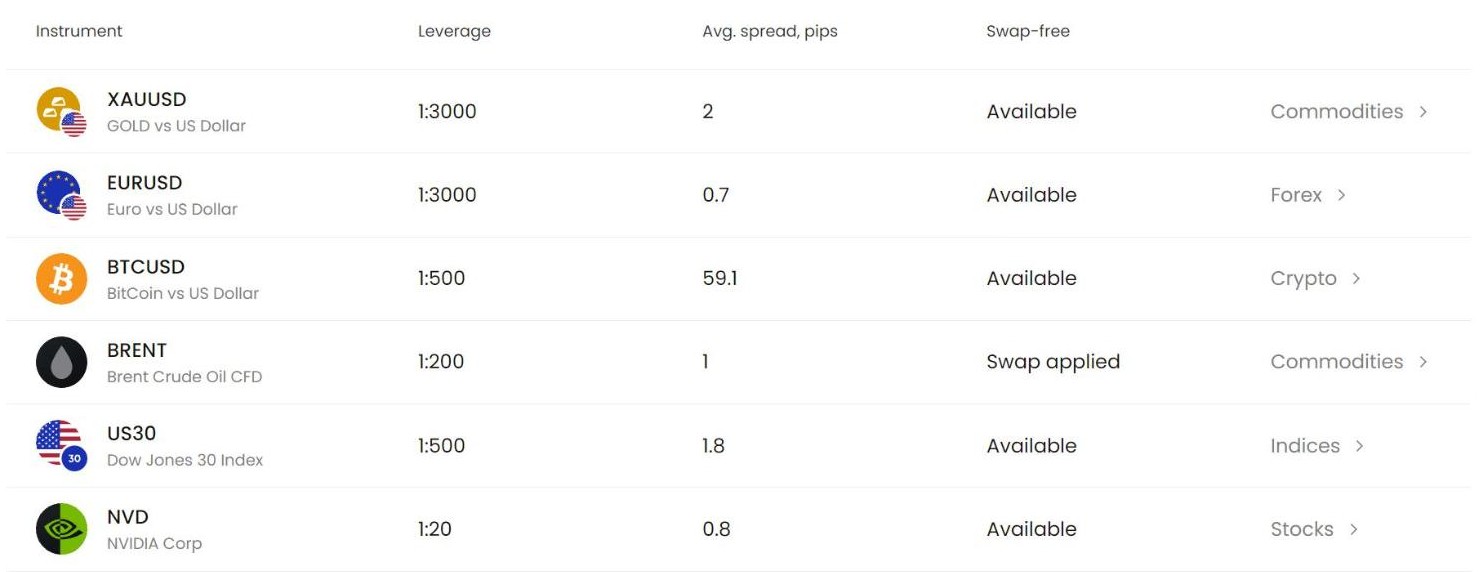
The 1:3000 JustMarkets headline is real but it is not universal, and the homepage says so in a table rather than burying it in a schedule. Gold and EURUSD carry 1:3000. Bitcoin and the Dow Jones 30 index carry 1:500. Brent crude carries 1:200. A single stock CFD – NVIDIA – carries 1:20, a hundred and fifty times less than the headline.
That spread of ratios is normal across the industry and reflects how volatile each instrument is. What is not normal is publishing it on the front page next to the marketing copy. A trader who budgets margin on the assumption that 1:3000 applies to a stock CFD would be wrong by two orders of magnitude, and JustMarkets makes that visible before registration rather than after.
The same JustMarkets table carries average spreads: 2 pips on gold, 0.7 on EURUSD, 1 on Brent, 1.8 on the Dow, 0.8 on the NVIDIA CFD and 59.1 on Bitcoin. Those are averages rather than floors, which makes them more useful than the “from” figures on the account pages for anyone sizing real costs.
Finding two: the JustMarkets swap-free claim and the swap-free column
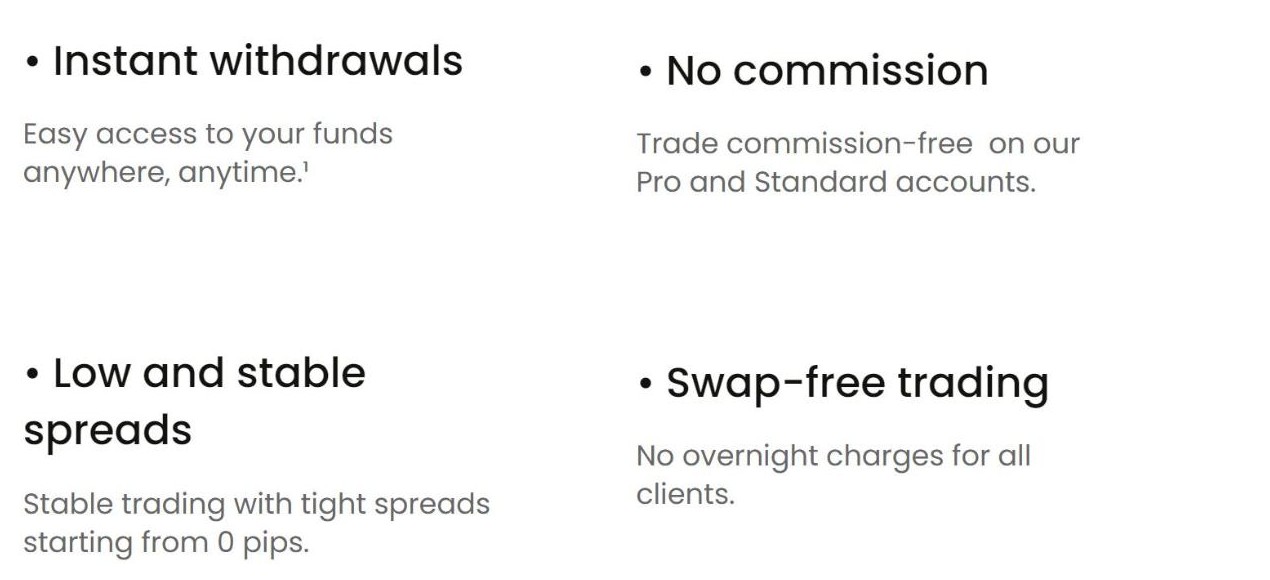
The JustMarkets homepage benefit block states it without qualification: “Swap-free trading – No overnight charges for all clients.” The account specification pages agree, listing swap-free as available on all four account types.
The instrument table sitting a few hundred pixels below that claim has a column headed Swap-free. Five of the six listed symbols read Available. The sixth, BRENT, reads Swap applied.
Both statements are published by JustMarkets on the same page, and nothing on that page reconciles them. The most likely reading is that swap-free is an account status with per-instrument exceptions, which is how most brokers operate it – but that reading is an inference, not something the site says. This review does not pick between the two. A trader planning to hold energy CFDs overnight should ask support which instruments are excluded and get the answer in writing before funding.
It is worth saying what this is and is not. It is not evidence of anything hidden; the exception is printed in the company’s own table, in public, next to the claim. It is a reminder that a blanket phrase in a benefit block is marketing copy and the table underneath it is the specification. The live table is where the current status of each symbol can be checked.
Deposits and withdrawals at JustMarkets, and the two footnotes
The JustMarkets deposit and withdrawal page leads with three promises: instant processing, protected transfers and zero commission on deposits and withdrawals with no hidden fees. Each of the first and third carries a superscript, and both footnotes are worth reading because they define the edges of the promise.
Footnote one: “Most deposits and withdrawals at JustMarkets are processed instantly, typically within one minute. Processing times may vary depending on your payment method and provider.” The deposit page phrases the same point as instant from our side, with delays from the provider possible. In other words the broker commits to its own leg of the transfer, not to the bank or wallet at the other end – which is the only commitment any broker can actually make.
Footnote two: “Selected payment systems can charge some fees from their side. It occurs outside of our payment processes.” Again accurate rather than evasive, and again worth checking against a specific payment method before assuming a transfer is free end to end.
One rule has no footnote and is absolute: JustMarkets does not accept third-party deposits. The company states it cannot accept funds from a payment account belonging to a relative or friend. That is standard anti-money-laundering practice and it is the single most common reason a first deposit gets rejected, so it is worth knowing before trying.
How client money is held
Four JustMarkets protections are published. Client funds are held in segregated accounts separate from company money. Negative balance protection applies – the company states that when a sharp market move pushes an account below zero, the balance is set back to zero. Card payments run through a processor certified to the PCI DSS standard, and withdrawals require a one-time password confirmation.
The company also states that liquidity is supplied by eighteen major banks and that clients receive the best price from that aggregated feed. That is a claim about the broker’s own plumbing which no outside party can verify, and it is recorded here as the company’s statement rather than as a fact.
Negative balance protection is the JustMarkets feature worth weighing most heavily on a broker offering 1:3000. At that ratio a position can move through the 20 percent stop out faster than the stop can fill in a gap, and the protection is what stands between a bad trade and a debt. It is published as applying to client losses that exceed account funds, without a stated cap.
Company information and licensing
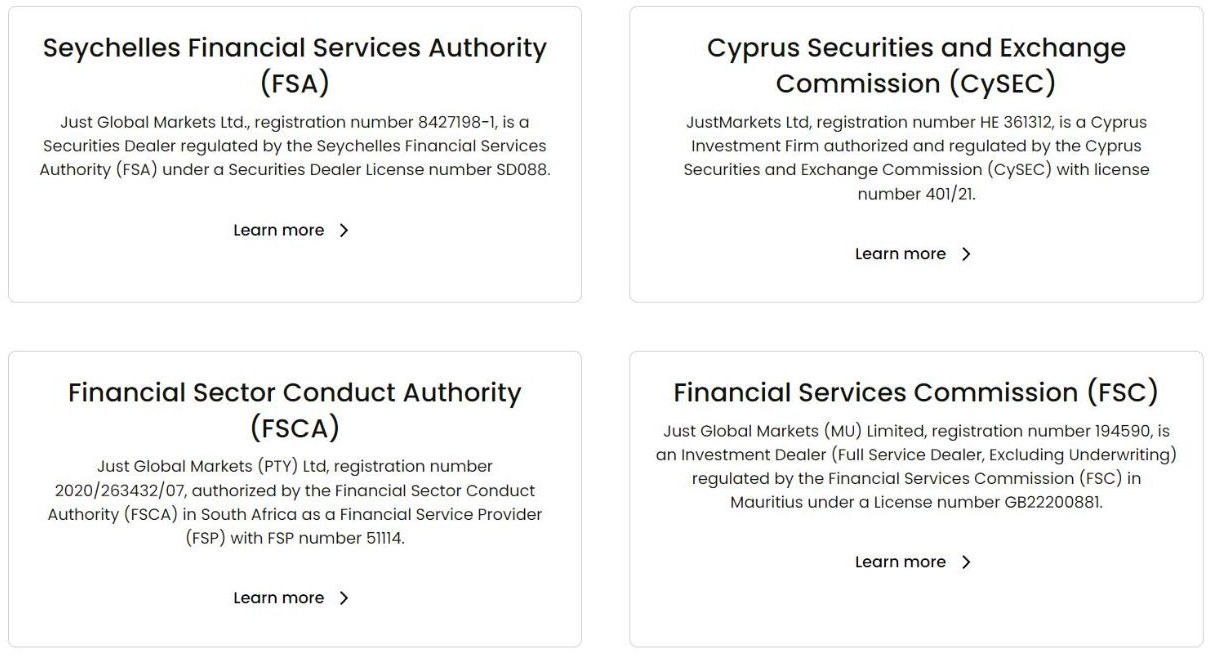
The JustMarkets regulations page names five licensed entities. Unlike some groups that list several companies while holding fewer authorisations, each of these five is matched to a named regulator and a licence number:
| Regulator | Entity | Registration | Licence |
| CySEC, Cyprus | JustMarkets Ltd | HE 361312 | CIF 401/21 |
| FSCA, South Africa | Just Global Markets (PTY) Ltd | 2020/263432/07 | FSP 51114 |
| Seychelles FSA (offshore) | Just Global Markets Ltd. | 8427198-1 | Securities Dealer SD088 |
| FSC Mauritius (offshore) | Just Global Markets (MU) Limited | 194590 | GB22200881 |
| FSC British Virgin Islands (offshore) | Just Global Markets (VG) Limited | 2139756 | SIBA/L/24/1177 |
Three of the five are offshore jurisdictions, and that should be stated plainly rather than averaged away: Seychelles, Mauritius and the British Virgin Islands apply lighter capital, reporting and compensation regimes than Cyprus or South Africa. The Cyprus entity is the one inside the European regulatory perimeter, and its authorisation can be looked up directly in the CySEC register of Cypriot investment firms using licence number 401/21.
A sixth company appears in the footer: GMFT Services Ltd, registration HE 424491, described as the EU merchant company that processes payment transactions. It is not presented as a licensed broker and should not be counted as one.
Finding three: the footer lists four licences, the regulations page lists five
Read the JustMarkets homepage footer and the regulations page one after the other and the lists do not match. The footer names Just Global Markets Ltd. (Seychelles), Just Global Markets (MU) Limited (Mauritius), JustMarkets Ltd (Cyprus) and Just Global Markets (VG) Limited (British Virgin Islands), plus the GMFT payments company. The South African entity authorised by the FSCA is absent from the footer, although it appears on the regulations page with its FSP number.
Meanwhile the JustMarkets homepage statistics block advertises five regulatory licences, which matches the regulations page rather than the footer. So the claim is supported – it is the footer that is one short, not the claim that is one long.
None of this changes what a client gets; it is a documentation inconsistency rather than a regulatory one, and the direction of the error is the harmless one. It is listed here because the footer is the legal disclosure most jurisdictions treat as authoritative, and because a reader can confirm the whole thing by opening two tabs.
Risk warning and restricted countries
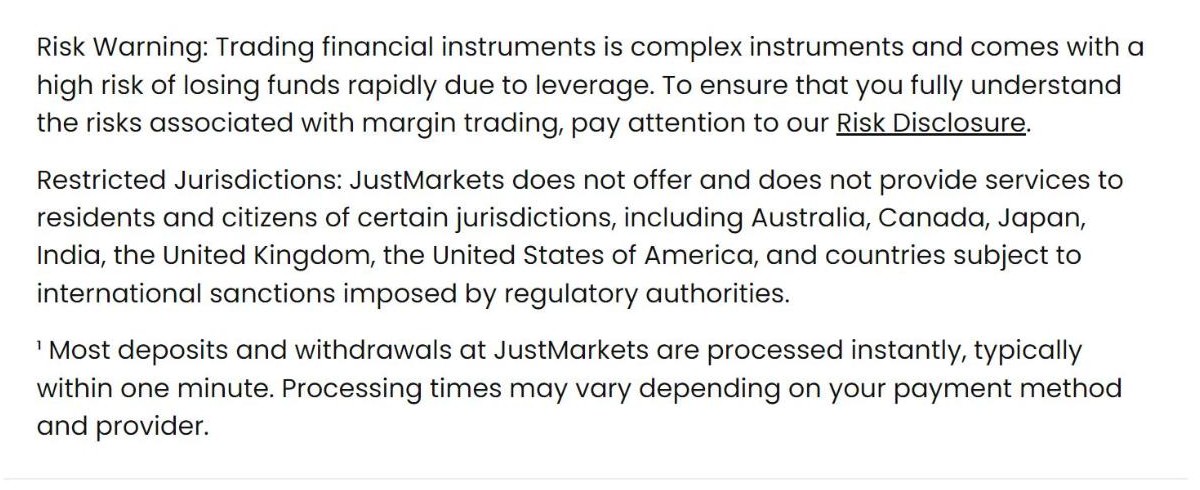
The JustMarkets risk warning, quoted exactly as the company publishes it: “Risk Warning: Trading financial instruments is complex instruments and comes with a high risk of losing funds rapidly due to leverage. To ensure that you fully understand the risks associated with margin trading, pay attention to our Risk Disclosure.”
The restricted jurisdictions notice is equally explicit: JustMarkets “does not offer and does not provide services to residents and citizens of certain jurisdictions, including Australia, Canada, Japan, India, the United Kingdom, the United States of America, and countries subject to international sanctions imposed by regulatory authorities.”
For traders in those six countries the question is closed – no account, regardless of entity. The word “including” also means the published list is not exhaustive, so residents of any country with an unusual regulatory status should confirm eligibility before depositing rather than after.
A final note on the leverage on offer. The majority of retail investor accounts lose money trading CFDs, and a 1:3000 ratio multiplies both directions of that outcome. The published stop out at 20 percent and the negative balance protection limit the downside to the funded balance, but they do not make the product low risk, and nothing here is a recommendation to trade it.
Who JustMarkets fits
JustMarkets fits a trader who wants to start small and in their own currency. A 10 USD Standard account with 0.01 lot sizing, available in VND, THB, IDR or MYR, is a genuinely low barrier, and the Cent account lowers it further for someone testing a system with real money rather than demo money.
It fits a cost-sensitive trader willing to do the 0.6 pip arithmetic above and watch live spreads for a week before committing to Pro or Raw Spread. It fits anyone who wants the regulator and licence number in front of them before funding rather than buried in a PDF. And it fits traders who want MetaTrader specifically, since MT4 and MT5 are the only platforms offered – there is no proprietary terminal to learn.
It is a weaker fit for residents of the six restricted countries, for whom the answer is simply no. It is a weaker fit for anyone who needs a single named regulator rather than a group structure, since the entity serving a given client is settled at registration rather than published in advance. And it is a weaker fit for traders who want platform choice beyond MetaTrader. Current account conditions are published in full on the broker’s own specification pages.
How this review of JustMarkets was done
Every figure above was read from the company’s own published pages on 23 October 2026: the Standard and Professional account specification tables, the homepage instrument table and benefit block, the regulations page, the client protection page, the deposits and withdrawals page and the site footer. Prices and spreads were read with the site served in its Vietnam edition.
No account was opened, no deposit was made and no order was placed, so nothing here is a measurement of real execution, slippage or withdrawal speed. Where this review says JustMarkets does something, it means the company states that it does. The three findings are arithmetic and comparison performed on published numbers, and every one of them is reproducible by a reader with a browser. Screenshots are unedited captures of those pages, cropped only to remove navigation furniture, and the live price figures they contain were accurate at the moment of capture only.
The short version
JustMarkets is a multi-asset broker with an unusually transparent specification layer: four account types with every parameter published side by side, leverage and average spreads listed per instrument on the front page, five legal entities each matched to a regulator and a licence number, a 10 USD entry point, thirteen account currencies including VND, negative balance protection and segregated client funds.
Against that, three of the five JustMarkets licences are offshore, the swap-free claim and the swap-free column disagree on one instrument, the footer lists one licence fewer than the regulations page, and the cheaper of the two professional accounts is not the one the naming suggests. All four are visible in public documents, which is the point – they are things a reader can check rather than things they have to take on trust.
Overall: 4.3 / 5. Strong published documentation and a genuinely low entry barrier, held back from a higher score by three small inconsistencies between the company’s own pages and by a group structure that leaves the governing entity unresolved until registration. Current conditions, the full instrument list and the complete licence details are on the JustMarkets site.


