









IQ Capital Review 2026: Rules, Pricing and Payouts
Reviews
IQ Capital is a proprietary trading firm that sells evaluation accounts on futures, CFD and crypto platforms, then funds the traders who pass. The model is the familiar one in this category: you buy a challenge, hit a profit target without breaking a drawdown rule, and move onto a funded account that pays you a share of what you make. What makes IQ Capital worth a close look is how much of the rule set it publishes up front, in plain tables, before you reach a checkout page.
This review reads the whole of that published rule set and lays it out in order: the platforms, the three evaluation modes, the current pricing, the drawdown mechanics, the funded-stage terms and the payout gates. Every figure below comes from the public IQ Capital website, checked on 21 October 2026. No account was bought and no trade was placed.
What IQ Capital actually is
The operating entity is BEYOND IQ CAPITAL Ltd., registered in Gros Islet, Saint Lucia, with Christoph Radecker named as managing director. IQ Capital is not a broker and does not hold client deposits. Its own risk disclosure is explicit about the arrangement: traders do not deposit their own capital, and they trade either in simulated evaluation environments or in proprietary funded accounts belonging to the firm.
That single sentence is the most important thing to understand before any pricing discussion. Money you pay IQ Capital is a fee for an evaluation, not a deposit you can withdraw. The capital you appear to trade in the funded stage is the firm’s capital, in the firm’s accounts, under the firm’s risk rules. What you are buying is access to a profit share, and the rules that govern that share are the product.
The company publishes headline numbers for scale: more than 20,000 funded traders, traders in 52 countries and more than 3.5 million US dollars paid out. Those are company claims rather than audited figures, and this review reports them as such.
Platforms and products on IQ Capital
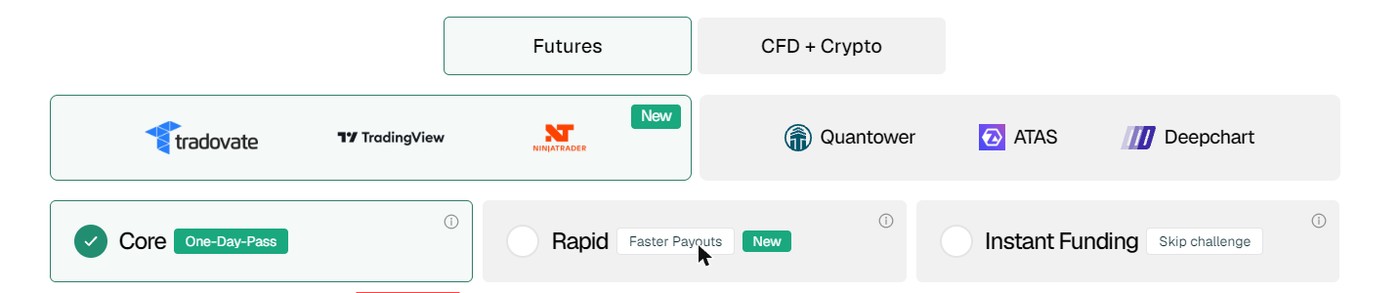
IQ Capital splits its offering in two, and the split matters because the platforms are different on each side.
On the futures side the supported platforms are Tradovate, TradingView and NinjaTrader. That is a conventional, well-understood stack: Tradovate for a browser-native order ticket, TradingView for charting traders who never want to leave their existing layout, and NinjaTrader for anyone who already runs custom indicators or automated strategies there.
On the CFD and crypto side the platforms are Quantower, ATAS and Deepchart. This is a less common line-up and a genuinely interesting one. ATAS and Quantower are order-flow and footprint platforms rather than generic charting tools, which suggests IQ Capital is aiming at traders who work from volume profile and depth-of-market data rather than from indicators alone.
The practical consequence is worth planning for. If your edge lives inside a specific platform, check that it is on the correct side of the split before buying anything, because the futures list and the CFD list do not overlap at all. The IQ Capital product page lists each platform against its account type, which is the fastest way to confirm this.
The three IQ Capital evaluation modes
IQ Capital offers three routes to a funded account, and they differ in how much patience and how much risk tolerance they demand.
Core, marketed as the One-Day-Pass, is the fastest route on paper: hit the profit target and the evaluation can clear in a single qualifying day. The appeal is obvious and so is the catch, which is that a single-day target concentrates all of your risk into one session.
Rapid sits in the middle, trading some of that speed for a looser ruleset. Instant Funding skips the evaluation stage altogether and puts you straight onto a funded account for a higher upfront fee.
There is no universally correct choice here, and the honest framing is that each mode sells a different thing. Core sells speed. Rapid sells room to breathe. Instant Funding sells the removal of evaluation risk and charges for it. A trader who has never worked inside a prop-firm rule set will usually learn more from the cheapest evaluation than from the most expensive shortcut.
IQ Capital challenge pricing, line by line
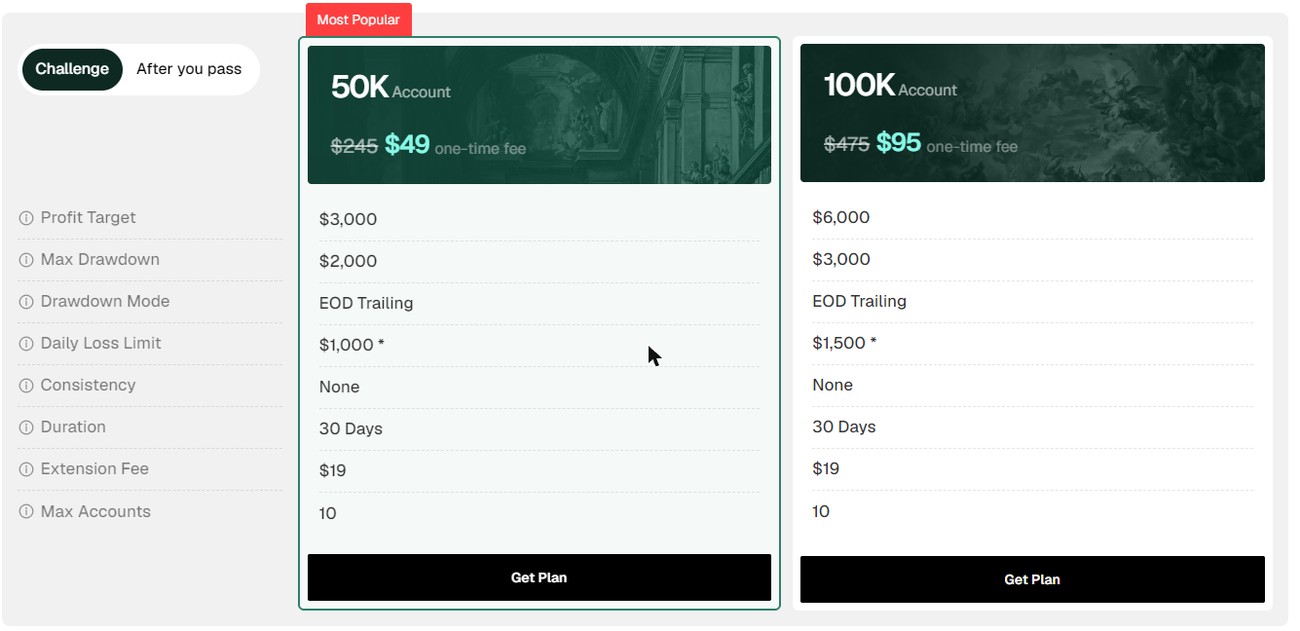
Pricing at IQ Capital is published as a comparison table rather than hidden behind a configurator, and at the time of writing both headline tiers sit at a heavy discount to list price.
| Rule | 50K account | 100K account |
| Price | 49 USD (list 245 USD) | 95 USD (list 475 USD) |
| Profit target | 3,000 USD | 6,000 USD |
| Maximum drawdown | 2,000 USD | 3,000 USD |
| Drawdown mode | End-of-day trailing | End-of-day trailing |
| Daily loss limit | 1,000 USD | 1,500 USD |
| Consistency rule | None during evaluation | None during evaluation |
| Minimum trading days | 30 days | 30 days |
| Extension fee | 19 USD | 19 USD |
| Maximum accounts | 10 | 10 |
Three things stand out when you read that table against the category. The profit target is 6% of account size on both tiers, which is at the gentler end of what prop firms ask. The drawdown allowance is 4% on the 50K and 3% on the 100K, so the larger account is proportionally tighter rather than more forgiving. And the absence of a consistency rule during the evaluation is a real advantage, because a consistency rule is what most often invalidates an otherwise passing account elsewhere.
The 30-day minimum is the counterweight, and it deserves emphasis because it sits awkwardly next to the One-Day-Pass marketing. You may be able to reach the profit target in a day; the published table still shows a 30-day minimum before the evaluation completes. Read both numbers together rather than either one alone, and confirm which applies to the specific mode you buy.
The asterisk IQ Capital attaches to its daily loss limit figures is also a reminder to read the full rule text at checkout rather than the summary table. Current IQ Capital challenge prices and the full rule text sit on the checkout page, and discounted pricing in this category changes frequently.
The drawdown rules that decide most accounts
End-of-day trailing drawdown is the mechanic that most often ends a prop-firm account, and it is worth spelling out because it behaves differently from the static version. Your drawdown floor rises with your closed balance at the end of each session, and it does not fall back when you give profit back. Reach a 2,000 dollar profit on a 50K IQ Capital account and your floor has moved up by 2,000 dollars; the 2,000 dollar allowance is now measured from that new high water mark, not from your starting balance.
The daily loss limit sits on top of that as a separate, harder stop. On the 50K account it is 1,000 dollars, which is half of the total drawdown allowance in a single day. In practice that means a bad session cannot take the whole account on its own, but two bad sessions can.
The combination is reasonable rather than generous, and it rewards a particular style: take profit off the table in modest increments, and never put a day’s worth of progress into a single position. Traders whose method relies on sitting through large open drawdown will find end-of-day trailing an uncomfortable fit regardless of which firm sells it.
What happens after you pass an IQ Capital challenge
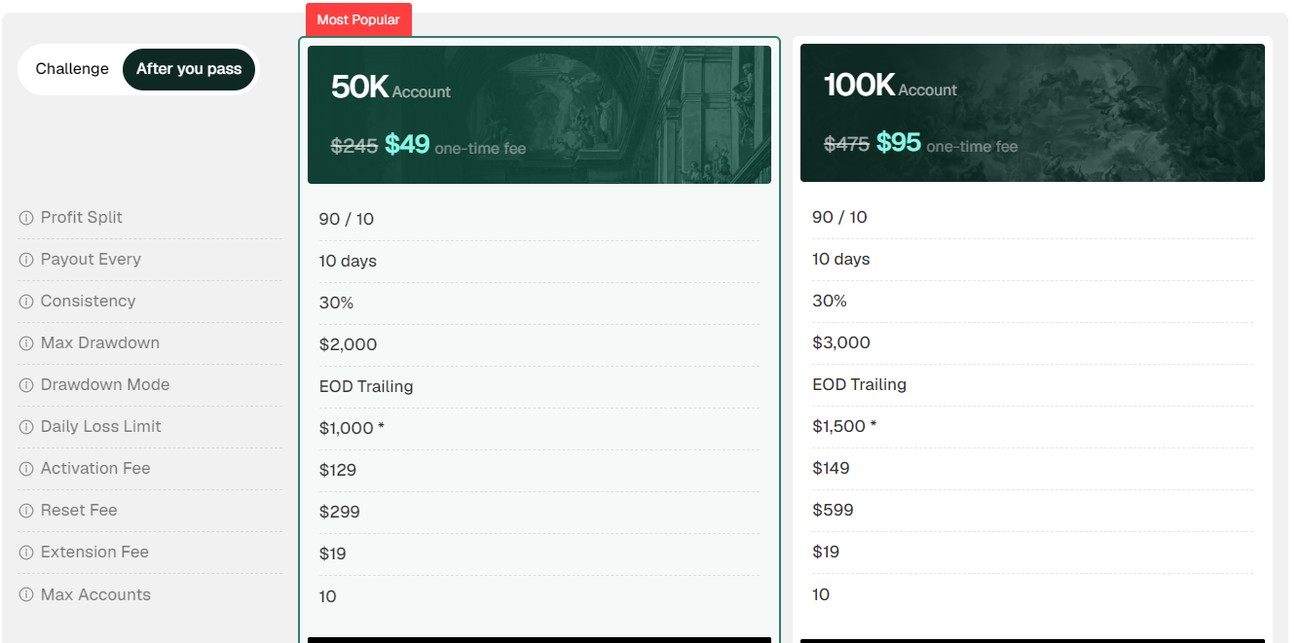
The funded stage introduces terms that do not appear in the evaluation table at all, and this is the part of the IQ Capital rule set most worth reading before you buy.
| Funded-stage term | 50K account | 100K account |
| Profit split | 90 / 10 in the trader’s favour | 90 / 10 in the trader’s favour |
| Payout frequency | Every 10 days | Every 10 days |
| Consistency rule | 30% | 30% |
| Activation fee | 129 USD | 149 USD |
| Reset fee | 299 USD | 599 USD |
The 90/10 split is at the top of the market and the ten-day payout cycle is faster than the monthly cycle many firms run. Both are genuine strengths and both are the reason this review scores IQ Capital as well as it does.
The two numbers to budget for are the activation fee and the consistency rule. The activation fee is a second payment, due after you pass, so the true cost of reaching a funded 50K account is 49 dollars plus 129 dollars rather than 49 dollars. And the consistency rule that was absent during the evaluation appears at 30% in the funded stage: no single day can account for more than 30% of your total profit. That one rule changes how a funded account has to be traded, and a trader who passes with one outsized day will need to adjust before requesting a payout.
Reset fees are a decision point, and IQ Capital publishes two different sets of numbers for them. The challenge comparison table lists 299 dollars on the 50K and 599 dollars on the 100K; the fee table on the rules page lists 49 dollars and 79 dollars for the same restart. Both figures are published by the company, and this review reports both rather than resolving them. On the higher figures a reset costs several times the original evaluation fee, which would make a fresh evaluation the cheaper path, so confirm the live number at checkout before you need it.
How IQ Capital payouts actually work
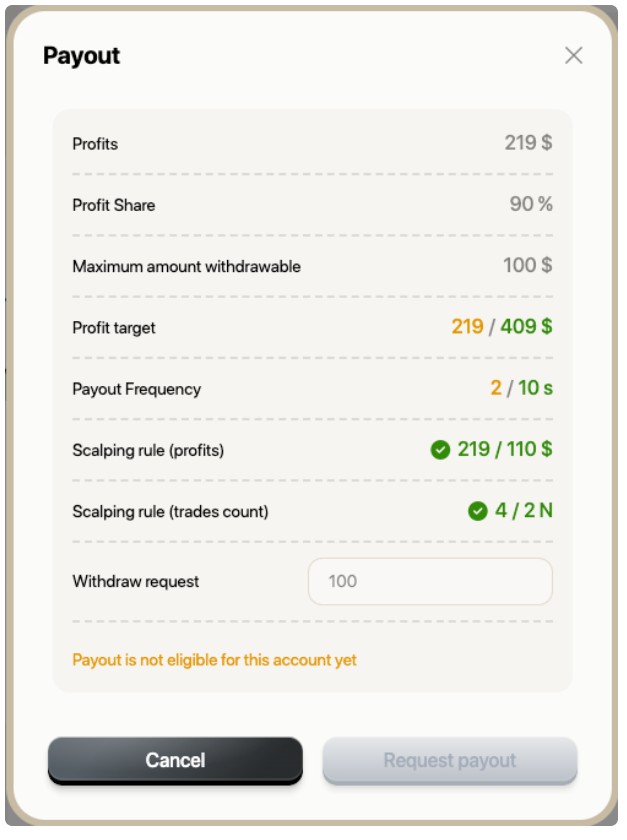
The payout mechanics are published, and they are more conditional than the headline 90% suggests.
The first gate is activity: a minimum number of trading sessions, documented as ten, before a payout request is eligible. The second gate is the calculation itself. Rather than paying 90% of all profits on the first request, IQ Capital documents the first payout as 90% of 50% of accumulated profits, with the remainder staying in the account. The effective rate on that first withdrawal is therefore 45% of profit, not 90%.
That is not hidden and it is not unusual in this category, but it is the single most common source of disappointment with prop-firm payouts, so it belongs in plain language: the 90% figure describes the split, and a separate rule describes how much of your profit is eligible at each request.
The third gate is the minimum trade duration rule, which IQ Capital applies against scalping. The documented requirement is that at least 50 percent of trades and profits must come from positions held longer than fifteen seconds. A pure high-frequency scalping approach is therefore not a fit for an IQ Capital funded account, and that is a deliberate design choice rather than an oversight.
The rules that can cost you a payout
Three further terms in the IQ Capital documentation deserve to be read before purchase rather than after.
There is a no-refund policy. Evaluation fees are not returnable, so the decision to buy is final. There is an inactivity clause: an account left dormant for more than 30 days may be terminated. And there is a risk-review clause stating that failure to comply with the firm’s risk reviews may result in forfeiture of payouts.
None of these is unreasonable for a firm putting its own capital behind other people’s trading, and the inactivity and risk-review clauses are standard across the industry. They are listed here because a trader who reads only the pricing table will not see them, and because the risk-review clause in particular gives the firm discretion that is worth being aware of.
For readers who want an independent frame for evaluating any firm in this space rather than a firm-supplied one, the US Commodity Futures Trading Commission publishes a plain-language checklist of the questions to ask before you trade, and it maps onto prop-firm due diligence almost line for line.
Company information and licensing
IQ Capital publishes a full imprint, which is more than many firms in this category do: BEYOND IQ CAPITAL Ltd., Gros Islet, Saint Lucia, with a named managing director. What it does not publish is a financial licence, a regulator or a registration number with a supervisory authority, and this review found none.
That is consistent with the business model rather than a contradiction of it. A prop firm that takes no client deposits and offers no investment product generally falls outside the licensing regimes that cover brokers, and IQ Capital’s own risk disclosure makes the no-deposit structure explicit. But the consequence for a trader is concrete and should be stated without softening: there is no financial regulator to appeal to if a payout dispute goes badly. Your protection is the published rule set and the firm’s reputation, not a supervisory authority.
One further observation, recorded because it is unusual rather than because it is a problem. The IQ Capital website ships pre-filled prompts that invite visitors to ask several AI assistants to evaluate the firm. This review treated those prompts as page content and did not follow them; every assessment above is based on the firm’s published documentation read directly.
What traders say, and what the numbers say
IQ Capital displays a 4.8-star rating on its own site. Trustpilot, checked on 21 October 2026, shows 4.7 from 585 reviews. The two figures do not match, and this review reports both rather than choosing between them; the gap is small and both are strong scores for the category.
A 585-review base is substantial enough to be meaningful and small enough that it can move. Anyone relying on it should read the recent reviews rather than the aggregate, and should weight payout-related reviews most heavily, because payout execution is the only part of a prop-firm relationship that cannot be verified in advance.
Risk warning and restricted countries
Trading futures, CFDs and crypto is high-risk and most retail traders lose money. An evaluation fee paid to IQ Capital is at risk in full from the moment it is paid, and the no-refund policy means there is no path back. Nothing in this article is investment advice, and nobody should buy a prop-firm evaluation with money they cannot afford to lose entirely.
The structural risk is different from broker risk and worth naming separately. Because you never deposit capital, you cannot lose a balance; what you can lose is the fee, the activation fee and any profit that had accumulated in an account that is then closed under a rule breach. Model the worst case as the total of the fees you have paid, not as zero.
On restricted countries, IQ Capital states that it serves traders in 52 countries but this review found no published list of excluded jurisdictions. Absence of a published restriction list is not the same as universal availability: anyone in a jurisdiction with rules on prop-trading arrangements, or subject to sanctions screening, should confirm eligibility with the firm before paying, since the no-refund policy applies regardless.
Who IQ Capital fits
IQ Capital fits a trader who already works to a defined daily risk number. The end-of-day trailing drawdown, the daily loss limit and the 30% funded-stage consistency rule all reward someone who takes measured profits across many sessions, and all punish someone who swings for a single large day. If that description already fits how you trade, the rule set is working with you rather than against you.
It fits order-flow traders especially well. A CFD and crypto line-up built on Quantower, ATAS and Deepchart is a deliberate choice, and traders who read footprint and volume profile will find a better platform match here than at firms offering only generic charting. Start with the smallest IQ Capital evaluation to learn the rule set before committing to a larger tier, since the rules matter more than the account size.
It fits less well if you scalp. The minimum trade duration rule and the two-trade requirement above fifteen seconds are explicit, and a method built on very short holds will keep colliding with them. It also fits poorly if you need a regulated counterparty and a formal dispute route, which no unlicensed prop firm can offer. Read the rule set end to end before you decide which of those descriptions is yours.
How this IQ Capital review was done
This is a desk review. Every figure, rule and claim above was read from the public IQ Capital website and its published documentation in a browser on 21 October 2026, with no account created, no evaluation purchased and no trade placed. No performance claim is made or implied, and this review has no way to verify payout execution, which can only be assessed by traders who have been paid.
Where the firm’s own figures disagree with a third-party source, both are reported side by side, as with the 4.8-star site rating against Trustpilot’s 4.7 from 585 reviews. Company statements on scale, funded-trader counts and total payouts are labelled as company claims because no independent verification is available. Screenshots are unedited apart from excluding named customer reviews and personal account data. Prop-firm pricing and rules change without notice, so confirm anything that matters at the live IQ Capital checkout page before you pay.
The short version
IQ Capital does the two things that matter most in this category better than most of its competitors: it publishes its rules in readable tables before checkout, and it pays a 90/10 split on a ten-day cycle. The 6% profit target is gentle, the absence of a consistency rule during the evaluation is a real edge, and the order-flow platform line-up on the CFD side is a genuine differentiator rather than a marketing line.
The costs to plan for are equally clear: an activation fee after you pass, a 30% consistency rule that only appears in the funded stage, a first payout calculated as 90% of half your profits, a minimum trade duration rule that rules out pure scalping, high reset fees, no refunds and no financial licence behind any of it. None of those is concealed, which is the point. Read the whole table, budget for the activation fee, and treat the evaluation fee as spent the moment you pay it.
Overall: 4.7 / 5


