








Reviews

Quick Verdict
Best for: Active crypto traders who want to discover market activity through other traders rather than relying exclusively on traditional charts and token lists.
Most interesting feature: Fomo’s social layer is integrated directly with trading rather than existing as a separate community.
Biggest advantage: Users can discover traders, follow activity, read trade theses, view leaderboards and receive alerts without leaving the trading ecosystem.
Biggest concern: A platform built around social activity can amplify both useful information and market hype.
Our verdict
Fomo is more interesting when viewed as a trading network than as another crypto exchange.
The product increasingly connects three activities:
Discover → Interact → Trade
That creates a potential network effect: the more traders participate, the more useful the social layer can become.
But it also creates a major challenge.
More users do not automatically mean better information.
What Is Fomo?
Fomo is an on-chain trading application built around social discovery.
Its current product combines crypto trading with:
- Social feeds.
- Trader profiles.
- Leaderboards.
- Real-time alerts.
- Token feeds.
- Trade theses.
- Multichain trading.
- Mobile and web access.
- Advanced charting through TradingView.
- Perpetual trading.
The company launched with a strong focus on making on-chain trading more accessible and has continued adding social features throughout 2026. Its official product updates show a progression from basic social interactions toward richer trader profiles, token-specific feeds, trade theses and desktop social experiences.
This is important because it changes how the product should be evaluated.
Fomo is not simply competing on:
“How many assets can you trade?”
It is increasingly competing on:
“How useful is the network of information around those assets?”
Fomo’s Feed Is the Center of the Experience
The traditional crypto exchange usually begins with markets.
Fomo begins with activity.
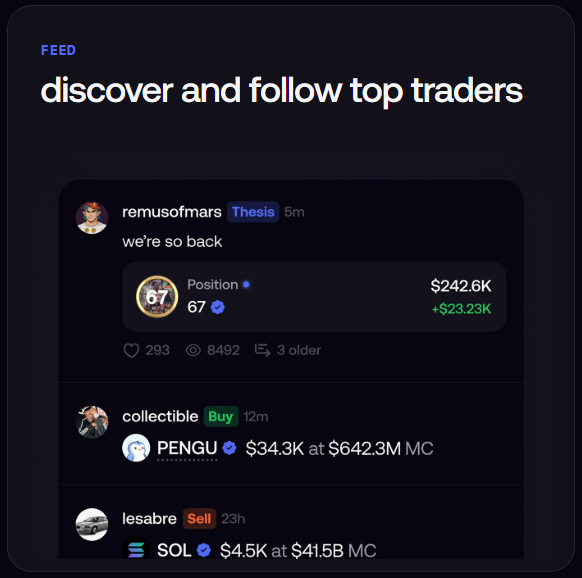
Its homepage highlights a social feed designed to help users “discover and follow top traders.”
The concept is straightforward.
Instead of manually searching for what is happening in the market, users can see trading activity generated by other people.
This can turn the feed into a real-time research environment.
A user may discover:
- A token gaining attention.
- A trader entering a position.
- A new market narrative.
- A thesis behind a trade.
- A trader worth following.
The important distinction is that the feed is not merely a discussion forum.
It is connected directly to trading activity.
That creates much more context than a traditional social post saying:
“I like this coin.”
Trade Thesis Adds Context to Social Trading
One of Fomo’s more interesting developments is its Trade Thesis feature.
The company introduced trade theses to allow traders to explain why they bought or sold a token. By February 2026, theses were surfaced in the global feed, where other users could view and interact with them. Fomo also says the thesis displays the trader’s PnL and balance for additional transparency.
This solves an important problem with social trading.
A transaction tells you:
What happened.
A thesis attempts to explain:
Why it happened.
That distinction matters.
Suppose a trader buys a token.
Without context, another user might assume:
“This trader thinks the token will go up.”
But the actual reason could be completely different.
They may be:
- Taking a short-term momentum trade.
- Hedging another position.
- Trading around an event.
- Testing liquidity.
- Planning to exit quickly.
A written thesis provides more context.
Our Take
Trade Thesis makes Fomo’s social layer more useful than a simple activity feed.
However, users still need to evaluate whether the reasoning is actually sound.
A detailed explanation can still be wrong.
Leaderboards Turn Traders Into Discoverable Profiles
Fomo’s leaderboard is another element that makes the platform resemble a social network.
The homepage explicitly promotes the idea of:
“become a legend, top the leaderboard.”
This creates a reputation layer.
Instead of traders being anonymous users behind wallet addresses, successful traders can become visible personalities within the ecosystem.
That has two potential benefits.
For Followers
Leaderboards can help users discover traders worth researching.
For Traders
Performance can become a form of reputation.
This is similar to how other social platforms turn content creators into recognizable accounts.
But there is an obvious weakness.
Performance rankings can encourage short-term thinking.
A trader who ranks highly during one period may not maintain that performance indefinitely.
Therefore, leaderboard position should be treated as a discovery mechanism—not proof of future results.

Alerts Create a Direct Link Between Following and Trading
Fomo also connects its social layer to real-time notifications.
Its homepage describes alerts as:
“real time notifications for what the best are buying.”
This feature is particularly important to the network concept.
Following someone is passive.
An alert makes that relationship active.
A user can follow a trader and potentially receive a notification when that trader enters a position.
From a product perspective, this creates a powerful loop:
Follow → Receive Alert → Investigate → Trade
That is much closer to how a social network works than a traditional exchange.
However, it also creates a psychological risk.
The faster information reaches the user, the easier it becomes to react without thinking.
Fomo Web Makes the Social Network Bigger
The launch of Fomo Web in April 2026 is particularly significant.
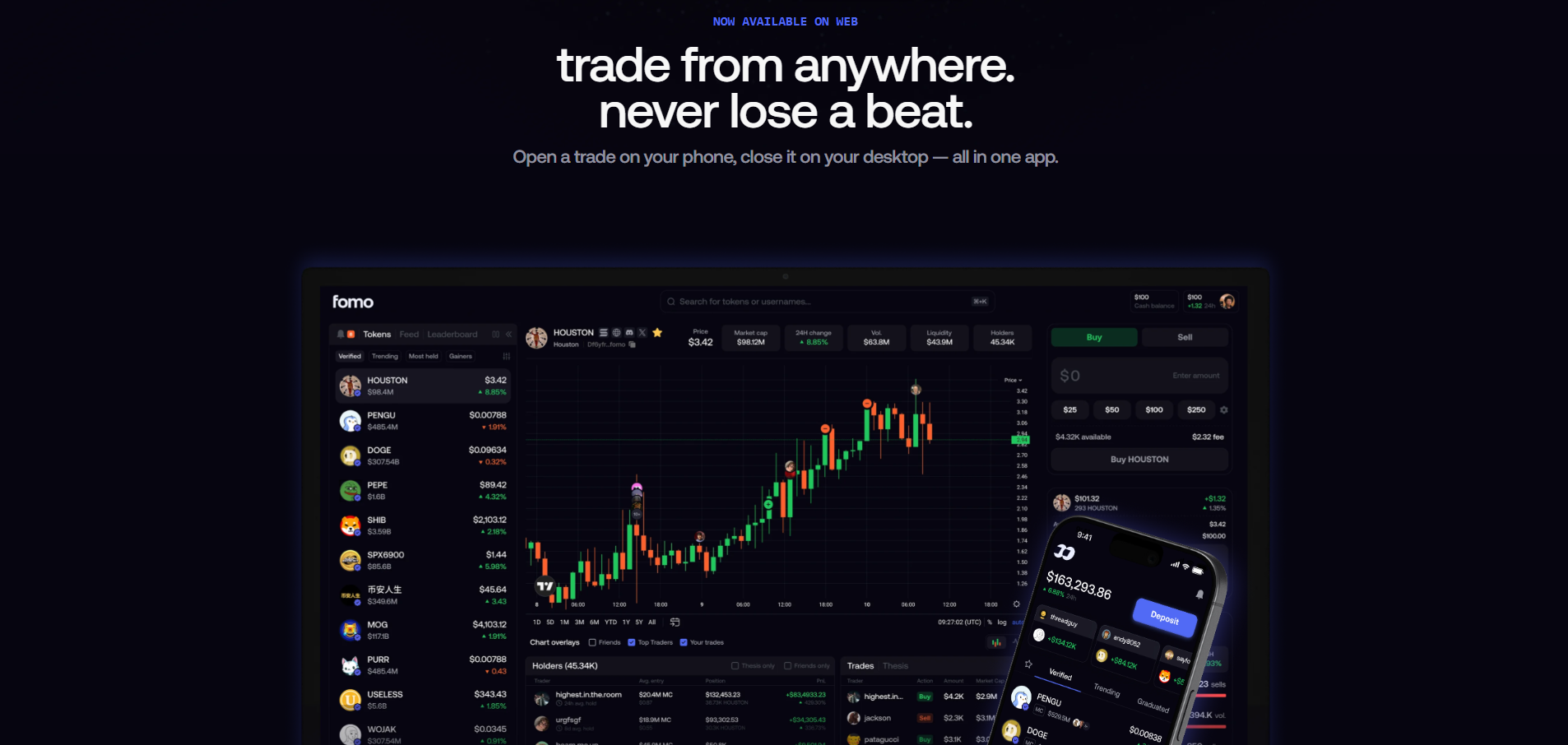
Fomo says the desktop platform provides the same account, balance and positions as the mobile experience while adding a larger environment for trading. It also introduced profile pages and coin pages containing more social context, including theses and information about token holders.
This matters because desktop is where many users spend more time researching markets.
The platform therefore moves beyond:
Mobile trading app
toward:
Persistent trading environment.
Fomo specifically says its web product is not a traditional trading terminal.
Instead, it retains the same intuitive journeys from mobile while expanding what can be done on a larger screen.
That decision reinforces the company’s social-first positioning.
TradingView Adds the Missing Research Layer
A social network for traders needs more than social information.
It also needs analytical tools.
In April 2026, Fomo partnered with TradingView to integrate professional-grade charts, technical indicators and drawing tools directly into Fomo Web.
This is strategically important.
Without advanced charting, Fomo could potentially feel like:
Social media + a buy button.
TradingView integration makes the experience closer to:
Social discovery + market analysis + execution.
Users can potentially discover a trade idea through the social feed and then analyze the asset without switching to another platform.
That reduces friction between:
Idea → Analysis → Decision
And that may ultimately be more valuable than any individual social feature.
Is Fomo Creating a Network Effect?
This is perhaps the most interesting question.
Social products become more useful as more people participate.
Fomo’s June 2026 Series B announcement provides some evidence that the platform is already developing meaningful scale.
The company reported:
- More than 625,000 users.
- More than $4 billion in trading volume.
- More than 110 million social interactions.
- More than 68,000 people who purchased crypto for the first time through Fomo using Apple Pay.
These are company-reported figures, not independently audited metrics in the source.
Still, they illustrate the direction of the product.
The more traders participate, the more potential data exists inside the social layer.
More trades can create:
More activity → More content → More discovery → More users → More activity
That is the basic mechanism behind a potential network effect.
But More Social Data Does Not Mean Better Information
This is where Fomo’s biggest advantage can also become its biggest weakness.
A busy social trading platform can produce enormous amounts of information.
But information and insight are not the same thing.
Imagine thousands of traders suddenly buying the same memecoin.
The feed becomes extremely active.
The leaderboard becomes interesting.
Alerts start appearing.
The token becomes popular.
But none of those things automatically tell you:
Whether the token is fundamentally worth buying.
Social momentum can create genuine opportunities.
It can also create crowded trades.
This is why Fomo’s social layer should be treated as a discovery engine, not a replacement for research.
Fomo’s Social Model vs Traditional Crypto Communities
| Platform Type | Main Purpose | Social Discovery | Direct Trading |
|---|---|---|---|
| Traditional Exchange | Trading | Limited | ✓ |
| Crypto Social Media | Discussion | ✓ | Usually limited |
| Telegram/Discord Communities | Community | ✓ | Usually separate |
| TradingView | Analysis | Moderate | Limited |
| Fomo | Social discovery + trading | ✓ Strong | ✓ |
Fomo’s potential advantage is the combination.
Users do not necessarily need to:
Find a trade idea on social media → research it elsewhere → open a wallet → connect to a DEX → execute.
The platform attempts to bring much of that workflow into one place.
That is the fundamental product proposition.
Fomo Perpetuals Expand the Social Network Beyond Crypto Tokens
The social layer is no longer limited to spot crypto.
In June 2026, Fomo launched perpetual trading powered by Hyperliquid and Trade[XYZ].
The offering includes perpetuals linked to:
- Crypto.
- Equities.
- Indices.
- Commodities.
- Pre-IPO assets.
Fomo says these markets retain the same social features, including feeds, leaderboards, theses, profiles and real-time trader activity.
This could significantly broaden the platform’s long-term positioning.
Instead of building a social network specifically for crypto traders, Fomo appears to be moving toward a broader idea:
A social network for people who trade financial assets on-chain.
That is a much larger ambition.
Fomo Security: Can Users Trust the Social Trading Model?
Fomo describes itself as a non-custodial trading app.
According to its security documentation, users retain control of their private keys, while the wallet architecture uses key sharding and biometric authentication for sensitive actions.
This is an important distinction.
Fomo’s social features may make trading feel more like a conventional social app, but the underlying assets remain subject to crypto-specific security risks.
Users still need to consider:
- Private-key security.
- Token scams.
- Liquidity.
- Smart-contract risk.
- Market volatility.
- Leverage.
- Social manipulation.
A polished social experience does not eliminate blockchain risk.
Fomo Pros and Cons
Pros
✓ Social Activity Is Directly Connected to Trading
Users can discover traders and market activity without leaving the trading environment.
✓ Trade Thesis Adds Context
Users can see not only what traders do but also the reasoning they choose to share.
✓ Leaderboards Create Trader Discovery
Performance-based rankings make active traders easier to identify.
✓ Web + Mobile Ecosystem
Fomo Web extends the same social and trading experience to desktop.
✓ Professional Charting
TradingView integration adds a stronger research layer to the platform.
Cons
✗ Social Signals Can Become Noise
More activity does not necessarily mean more useful information.
✗ Popularity Can Influence Decisions
Users may feel pressure to follow popular traders or trending tokens.
✗ Leaderboards Can Encourage Short-Term Thinking
Recent performance does not guarantee future performance.
✗ Social Trading Is Not a Substitute for Research
A successful trader can still make a bad trade.
Who Is Fomo Best For?
Fomo is particularly interesting for:
- Active crypto traders.
- Traders who enjoy market discovery.
- Users who follow other traders.
- People interested in on-chain activity.
- Users who want social information alongside trading tools.
- Traders who want mobile and desktop access.
It may be less suitable for:
- Passive investors.
- Users who want a purely private trading environment.
- People who dislike social influence.
- Beginners who may interpret popularity as proof of quality.
Is Fomo Worth It?
Fomo becomes more compelling if you think of trading as a social activity.
If your process is:
Discover → Research → Trade → Share
then Fomo’s product architecture makes sense.
The platform gives each stage a place inside the same ecosystem.
You can discover a trader.
Follow them.
See a trade.
Read their thesis.
Check the chart.
Research the token.
Execute the trade.
Then potentially build your own reputation through your trading activity.
That is much more than a conventional exchange workflow.
But if you simply want somewhere to buy Bitcoin and hold it for several years, most of these social features may provide little additional value.
Final Verdict: Is Fomo Becoming the Social Network for Traders?
Fomo’s most interesting development is not any individual feature.
It is the connection between features.
Feed creates discovery.
Profiles create identity.
Leaderboards create reputation.
Alerts create engagement.
Trade Thesis creates context.
TradingView creates analysis.
Trading creates the economic activity underneath everything.
Together, these components create something that looks increasingly like a social network built around financial activity.
Fomo’s own growth figures suggest that this model is gaining traction, with the company reporting more than 625,000 users and 110 million social interactions by June 2026.
Our Final Take
Fomo is more interesting as a social trading network than as another crypto trading app.
Its strongest potential advantage is the network itself.
If enough skilled traders participate and share useful information, the platform can become increasingly valuable for discovery.
But that same network can amplify hype, herd behavior and bad decisions.
So the best way to use Fomo is not:
“Tell me what to buy.”
It is:
“Show me what is happening, who is trading it, and why—then let me decide.”
That is where Fomo’s social-first model has the most potential.
FAQs
What makes Fomo different from a normal crypto exchange?
Fomo combines crypto trading with a social layer that includes feeds, trader profiles, leaderboards, alerts and trade theses. Its goal is to make discovery part of the trading experience rather than separating social activity from execution.
Is Fomo a social media platform?
Fomo is primarily a trading application, but social functionality is central to its product. The platform describes itself as a social-first trading app and includes feeds, followers, leaderboards, profiles and trader interactions.
Can you follow other traders on Fomo?
Yes. Fomo’s feed and alert features are designed around discovering and following traders, while its leaderboards provide another way to find active participants.
What is Trade Thesis on Fomo?
Trade Thesis allows traders to explain the reasoning behind a buy or sell decision. Fomo expanded the feature from token-specific feeds to the global feed in February 2026.
Does Fomo have a desktop version?
Yes. Fomo Web launched in April 2026 and provides access to the same account, balance and positions as the mobile experience while adding desktop-oriented features and social context.
Does Fomo have professional charts?
Yes. Fomo partnered with TradingView in April 2026 to integrate professional-grade charts, indicators and drawing tools directly into Fomo Web.
Does Fomo offer perpetual trading?
Yes. Perpetuals launched on Fomo in June 2026, covering crypto as well as selected equities, indices, commodities and pre-IPO assets.
Is Fomo good for beginners?
Fomo’s simplified interface and social discovery can make crypto easier to navigate, but beginners should not assume that popular traders or trending tokens are automatically good investments. Crypto trading remains highly speculative and risky.


