








CPT Markets in 2026: FSCA, CMA and FSC licences, Classic/ECN/Prime accounts, four platforms and copy trading with a published quality gate.
Reviews
Eighteen years is a long run in online trading, and CPT Markets has spent them building something most brokers only talk about: a group of separately licensed entities, each answering to a real regulator, sitting behind one trading account. In 2026 that account reaches forex, indices, metals, energies, commodities, global shares and crypto, on MetaTrader 4, MetaTrader 5 and CPT’s own desktop and mobile apps, with leverage available up to 1:1000 and minimum trade sizes of a hundredth of a lot.
What makes CPT Markets worth a closer look is how much of that is published rather than implied. The licence numbers are on the site. The account comparison table is on the site. Even the performance bar a trader must clear before other people can copy them is on the site, in numbers. This review walks through what is actually there, and you can open an account with CPT Markets here once you have seen it.
CPT Markets at a glance
CPT Markets Group describes itself as a global broker specialising in leveraged products, offering more than 180 trading instruments to investors worldwide. The group runs offices from Dubai to London to Bangkok, which is the practical reason its support desk answers around the clock and in more than one language — there is always a team awake somewhere in the chain. Client funds are held in segregated accounts, and the group leans on that fact rather than on marketing language.
- 18+ years of operation, with the anniversary badge sitting in the site header
- 180+ instruments across seven market groups on a single login
- Offices in Dubai, London and Bangkok, with 24/7 multilingual support
- Segregated client funds under the oversight of each entity’s regulator
- Platforms: MT4, MT5, CPT App and CPT Desktop, plus a TradingView partnership for charting
Three regulators stand behind CPT Markets
Plenty of brokers say they are “regulated” and leave it there. CPT Markets publishes a dedicated licences page that names the operating entity, the regulator and the licence number for each jurisdiction — which means anyone can check the claims independently rather than take them on faith.
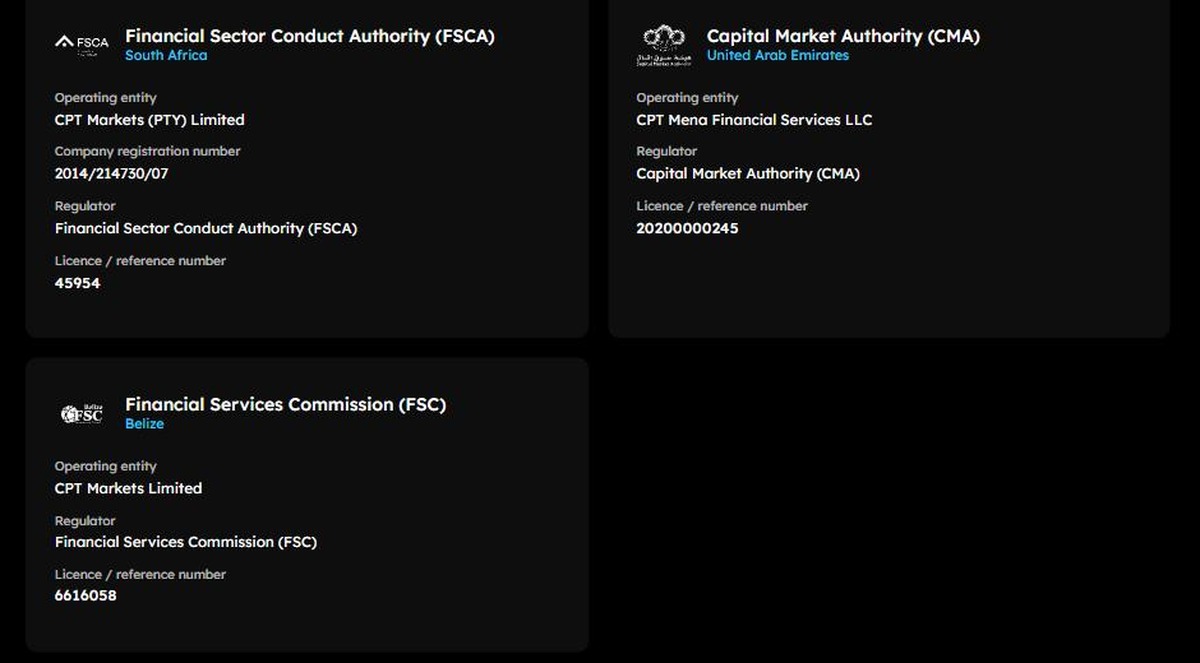
- Financial Sector Conduct Authority (FSCA), South Africa — CPT Markets (PTY) Limited, company registration 2014/214730/07, licence 45954
- Capital Market Authority (CMA), United Arab Emirates — CPT Mena Financial Services LLC, licence 20200000245
- Financial Services Commission (FSC), Belize — CPT Markets Limited, licence 6616058
The South African authorisation is the one worth pausing on, because the FSCA maintains a public register you can search by licence number, and 45954 resolves to a live financial services provider. A group that gives you the registration number of the company as well as the licence is inviting that check rather than hoping you skip it.
Classic, ECN and Prime: pick the cost structure that fits
CPT Markets runs three live account types and publishes them side by side instead of hiding the differences behind a sales call. The distinction is genuinely about cost structure rather than tiering by deposit size — all three carry the same 0.01 lot minimum and the same headline leverage.
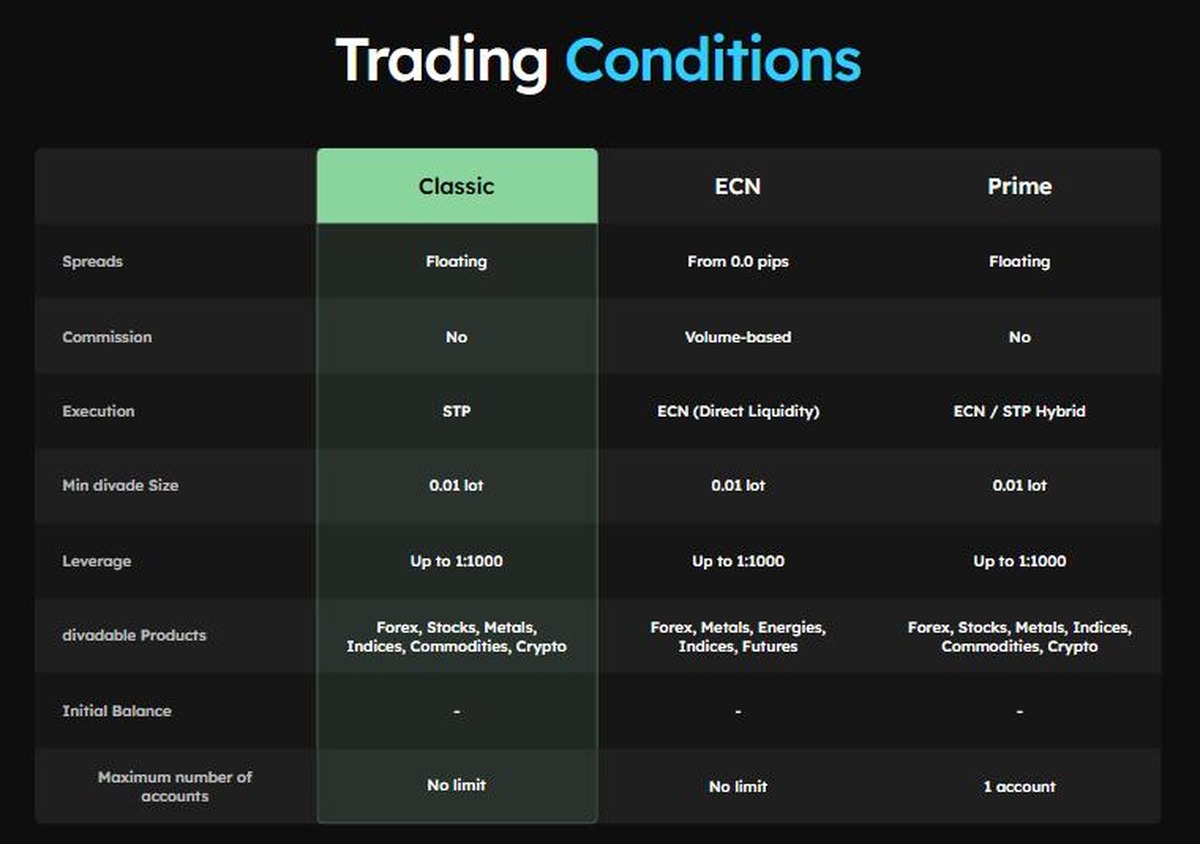
- Classic — floating spreads with no commission, STP execution with direct market access, sub-millisecond fills and no re-quotes. Forex, stocks, metals, indices, commodities and crypto, with no cap on how many accounts you hold.
- ECN — spreads from 0.0 pips with a volume-based commission, true ECN routing into a multi-provider liquidity pool. Forex, metals, energies, indices and futures.
- Prime — floating spreads, no commission, an ECN/STP hybrid engine and the full product range, limited to one account per client.
For a discretionary trader placing a handful of positions a week, Classic keeps the arithmetic simple: one number to watch, no commission line to reconcile. For anyone running high-frequency or algorithmic strategies, ECN is the cheaper structure once volume builds, because a raw spread plus a known commission almost always beats a marked-up floating spread at scale. Both routes are no-dealing-desk, so the price you are filled at is the price the market gave. You can compare the two directly when you open a CPT Markets account and switch as your style changes.
One account, every market
The pitch behind CPT Markets is that you should not have to move money between brokers to change asset class. The same login reaches:
- Forex — majors, minors and exotics in the deepest market there is
- Indices — S&P 500, DAX, Nikkei 225 and other benchmark futures
- Precious metals — gold and silver, the two instruments most traders reach for when volatility arrives
- Commodities and energies — hard and soft commodities with leverage
- Stocks — global names such as Apple, Meta and Tesla at low trading cost
- Crypto — BTC, ETH and the major pairs inside the same regulated environment
A live market snapshot on the homepage keeps top movers, top performers and top turnover visible without logging in, which is a small thing that makes the platform easier to keep an eye on between sessions.
Four platforms on the same CPT Markets login
Platform choice is where a lot of brokers quietly limit you. CPT Markets does the opposite: MetaTrader 4 for traders with years of expert advisors and custom indicators they are not about to abandon, MetaTrader 5 for faster processing, deeper market depth and a wider set of timeframes, and CPT’s own proprietary app and desktop terminal for anyone who would rather have something built for this broker specifically.
MT5 is available on the App Store, Google Play, macOS, Windows and Android, so a strategy started on a desktop follows you onto a phone without re-entering anything. On top of that, CPT Markets has partnered with TradingView, which puts professional charting, real-time stock data and a full stock screener in front of traders who do their analysis there rather than inside MetaTrader.
CPT Markets copy trading has a real quality gate
Copy trading is common. Copy trading with a published admission standard is not. Before a CPT Markets account can be followed by anyone else, the signal provider has to clear four numeric hurdles — and the broker prints them openly:
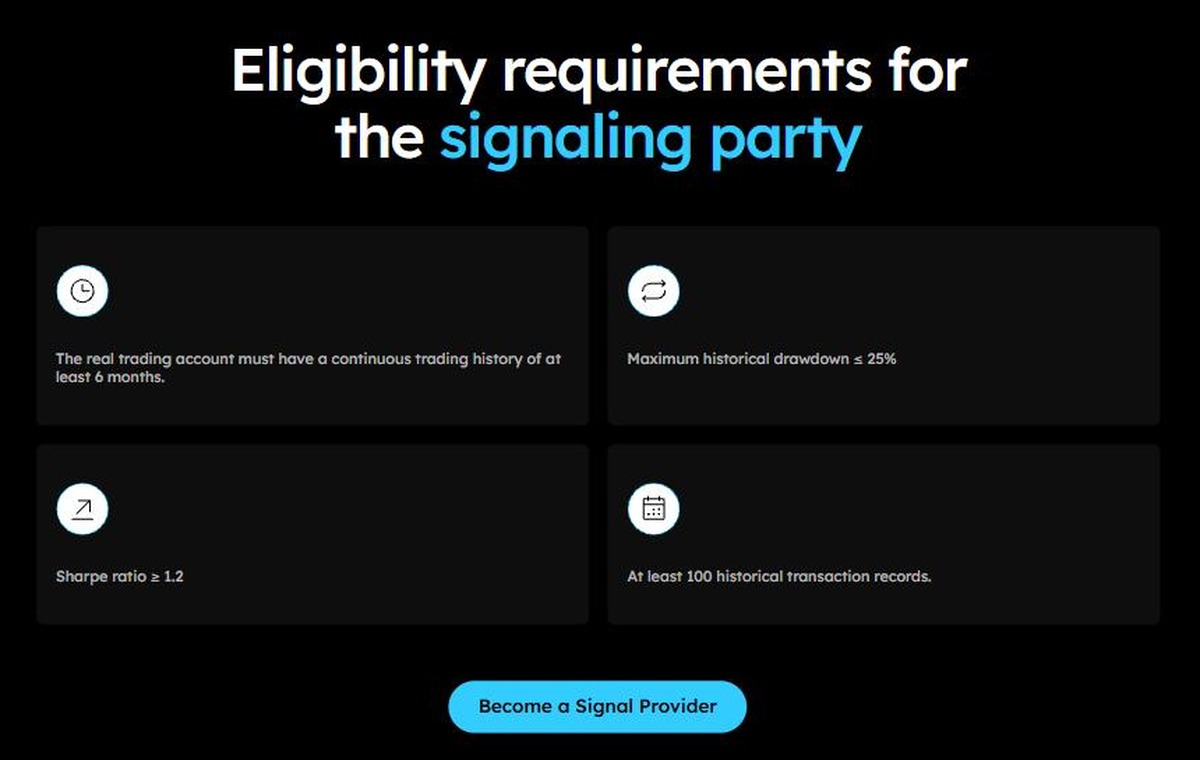
- A real trading account with at least six months of continuous trading history
- Maximum historical drawdown of 25% or less
- Sharpe ratio of 1.2 or higher
- At least 100 historical transactions
Those four lines do more work than any amount of reassuring copy. A six-month history rules out the account that got lucky last week; a 25% drawdown ceiling rules out the martingale blow-up waiting to happen; a Sharpe ratio above 1.2 means returns have to be earned with controlled risk rather than leverage; and a hundred-trade minimum means the record is a method, not a streak. Followers get one-click copying, stop-loss limits they set themselves, and the ability to stop following at any moment. Providers earn a pre-agreed share of the profit their followers make, plus platform traffic support if they rank near the top.
Worth saying plainly: copy trading replicates another person’s activity, and timing, pricing and results can differ from the provider’s own because of market conditions, liquidity and latency. Past performance is not a forecast. The quality gate raises the average, it does not remove the risk.
Myfxbook verification, not screenshots
CPT Markets accounts connect to Myfxbook, the independent analytics platform used by over a million traders. Once linked, win rate, drawdown, monthly returns and the full trade history publish automatically, pulled straight from the account with nothing edited and nothing cherry-picked. For a follower choosing who to copy, that is the difference between a track record and a marketing claim. For a provider, it is the fastest way to prove a strategy works to people who have never heard of you.
MAM accounts and the CPT crypto card
Two features round out the offering for traders who have outgrown a single account. The MAM (Multi-Account Manager) system lets a fund manager or professional trader run one strategy across many sub-accounts from a single master interface, with allocation and synchronisation handled in real time instead of order by order.
The other is the CPT crypto card — a Visa Gamma virtual card that turns digital balances into everyday spending power.
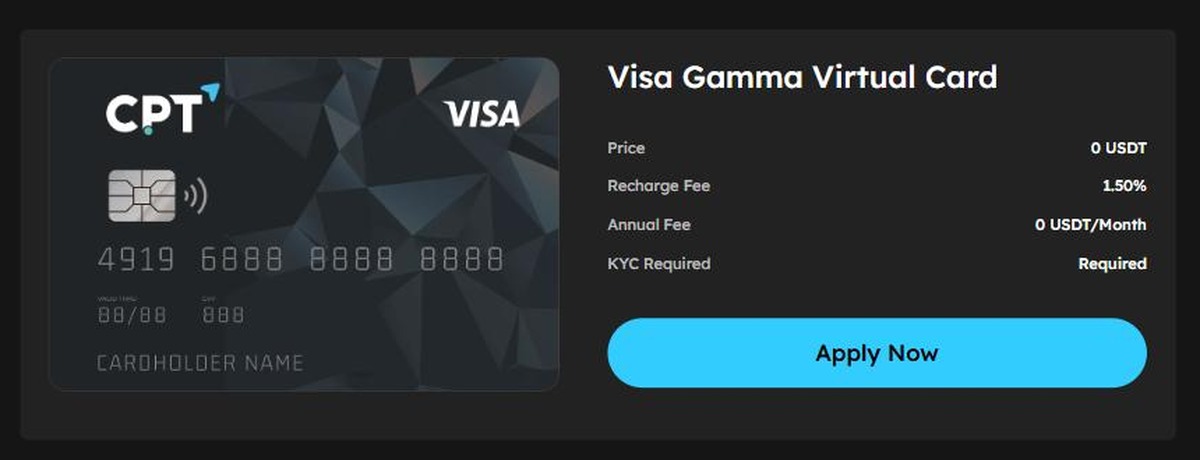
- Price: 0 USDT — nothing to issue the card
- Annual fee: 0 USDT per month — no standing cost for holding it
- Recharge fee: 1.50% when you load it
- KYC required, completed in about a minute
- Accepted in 200+ countries, with withdrawals supported through Alipay and WeChat and funds credited instantly once reviewed
A free demo, and the legal paperwork published up front
The CPT Markets demo account mirrors the live environment — same instruments, same trading rules, same live price feed — using virtual funds, which makes it the sensible place to learn the platform and test an approach before any real money moves. Nothing about the demo is a stripped-down version; it replicates the live account’s features rather than approximating them.
Alongside it, the broker keeps a Legal Documents page you can read before opening anything: the Risk Disclosure Notice, the Order Execution Policy, the Complaints Policy, the Privacy and Cookies policies, and separate Terms & Conditions for the Belize and South Africa entities. Publishing the entity-specific terms separately is a small detail that tells you the group treats its licences as distinct obligations rather than one badge reused everywhere. You can review all of it and register with CPT Markets when you are ready.
What to know before you fund a CPT Markets account
Three facts belong in any honest broker review, and CPT Markets states all of them itself. First, these are margined over-the-counter products — CFDs and spot forex — and the broker’s own disclaimer puts it bluntly: “It is possible to lose more than your initial deposit.” Leverage of 1:1000 magnifies a losing position exactly as fast as a winning one, so position size, not leverage, is the number to manage.
Second, the licences differ in weight. The FSCA and CMA authorisations are national regulators; the Belize FSC licence is an offshore one and does not carry the same statutory protections — no compensation scheme, no retail leverage cap — as an FCA or ASIC authorisation would. Knowing which entity holds your account is worth two minutes of reading at sign-up.
Third, eligibility. CPT Markets does not provide services to residents of the United States or the DPRK, or to anyone in a jurisdiction where the offering would be unlawful. Its crypto services are additionally closed to residents and entities of FATF blacklisted and grey-listed jurisdictions, including Russia, Iran, North Korea and Myanmar. Check your own country against the terms before you deposit rather than after.
Is CPT Markets right for you?
CPT Markets suits the trader who wants breadth without fragmentation: one account, seven market groups, four platforms, and a choice between commission-free and raw-spread pricing rather than being pushed into whichever one the broker prefers. It suits copy traders who would rather follow someone who cleared a published statistical bar than someone with a pretty equity curve. And it suits professionals who need MAM allocation or Myfxbook-verified reporting without moving to an institutional desk.
A sensible order of operations:
- Read the licences page and note which entity will hold your account
- Open the demo first and spend a session in MT5 or the CPT app before funding anything
- Pick Classic if you trade a few positions a week, ECN if volume is your normal
- Set your own stop-loss limits before following any copy-trading provider, however good the numbers look
- Keep leverage as a tool, not a target — 1:1000 is available, not compulsory
Eighteen years, three regulators, 180+ instruments and a copy-trading programme that publishes its admission standard in numbers add up to a broker that is unusually willing to be checked. If that is the kind of transparency you want behind your account, you can start with CPT Markets here.


