








Apex Trader Funding Review 2026: The Prop Firm That Rewrote the Rules — And Then Rewrote Them Again
Reviews

Overall Rating: 4.3 / 5 ⭐⭐⭐⭐
The Question Every Serious Trader Is Asking
You’ve been grinding charts for months. Maybe years. Your strategy works — you’ve proven it on paper, proven it on demo, and you know in your gut that given real capital to work with, you could turn it into consistent income. The problem is what it’s always been: you don’t have $100,000 sitting around to fund a trading account with.
This is exactly the gap that proprietary trading firms exist to fill. And in the futures prop firm space, one name keeps coming up in every forum, every trading Discord, every YouTube comment section: Apex Trader Funding.
Apex Trader Funding, founded in 2021 by CEO Darrell Martin in Austin, Texas, is a proprietary trading firm specializing in futures funding. It provides traders access to capital through a one-step evaluation process, allowing qualified individuals to trade firm funds and keep the majority of profits. Unlike traditional brokers, Apex focuses on futures instruments across exchanges like CME, CBOT, NYMEX, and COMEX.
The company is based in Austin, Texas, and has active users in over 150 countries worldwide. In four years of operation, it has grown from a startup challenging the established prop firm order to what many traders now consider the benchmark against which every competitor is measured.
The numbers behind that claim are not marketing fluff. Payout proof shows over $660 million paid out since 2022, with $13 million average monthly in 2024–2025. Recent data shows $65 million in the last 90 days.
$65 million in payouts in 90 days. To real traders. That is the kind of verifiable track record that separates a legitimate operation from a firm that collects evaluation fees and finds reasons to deny funded accounts.
How Prop Trading Actually Works — Skip This If You Already Know
For readers new to the prop firm concept, a quick grounding before diving into Apex specifics.
Prop trading, or proprietary trading, has recently gained popularity as a way to trade in the markets. Essentially, the firm will lend you money to trade with. Your profits will be split with the company at a set rate depending on your account type. Most of the risk and losses are incurred by the prop firm, and generally, they will limit or close your account if you lose too many trades. The firm will require you to pass an evaluation test before funding your account with real money.
The economic logic is straightforward: you pay a relatively small monthly fee for an evaluation account. If you prove you can trade profitably within the firm’s risk parameters, you get funded — meaning you trade with the firm’s capital, keep most of the profits, and never risk more than the cost of the evaluation itself if things go wrong.
The most you can ever lose is the cost of buying the evaluation account and a one-time activation fee after passing the evaluation. If you fail the evaluation account, you can reset the account for a small fee and try again until you pass. You will never be responsible to pay Apex for losses in the account.
That risk asymmetry is the entire value proposition of prop trading: limited personal downside, access to significant trading capital, and the ability to scale in a way that would be impossible with a personal trading account.
The March 2026 Reset: Why This Moment Matters
Here is the context that makes the 2026 Apex review different from every previous one: the company went through a significant product overhaul in March 2026 that fundamentally changed the rules, the account structures, and the payout process.
Apex’s New Products launched in March 2026 with a clean slate, eliminating arbitrary rules like MAE warnings, 5:1 risk-reward mandates, and payout denials — replacing them with clarity, fairness, and trader autonomy. Built around three core pillars: No Gray Area Rules where every parameter is binary — breach means fail, stay within means pass. No Payout Denials. And a No Micromanagement philosophy.
The new rules in March 2026 moved the needle in the right direction — transparency instead of confusing rules, clear comparison of available account sizes and pricing instead of endless scrolling through options.
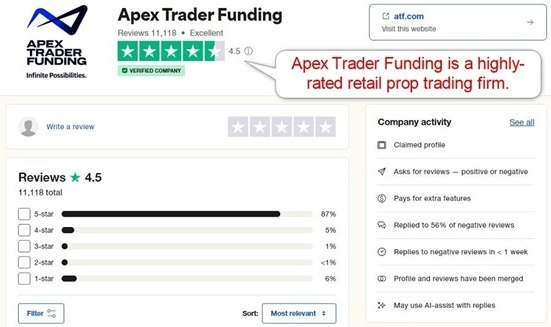
The Trustpilot rating currently sits at 4.4 out of 5, based on over 18,070 reviews, categorized as Excellent.
For traders who had been burned by Apex’s previous iteration — with its MAE rules, payout review delays, and occasional denial disputes — the March 2026 changes represent a genuine course correction. One verified Trustpilot reviewer who has traded with Apex since April 2023 put it directly: “It’s the best prop firm in many ways, especially since the new rules in March 2026. They no longer have any serious competitors. It’s incredible to be able to copy up to 20 accounts at the same time and still receive 100% of the profits.”
The Evaluation Process: Simpler Than You Think
The evaluation structure at Apex is deliberately straightforward — by design. Simple rules. No gray area. No interpretation of rules. Nothing vague. Nothing obscure. No arbitrary rules. No gimmicks. No hidden rules.
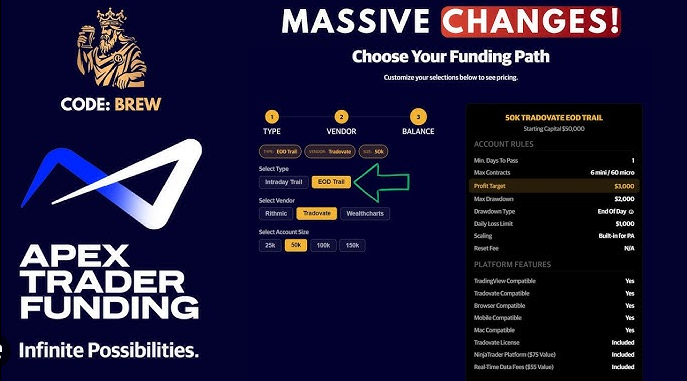
The core evaluation rule is elegantly simple. The trailing drawdown is the most important rule to understand. Apex uses a trailing drawdown that follows your profit until it locks at your starting balance.
In practice: as your account grows in profit, the trailing stop — the floor below which your balance cannot fall — rises with it. Once your balance reaches a certain threshold, the trailing stop locks at your starting balance and stops moving. From that point forward, you simply need to hit the profit target without letting your balance drop below your starting point.
No daily loss limits on the new Intraday accounts. No news trading restrictions. No required number of trading days beyond the minimum. Apex offers EOD and Intraday Trailing Drawdown evaluations with one-day pass potential. If you’re disciplined and the market moves in your favour, you can theoretically pass an evaluation in a single trading day.
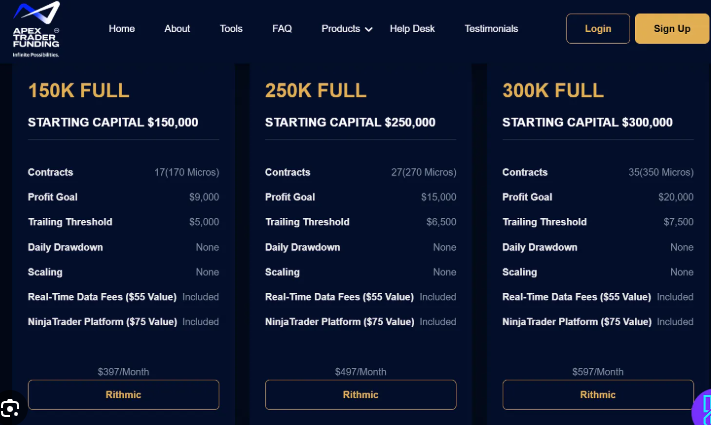
Account sizes run from $25,000 up to $300,000, covering the full spectrum from traders just starting their prop firm journey to experienced professionals managing significant positions.
Pricing: The Discount Game That Actually Works in Your Favour
Full retail pricing at Apex is not cheap. But nobody pays full retail.
Evaluation accounts often start for as little as $30–$70 during sales when using an 80% off promo code. Apex frequently offers 50–80% off promotions.
With common 80% off promotions, a $50K account costs roughly $35 per month. Always wait for sales.
This promotional pricing strategy is so consistent that treating any Apex evaluation fee as a temporary full-price situation would be financially naive. The brand runs sales with sufficient regularity that patient traders can almost always find a meaningful discount before committing. The trading community actively tracks and shares these promotional codes in Discord servers, Reddit threads, and YouTube comments, making them effectively public knowledge.
The one-time activation fee after passing the evaluation deserves mention because it catches some traders by surprise. EOD accounts come with an activation fee of $99. Intraday accounts have a $79 activation fee. These are one-time charges, not recurring — but factor them into your cost calculation upfront rather than encountering them as an unexpected expense after passing your evaluation.
The Payout Structure: 100% Profits — With Important Asterisks
This is where the review has to be precise, because Apex’s “100% profit split” marketing language requires careful reading.
Apex implies a 100% profit split, but payout rules show limits on total amounts per payout. So yes, it is factually correct that 100% of profit can be paid out, but only up to a point. At maximum it is only possible to withdraw money 6 times before the account gets closed and everything has to start over again.
The payout structure for new accounts works as follows. First, 6 payouts are capped based on balance — for example, a $2,000 maximum payout requires at least $54,100 in account balance. After those initial 6 payouts, the account closes and a new evaluation cycle begins.
The profit split is 100% for the first $25,000 in profits, then 90% after that.
For most retail traders building toward consistent profitability, the 100% split on the first $25,000 and 90% thereafter is genuinely generous compared to industry alternatives. The 6-payout cycle limit is a structural constraint worth understanding before signing up, but not a dealbreaker for traders with realistic profit expectations per evaluation period.
Apex offers 5-day payout cycles and up to 20 active funded accounts simultaneously. That 20-account capacity is significant for traders who want to scale. Running 20 funded accounts concurrently means your total capital exposure and profit potential multiplies dramatically — and Apex’s one-username multi-account structure makes this operationally manageable.
Apex is currently the only futures prop firm publicly known to approve million-dollar payouts, making it one of the most scalable funding programs in the industry.
Trading Platforms: Real Infrastructure, Not Demo Toys
One of the most important questions about any prop firm is whether the trading infrastructure is legitimate or whether you’re trading on a glorified simulator.
Apex partners with established, industry-standard platforms: Traders can use Rithmic, Tradovate, and WealthCharts.
Rithmic is institutional-grade futures infrastructure used by professional trading firms and individual high-frequency traders. Tradovate is a modern, well-engineered futures platform with an excellent mobile app and competitive commissions. WealthCharts is a newer addition that has become popular among Apex traders for its charting and analysis tools.
Apex Trader Funding is backed by real infrastructure, and NinjaTrader integration is also available. NinjaTrader’s inclusion is particularly meaningful for algorithmic traders and system builders who use NinjaTrader’s development environment for automated strategy execution.
Trading automation using bots and tools like third-party signal execution platforms are permitted if actively managed — no full set-it-and-forget-it. For traders who use automated execution to manage multiple accounts simultaneously, this policy is workable — the key distinction being that fully unattended algorithmic trading is prohibited, while semi-automated execution with human oversight is acceptable.
The Consistency Rule: Fair or Frustrating?
The 30% consistency rule on funded accounts generates more community debate than any other Apex feature. Understanding it precisely matters.
Apex enforces a 30% consistency rule on funded accounts. This means no single day’s profits should exceed 30% of your total monthly profits. This is to discourage gambling with their accounts to make a big score and get a payout.
In plain language: if you want to withdraw $10,000, no single trading day in that payout cycle can account for more than $3,000 of those profits. If you have one exceptional day — say, catching a major market move for $5,000 while your other days average $500 — you cannot withdraw until you’ve traded enough additional profitable days to bring that big day below the 30% threshold of your total.
For trend traders and swing traders who seek large, infrequent wins, this rule can be genuinely limiting. For disciplined day traders whose profits accumulate consistently across multiple sessions, it’s barely noticeable.
They don’t cut your account off or punish you for breaking this rule immediately — they just ask that you quickly reduce your position and take action to correct it. Consistently breaking this rule and not correcting it could lead to disciplinary action or not getting paid if deemed malicious.
The new March 2026 rules adjusted this to a 50% consistency rule for payout cycles: the biggest profitable day cannot exceed 50% of total profit in that cycle. This is a meaningful relaxation from the previous 30% rule and directly addresses one of the most common trader complaints about the old structure.
The Honest Bad News: Complaints That Deserve Acknowledgment
Any honest review of Apex has to address the negative experiences that real traders have documented publicly, because they represent real risks and real frustrations.
One detailed negative review describes a trader who claims Apex owes over $20,000 in payouts, and after more than two months of trying to contact them, received little to no meaningful response. Emails ignored, support useless, and zero accountability when it comes to paying profitable traders.
This type of complaint — high-value payout stuck in limbo with unresponsive support — appears with enough frequency across review platforms to constitute a pattern rather than isolated bad luck. The common thread in these cases is either large payout amounts triggering additional review processes, or rule interpretation disputes where Apex determined the trading violated terms and the trader disagreed.
Customer support response time can be slow at times, and some rules for payouts and trading restrictions feel quite strict.
Some complaints involve payout denials due to rule violations, such as 30% negative P&L or consistency rule breaches.
The pattern here is consistent and important: the majority of traders who follow the rules precisely and trade consistently receive their payouts without issue. The traders who encounter serious problems are disproportionately those who either violated rules they didn’t fully understand, or whose trading style was aggressive in ways the consistency rules were designed to prevent.
This doesn’t make the frustrated traders wrong. It means that Apex’s rules demand thorough understanding before committing to the platform. Read every rule. Use the consistency calculator tool in the member dashboard. If you’re unsure whether a specific trading behaviour is permitted, ask support before doing it — not after.
Who Apex Is Built For — And Who Should Look Elsewhere
Apex Trader Funding is best for traders who want simple rules without daily limits, and who can wait for promotional pricing to minimize evaluation costs.
More specifically, Apex makes the most sense for experienced futures traders who already have a proven, rules-based methodology and understand exactly how trailing drawdowns affect position sizing, traders who want to scale across multiple funded accounts simultaneously using the 20-account capacity, disciplined consistency traders whose profits distribute evenly across sessions rather than concentrating in occasional massive wins, algorithmic or semi-automated traders who want to run strategies across multiple accounts using platforms like Rithmic and Tradovate, and patient traders who will wait for the frequent 70–80% promotional discounts before buying evaluations.
Apex is the harder choice for complete beginners to futures trading who haven’t yet developed a consistent strategy, traders whose natural style produces infrequent large wins rather than steady daily gains, anyone who needs immediate, responsive customer support when issues arise, and traders whose preferred instruments extend beyond CME, CBOT, NYMEX, and COMEX futures.
The Bottom Line: A Legitimate Opportunity With Real Requirements
Apex Trader Funding is the most trader-first prop firm reviewed in 2026. Its elimination of punitive rules while maintaining strict drawdown discipline sets a new standard for fairness.
That’s a strong endorsement — and the data supports it. Over $660 million in total payouts. A 4.4 Trustpilot rating across nearly 19,000 reviews. The only futures prop firm known to approve million-dollar single payouts. Twenty simultaneous funded accounts on a single username. A March 2026 rule reset that addressed the most common trader criticisms of the previous system.
None of that means Apex is risk-free or right for everyone. The trailing drawdown will close accounts that oversize positions. The consistency rule will delay payouts for traders whose profits concentrate in single sessions. The customer support, while improved, remains a friction point for complex disputes.
But for the disciplined futures trader who understands what they’re signing up for, treats the rules as the operating framework within which their edge must function, and approaches the evaluation with the same professionalism they’d bring to trading their own capital — Apex Trader Funding in 2026 is the benchmark against which every alternative should be measured.
⭐ Apex Trader Funding Full Scorecard 2026
| Category | Score | Notes |
|---|---|---|
| Legitimacy & Track Record | 9.5/10 | $660M+ paid, 4+ years operating, Austin TX HQ |
| Evaluation Simplicity | 9.0/10 | One rule: don’t breach trailing drawdown |
| Payout Speed | 8.5/10 | 1–4 days for most, delays reported on large amounts |
| Profit Split | 8.5/10 | 100% to $25K, 90% after — among the best in industry |
| Pricing & Promotions | 9.0/10 | Frequent 70–80% off discounts make entry very affordable |
| Platform Quality | 9.0/10 | Rithmic, Tradovate, WealthCharts, NinjaTrader |
| Scalability (20 accounts) | 10/10 | Unmatched multi-account capacity in the market |
| Rule Transparency (post-March 2026) | 9.0/10 | Binary rules, no gray area — significant improvement |
| Customer Support | 6.5/10 | Responsive for most, slow for complex payout disputes |
| Community & Resources | 8.5/10 | Large active community, good educational content |
| Overall Rating | 🌟 4.3 / 5 | The futures prop firm benchmark in 2026 |
This review is for informational purposes only and does not constitute financial or investment advice. Futures trading involves substantial risk of loss. Past payout performance does not guarantee future results. Always read the full terms and conditions of any prop firm before purchasing an evaluation account.


