








InsiderFinance review 2026: we recomputed the gamma exposure table, the pricing cards and the open-source Black-Scholes example to see which InsiderFinance numbers hold up.
Reviews

How this review was done. This is a desk review. Every figure below was read off the public InsiderFinance pages on 26 November 2026 — the home page, the free flow dashboard, the gamma exposure page, both pricing pages, the about page, the Terms and the open-source documentation. No account was created, no plan was bought and no trade was placed. Where a number could be checked against another number on the same site, or recomputed from scratch, it was.
Disclosure: Some of the links in this article are affiliate links. If you sign up or make a purchase through these links, we may receive a commission at no additional cost to you. This does not influence how we evaluate or rate products.
Most trading-tool reviews stop at the feature list. This one does arithmetic. InsiderFinance publishes a great many numbers in public, from gamma exposure tables to an open-source library that prices options, which makes it unusually easy to test. The short answer: the data engine holds up extremely well, and the marketing copy around it is where the slips are.
What InsiderFinance actually sells
InsiderFinance is a financial intelligence and trading analytics platform, not a broker. You cannot deposit with it, trade through it or hold a position on it. What you buy from InsiderFinance is a dashboard built on top of the options tape and the dark pool tape, plus a technical analysis system that runs as a set of TradingView scripts. The company describes itself in its own footer as “a financial intelligence and trading analytics platform for active traders”, and its legal disclaimer goes further, saying it is “solely a data-provider and not a stock picks alert service”.
There is no feature ladder in the InsiderFinance line-up. The all-inclusive plan bundles fifteen listed features, from real-time options order flow and dark pool prints through to a market scanner, historical data, a custom watchlist and Discord access, and it is sold as one tier billed monthly, quarterly or annually — the only thing that changes between the three plans is the price per month. You can see the current plan structure on the official page here.
The four order types InsiderFinance ranks
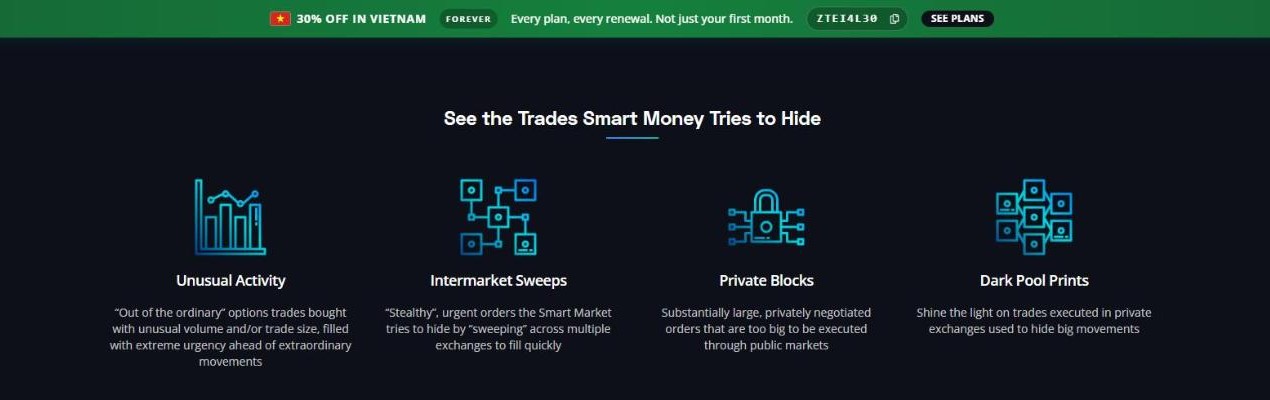
The core idea is simple: out of the millions of contracts and prints that cross each day, a small number carry information. InsiderFinance sorts those into four named buckets, and the whole dashboard is organised around them.
| Category | What the platform says it is |
|---|---|
| Unusual Activity | Options trades bought with unusual volume or trade size, filled with extreme urgency ahead of large moves |
| Intermarket Sweeps | Urgent orders split and “swept” across multiple exchanges so they fill quickly |
| Private Blocks | Substantially large, privately negotiated orders too big to execute through public markets |
| Dark Pool Prints | Trades executed in private exchanges, surfaced after the fact |
Above that sits the InsiderFinance filter bar. You can switch the feed between total and net premium, restrict it to equities or ETFs, and apply presets named Unusual, Sweeps, Momentum and Moonshots. One detail is easy to miss: the trade-side filters are split. Above Ask and Ask are open to everyone, while Mid, Bid and Below Bid are marked Pro in the filter bar itself. If the distinction between aggressive buying and passive selling is central to how you read flow, that is the line you are paying to cross.
What the free InsiderFinance dashboard shows
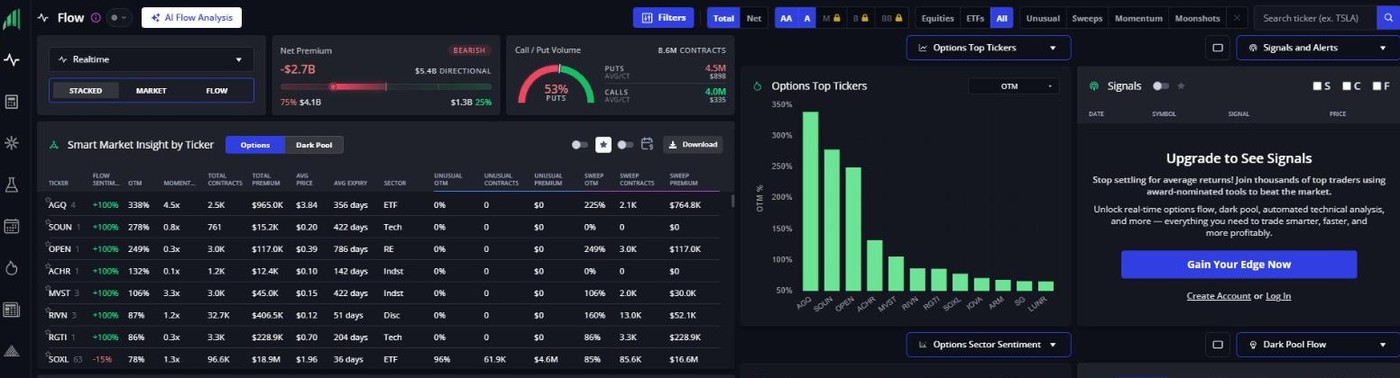
The free InsiderFinance tier is more generous than the marketing suggests. The home page advertises the free feed as the “15 most recent trades delayed by 30 minutes”, which undersells it: open the flow page and you get a live net premium gauge, a call and put volume breakdown, options top tickers, a sector sentiment chart, a smart market insight table and the realtime flow table, all without paying. What InsiderFinance actually walls off is narrower — the Signals panel and the Dark Pool Flow panel, both showing an upgrade prompt instead of data.
The numbers on that free InsiderFinance page also hang together. On the morning of 26 November the gauge read a net premium of minus 2.7 billion dollars against 5.4 billion directional, split 75 percent bearish at 4.1 billion and 25 percent bullish at 1.3 billion — and 4.1 plus 1.3 is exactly that 5.4 billion total. The contract counter read 8.6 million, 53 percent puts, with 4.5 million puts and 4.0 million calls underneath it. Nothing in that panel contradicts anything else in it.
Gamma exposure: the page where every number checks out
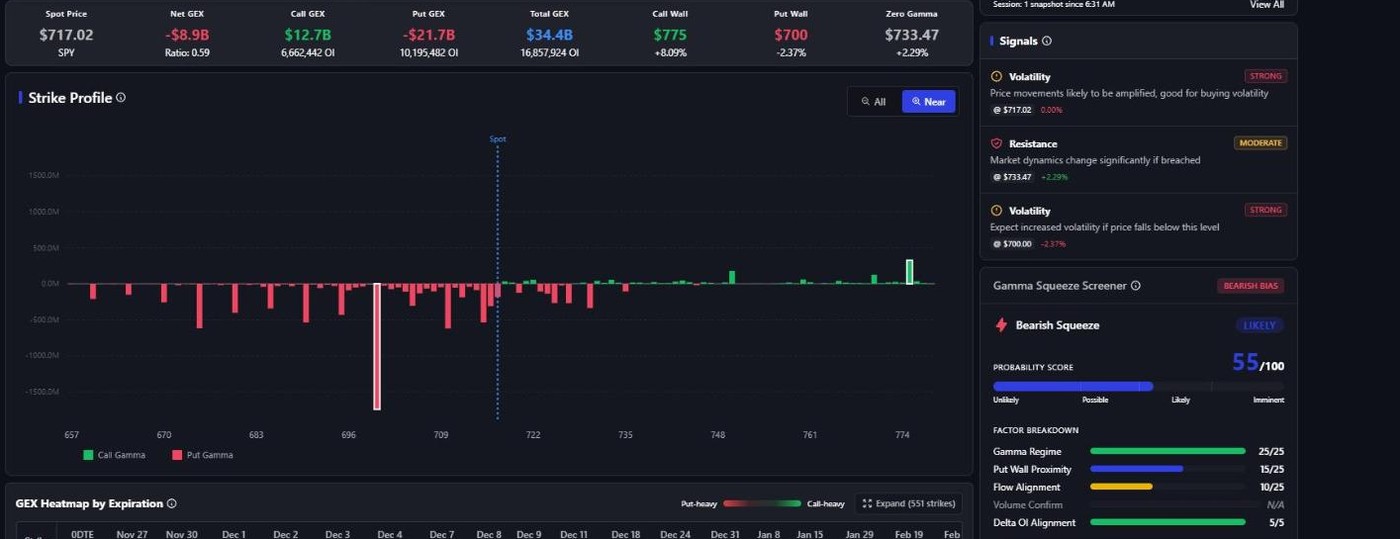
This is the page that convinced me the data engine behind InsiderFinance is built by people who care. Gamma exposure is derived data in the InsiderFinance stack, computed from the options chain rather than read off a tape, so a sloppy implementation shows up immediately as internal contradictions. There were none. Here is the InsiderFinance SPY panel as it stood on 26 November, with every derived figure recomputed by hand from the figures sitting next to it.
| Figure on the page | Value shown | Check |
|---|---|---|
| Spot price | 717.02 dollars | Matches the ETF quote block on the same page |
| Call GEX | 12.7 billion dollars (6,662,442 OI) | — |
| Put GEX | minus 21.7 billion dollars (10,195,482 OI) | — |
| Net GEX | minus 8.9 billion dollars | 12.7 minus 21.7 equals minus 9.0, rounds to minus 8.9 |
| Total GEX | 34.4 billion dollars (16,857,924 OI) | 12.7 plus 21.7 equals 34.4; the two OI figures sum exactly |
| Call/put ratio | 0.59 | 12.7 divided by 21.7 equals 0.585 |
| Call wall | 775 dollars, plus 8.09 percent | 717.02 times 1.0809 equals 775.03 |
| Put wall | 700 dollars, minus 2.37 percent | 717.02 times 0.9763 equals 700.00 |
| Zero gamma | 733.47 dollars, plus 2.29 percent | 717.02 times 1.0229 equals 733.44 |
Eight derived figures, eight matches, including the two open interest totals that add up to the digit. The InsiderFinance gamma squeeze screener on the right does the same thing: it showed a bearish squeeze flagged as likely with a probability score of 55 out of 100, and the factor breakdown underneath read gamma regime 25 of 25, put wall proximity 15 of 25, flow alignment 10 of 25, volume confirmation not available and delta OI alignment 5 of 5. Twenty-five plus fifteen plus ten plus five is fifty-five. The score is not a black box with a number bolted on the front; it is the sum of the parts printed below it.
For anyone who has used options dashboards that quietly disagree with themselves, this is the single most reassuring thing about InsiderFinance: whatever else is true, the quantitative layer is disciplined.
The InsiderFinance technical analysis system
The second product is a technical analysis system, and it is not a chart on the InsiderFinance website. It ships as a set of TradingView scripts that you add to your own charts, and the plan page makes a point that will matter to a lot of people: “No TradingView Subscription Required”. You do not need a paid TradingView tier to run them.
The InsiderFinance system is described in six numbered parts, and the InsiderFinance pitch for it is that the whole thing adapts itself rather than needing to be tuned per symbol.
| Component | What it does |
|---|---|
| Buy and sell signals | A series of indicators that detect entries and exits across any symbol and timeframe |
| Automatic risk levels | Profit targets and stop levels generated with every signal, adjustable for risk tolerance |
| Trend confirmation | Trend lines, triangles and reversal diamonds giving multiple reads on direction |
| Dual oscillators | A momentum oscillator and a squeeze oscillator used together to filter false signals |
| Swing signals | Longer-horizon alerts intended for any asset class |
| Caution candles and dots | Yellow candles and caution dots marking trend slowdown |
The InsiderFinance plan also bundles breakout signals, a squeeze and a momentum indicator, moving average clouds, Bollinger Bands, real-time news and sentiment, full Discord access and a bonus of real-time trade ideas. The claims about accuracy are the company’s own and cannot be verified from outside; what can be verified is the scope of what you receive and the fact that it runs on a charting platform you may already use.
Congress trades, insider filings and the rest of the toolkit
Alongside flow and charts, InsiderFinance runs a set of trackers built on public filings. The InsiderFinance congress stock trades tracker lets you filter disclosed trades by ticker, legislator, chamber, party, amount band and filing date, and it charts net trade amounts across Congress over the trailing sixty days. A companion tracker covers corporate insider filings.
Outside the paywall as well: an options profit calculator, ticker research, historical flow, open interest levels, an S&P 500 heatmap, an earnings calendar, market news, a free hourly AI flow analysis, four free courses marked “Completely Free, No Card Required”, and mobile apps on both stores.
InsiderFinance pricing, and the one card that does not add up
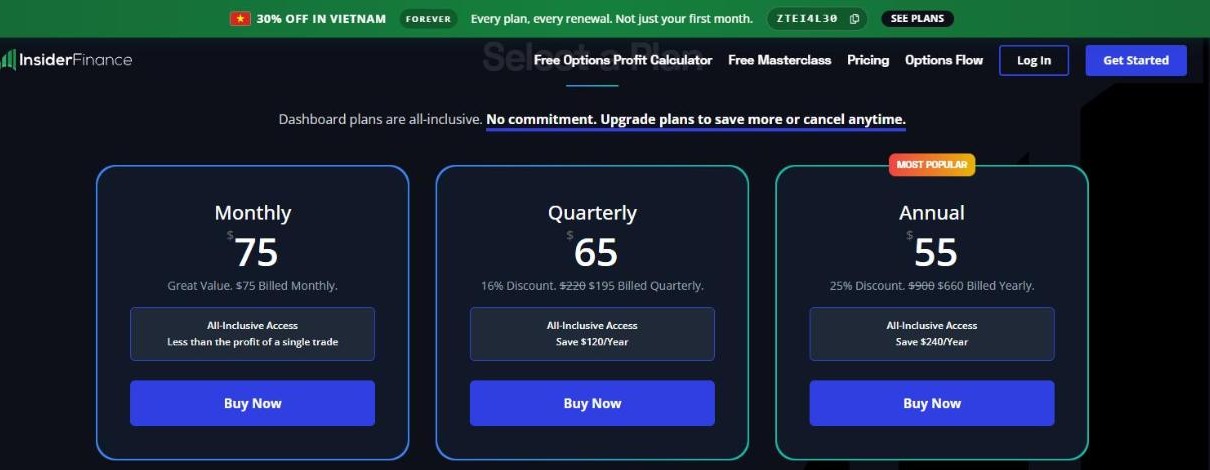
InsiderFinance dashboard pricing is three plans with identical features and different billing cycles. All prices are quoted in US dollars, and the Terms state plainly that “All prices in USD”.
| Plan | Headline rate | Billed | Label on the card |
|---|---|---|---|
| Monthly | 75 dollars per month | 75 dollars monthly | Great Value |
| Quarterly | 65 dollars per month | 195 dollars quarterly | 16 percent discount, struck price 220 dollars, Save 120 dollars per year |
| Annual (most popular) | 55 dollars per month | 660 dollars yearly | 25 percent discount, struck price 900 dollars, Save 240 dollars per year |
Two of those InsiderFinance labels do not survive a calculator. The quarterly card strikes through 220 dollars, but three months at the monthly rate of 75 dollars is 225 dollars, not 220. And 195 dollars against 225 dollars is a 13.3 percent discount, not the 16 percent printed on the card. The annual card has the opposite problem, in the customer’s favour: 660 dollars against 900 dollars is a 26.7 percent saving, while the card claims 25 percent. The two “Save per year” figures, meanwhile, are both correct — 900 minus 780 is the 120 dollars on the quarterly card, and 900 minus 660 is the 240 dollars on the annual one.
None of this changes what you pay: the amount billed is 195 or 660 dollars, and those are the numbers that matter. It is a copy error on a marketing card, not a pricing trap. It is still worth naming, because the next section shows the same company getting the identical sum right one page over.
The technical analysis plans, where the same template adds up
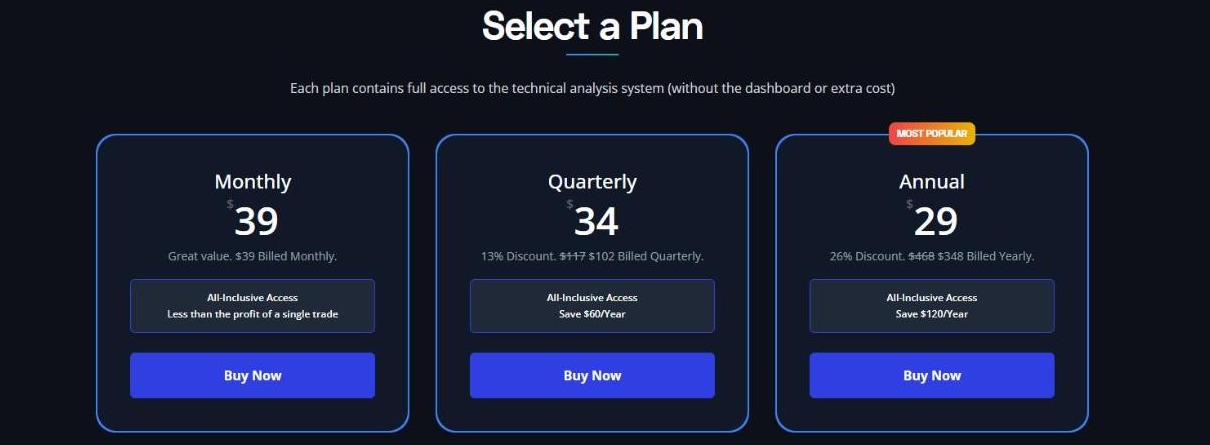
The InsiderFinance technical analysis system can be bought on its own: each plan contains full access to it “without the dashboard or extra cost”. The cards look identical to the dashboard ones. The numbers on them do not have the same problem.
| Plan | Headline rate | Billed | Struck price | Discount claimed | Discount actual |
|---|---|---|---|---|---|
| Monthly | 39 dollars per month | 39 dollars monthly | — | — | — |
| Quarterly | 34 dollars per month | 102 dollars quarterly | 117 dollars (equals 3 x 39) | 13 percent | 12.8 percent |
| Annual | 29 dollars per month | 348 dollars yearly | 468 dollars (equals 12 x 39) | 26 percent | 25.6 percent |
Every figure on that page reconciles: the struck prices are exactly three and twelve times the monthly rate, both discount percentages round correctly, and the save-per-year figures of 60 and 120 dollars are right. The template is not broken — the quarterly dashboard card simply carries stale numbers. Worth noting too: the dashboard plan already includes technical analysis among its fifteen features, so the 39 dollar tier is the dashboard-less version rather than an add-on, and there is no sensible reason to buy both.
The 30 percent Vietnam banner, and what it does not change
Every InsiderFinance page carries a green banner reading “30% OFF IN VIETNAM”, marked FOREVER, with the line “Every plan, every renewal. Not just your first month.” and a copyable code, ZTEI4L30. This is geo-targeted: the prices and the banner described in this review are what a visitor sees from Vietnam, and a reader elsewhere may see something different.
What the banner does not do is change the figures on the plan cards: they still read 75, 65 and 55 dollars with the banner active, so the discount is a code applied at checkout rather than a price the cards reflect. Budget from the undiscounted number and treat the code as something to verify at the point of payment.
TotalFinance: the open-source library behind the math
This is the part that separates InsiderFinance from most of the category, and a reader can verify it in about three minutes. InsiderFinance publishes an open-source TypeScript library called TotalFinance on GitHub, with full documentation on its own domain. The description is refreshingly narrow: it computes, it runs in Node and the browser, it has no runtime dependencies, and in the library’s own words it “never fetches market data on its own”.
The InsiderFinance documentation opens with a worked example: a Black-Scholes call with spot 100, strike 105, a quarter of a year to expiry, 20 percent volatility and a 4 percent risk-free rate, printing a price of 2.3909. I recomputed that from the standard Black-Scholes formula independently of their code, and got 2.3908769, which prints as 2.3909. The documentation also states that “Every code block on this site is executed in CI against the library”, which explains why the printed output matches rather than drifting as the code changes.
The InsiderFinance library is not a toy. The documented surface runs to twenty modules; the technical analysis module alone exposes 1,577 symbols across 32 entry points, with options at 444, volatility at 460 and fixed income at 431. For a trader with any coding ability that is a real asset, because the methodology behind the dashboard’s derived figures becomes readable rather than asserted. Very few vendors in this space let you audit the math.
Two pages, four counters, two sets of numbers
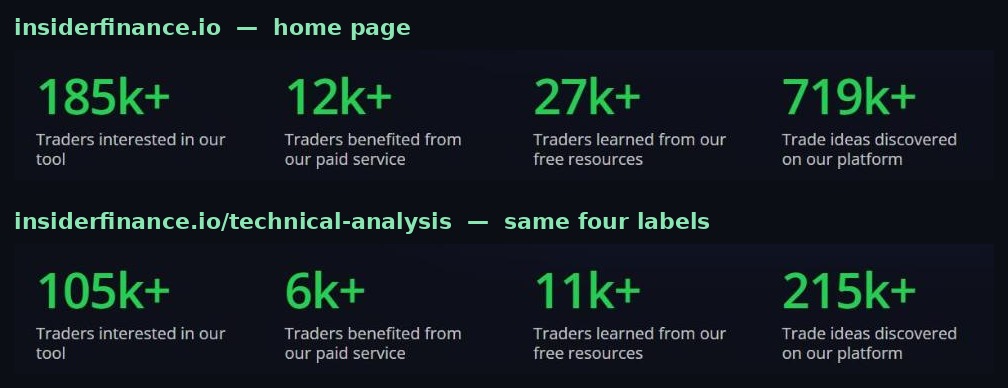
The second slip is in the InsiderFinance social-proof counters. The home page and the technical analysis page both carry the same four labels, and the numbers under them disagree by roughly a factor of two to three.
| Counter label | Home page | Technical analysis page |
|---|---|---|
| Traders interested in our tool | 185k+ | 105k+ |
| Traders benefited from our paid service | 12k+ | 6k+ |
| Traders learned from our free resources | 27k+ | 11k+ |
| Trade ideas discovered on our platform | 719k+ | 215k+ |
Both sets were read within minutes of each other, so this is not a refresh lag. There is no way from outside to tell which set is current; the ordinary explanation is that the technical analysis page predates the home page and was never updated. This review does not pick a side. The honest reading is that InsiderFinance has an audience in the low hundreds of thousands at the interest end and in the five figures at the paying end, and that the precise counter you land on is not evidence of much.
Awards, media coverage and what the badges actually say
The InsiderFinance site leads with “award-nominated” rather than “award-winning”, which is already more careful than most. The footer claims six Benzinga Fintech Awards finalist placings, and the badge wall backs that up: six Benzinga Global Fintech Awards finalist badges, five of them dated 2023 and one dated 2022. Alongside them the page lists eight category names, two of which carry an (N) marker indicating a nomination rather than a finalist placing. The count the footer gives and the badges on the page agree, which is not something that can be taken for granted.
Keep one thing in perspective: the most recent badge is dated 2023, so “award-nominated” is a statement about 2022 and 2023 rather than this year. The separate “As Seen In” strip lists MarketWatch, Yahoo Finance, Benzinga, Stocktwits, the USA Today Network, the Associated Press, TradingView, Morningstar and two more outlets. The current recognition wall is on the official site.
Company information, data sources and regulatory status
The entity operating InsiderFinance is InsiderFinance Intelligence LLC, with a 2026 copyright line and a support address at team@insiderfinance.io. The InsiderFinance about page describes a founding team of engineers, data scientists and active traders who built the platform as an internal tool first. What the public pages never state is a head office, a state of incorporation or a year founded, so this review leaves those blank rather than guessing.
Two disclosures are worth pulling out. First, the Terms name a third-party source: “Company data provided by Financial Modeling Prep.” Naming a data vendor in the Terms is better practice than the silence most platforms keep. Second, and more important, the legal disclaimer states that the company is not a registered investment advisor and is not licensed as such with any federal or state regulatory agency, and that it does not manage client assets.
That is an accurate description of what InsiderFinance is, not a red flag — a data vendor is not required to hold an advisory registration, and holding one would change the nature of the product. But it does mean there is no regulator standing behind the analytics, no compensation scheme and no supervisory body to complain to about a signal that did not work. If you want the official framing of how options work and what can go wrong with them, FINRA publishes an investor guide to options that is independent of any vendor and worth reading before you subscribe to anything in this category.
Risk warning, refunds and the account rules
Trading options carries a high degree of risk, and the company says so itself in its Terms: “There is a high degree of risk involved in trading stocks and options. Past results are not indicative of future returns.” A substantial proportion of retail accounts trading leveraged products lose money. Nothing in this article is investment advice, and no dashboard changes the arithmetic of a position that goes against you.
The InsiderFinance commercial terms deserve a careful read, because the pricing page and the Terms describe the same arrangement in very different tones. The pricing page says “No commitment. Upgrade plans to save more or cancel anytime.” The Terms, under a heading that reads DIGITAL GOODS (NO REFUND POLICY), say “we do not issue refunds”, that “All sales are final”, and that “No pro-rated refunds will be given”. Both are true at once: cancelling stops the next renewal, it does not return money already paid. On the annual plan that distinction is 660 dollars paid up front with no route back, so treat the monthly plan as the way to try the dashboard and the annual plan as a decision you make after you are sure.
Three more InsiderFinance clauses are worth knowing before you sign up. Account sharing triggers an automatic 24-hour lock when the system sees simultaneous logins from multiple locations, which the Terms attribute to data provider agreements. Automated extraction of data — including into Discord, Slack or Twitter — is prohibited, with a stated penalty of a ban without notice and no refund. And liability is capped twice: at fees paid in the preceding twelve months, and in absolute terms at 1,000 dollars.
Neither InsiderFinance nor any individual or organization that may be a source of content distributed through the Site makes any warranty as to the timeliness and accuracy of the information. — InsiderFinance Terms and Conditions, section 10
That clause is standard for a data vendor and it would be unreasonable to expect otherwise, but it is worth reading next to a product whose value proposition is real-time accuracy. On restrictions, the Terms do not publish a list of countries that may not subscribe. There is no jurisdictional restrictions section and no named excluded territories, so the only location-dependent behaviour described anywhere is the simultaneous-login lock.
Who InsiderFinance suits
InsiderFinance fits an active options trader who already knows what a sweep, a block and a dark pool print are and wants them ranked rather than raw. It fits anyone who trades around gamma levels, because that page is free, detailed and internally consistent. It fits a technically minded trader who will open the library and read how a number is derived. And it fits someone who wants to test a platform properly before paying, because the free tier goes well beyond a teaser.
It fits less well if you want signals to follow without understanding them, because the disclaimer is explicit that this is data rather than a picks service; if refund flexibility matters, given that all sales are final; or if you need a regulated counterparty behind the analytics, because there is not one. The free dashboard is the sensible place to start, and it costs nothing to form your own view first.
The short version
InsiderFinance is a carefully built options analytics platform with an unusually generous free tier and a level of quantitative discipline that stands up to direct testing. The gamma exposure page reconciled on eight out of eight derived figures, the squeeze score equalled the sum of its own factors, the free flow gauges agreed with each other, and the documented Black-Scholes example reproduced to four decimal places when recomputed independently.
Against that, two pieces of marketing copy do not survive the same scrutiny: a quarterly pricing card whose struck price and discount percentage are both wrong, and user counters that read differently on two pages of the same site. Neither affects what you are billed or what the dashboard shows you, and both are the sort of thing fixed in an afternoon. But a review that checked the hard numbers and skipped the easy ones would not be worth much.
Overall: 4.3 / 5. Recommended for traders who want institutional-grade options and dark pool data with the math open to inspection, with the caveat that all sales are final and the platform is a data provider rather than a regulated advisor. Visit the official InsiderFinance site to see the current plans and try the free dashboard.


