








A desk review of BluSky, the funded futures prop firm: what the four routes really cost, where the 90/10 split applies, the three-stage reset ladder, and the risk terms.
Reviews

How this review was done. This is a desk review. Every figure below was read off BluSky’s own public pages on 24 November 2026 — the plan selector on the home page, the How BluSky Compares page, the FAQ, the Subscription Terms and the Terms and Conditions. No account was opened, no fee was paid and no trade was placed, so nothing here is a claim about what it feels like to trade a BluSky account. What it is instead is an arithmetic read of the published rules, including three places where two BluSky pages describe the same thing differently.
What BluSky is, and what you are actually buying
BluSky Trading Company LLC is a funded futures prop firm. You pay a fee, trade a simulated account against a published rule set, and if you clear the stages you share in the profits the simulated account produces. The headline terms on the BluSky home page are a 90/10 profit split, payouts available Monday to Friday, and a counter reading “Over 15M paid out in total.”
The distinction that matters most to anyone new to this: you are not depositing trading capital. BluSky answers this directly in its FAQ — “You are not risking your personal funds. The brokerage provides the capital for trading.” What you are risking is the fee, plus any profit you have earned but not yet withdrawn when a rule is broken. That is the whole downside, and it is the number worth modelling before you start rather than after.
There are two instrument families on the BluSky plan selector, Futures and Stocks, and four routes into a funded account. The BluSky plan page lets you switch between all four and watch the order summary update as you go, which is what makes the arithmetic below checkable in about two minutes.
The four BluSky routes, side by side
Every figure in this table is for a 50K futures account, taken from the BluSky plan selector at list price. The two Instant routes skip the evaluation entirely.
| Route | Price (50K) | What you do first | Profit split |
|---|---|---|---|
| Launch | $59 / 30 days, plus $99 at Launch | Pass the evaluation, then clear the Buffer stage once | 90% to the trader |
| Propel | $112 / 30 days with 30OFF ($160 list) | Pass the evaluation, then clear the Buffer stage once | 90% to the trader |
| Orbit | $199 one-time, expires in 30 days | Hit a $3,000 target with no consistency rule in the evaluation | 90% to the trader |
| Instant Sim Funded | $599 one-time | Nothing — you start at $50,000 | 80% to the trader |
| Direct to Funded (3.5K) | $749 one-time | Nothing — you start at $3,500 | 50% for 30 trading days, then 80% |
Two things fall out of that table straight away, and both are discussed in their own sections below: the 90/10 split the BluSky home page leads with applies to three of the five routes, and the smallest account on the list is the most expensive one.
BluSky Launch and Propel: the subscription route
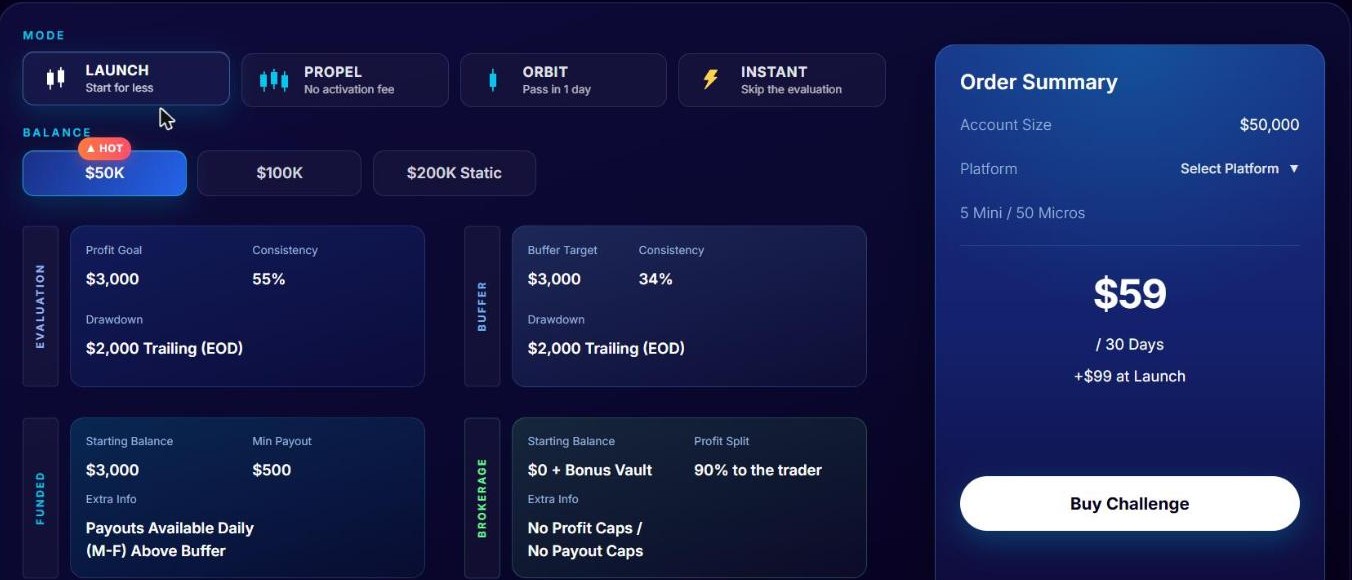
Launch and Propel are the two monthly plans, and they share an identical rule set. The evaluation asks for a $3,000 profit goal at 55% consistency with a $2,000 end-of-day trailing drawdown. Clear that and you move to the Buffer stage, which asks for a $3,000 Buffer target at 34% consistency against the same $2,000 trailing drawdown. Funded, you start with a $3,000 balance, the minimum payout is $500, and payouts are available daily Monday to Friday once you are above the Buffer.
| Stage | Target | Consistency | Drawdown |
|---|---|---|---|
| Evaluation | $3,000 profit goal | 55% | $2,000 trailing (EOD) |
| Buffer | $3,000 Buffer target | 34% | $2,000 trailing (EOD) |
| Sim Funded | Starting balance $3,000 | — | Minimum payout $500 |
| Brokerage | Starting balance $0 + Bonus Vault | — | 90% to the trader |
The split between the two plans is about when you pay. Launch is cheaper up front at $59 for 30 days but carries a $99 fee that falls due when you pass. Propel costs $112 for 30 days with the 30OFF code that the BluSky compare page describes as always on, against a $160 list price, and has no Launch fee at all. Propel also opens up far more account sizes — 25K, 50K, 100K, 150K Static, 200K Static and 300K Static, against Launch’s three.
One useful detail from the BluSky FAQ: the subscription stops when you pass. “Once you pass the evaluation, the subscription ends.” The Subscription Terms add the standard conditions around that — renewals every 30 days, cancellation taking effect at the end of the current period, cancel at least one day before renewal, and payments non-refundable once processed except where required by law.
Finding one: the headline BluSky price is about a third of the real one
The number printed largest on the Launch order summary is $59. Directly beneath it, in smaller type, sits +$99 at Launch. Both are real, and the second only arrives if things go well, but a trader budgeting from the big number is budgeting for roughly a third of the cost of reaching a funded BluSky account.
| Path through Launch 50K | What you pay | Multiple of the $59 headline |
|---|---|---|
| Pass first time, one 30-day cycle | $59 + $99 = $158 | 2.7x |
| One evaluation reset, then pass | $59 + $49 + $99 = $207 | 3.5x |
| One evaluation reset and one Buffer reset | $59 + $49 + $250 + $99 = $457 | 7.7x |
None of those numbers are hidden. The $49 and $250 resets are printed on the BluSky compare page in the same size as everything else, and the $99 is on the order summary. They are simply never added up in one place, which is the arithmetic this review is doing for you. For what it is worth, the discount runs the other way too: the compare page notes that the Welcome26 code takes 50% off a new customer’s first Launch account, putting the subscription leg at $29.50 rather than $59.
The honest framing for a BluSky Launch account, then, is that $158 is the floor, not $59, and that the floor is only the floor if you pass on the first attempt. You can check all of this yourself on the BluSky pricing page in less time than it took to read this section.
BluSky Orbit: pass in a day, then meet three rules the evaluation did not have
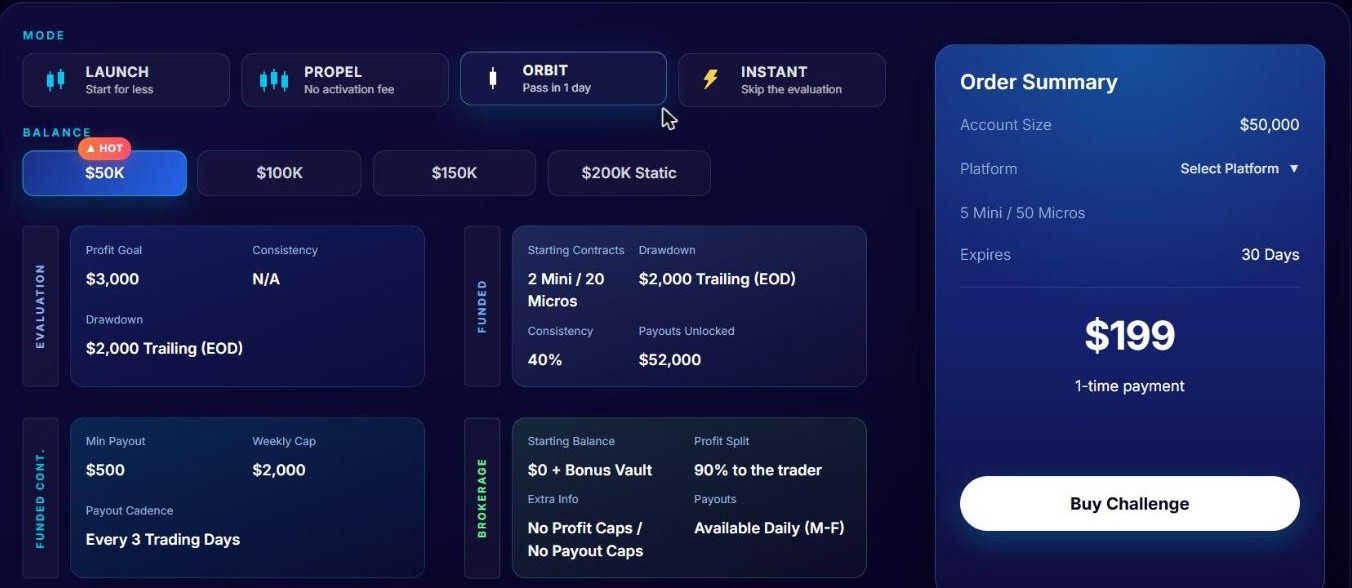
Orbit is the speed route. It is a $199 one-time purchase that expires in 30 days, the BluSky compare page sells it as “Pass in 1 day. First payout in about 4,” and the evaluation genuinely is lighter: a $3,000 profit goal with consistency marked N/A and the same $2,000 end-of-day trailing drawdown.
What the evaluation removes, the funded stage adds back. Once funded on Orbit you are trading 2 Mini / 20 Micros, under a 40% consistency rule, and payouts do not unlock until the account is above $52,000. Payout cadence is every three trading days rather than daily, with a $500 minimum and a $2,000 weekly cap.
| Orbit 50K | Evaluation | Funded |
|---|---|---|
| Consistency | N/A | 40% |
| Contracts | 5 Mini / 50 Micros on the order summary | 2 Mini / 20 Micros |
| Payout gate | — | Account above $52,000 |
| Payout cadence | — | Every 3 trading days, $500 minimum |
| Weekly cap | — | $2,000 |
That contract line is the one worth pausing on. Orbit costs more than three months of a BluSky Launch subscription and trades fewer contracts in the funded stage than Launch or Propel do. Whether that is the right trade depends entirely on how much you value getting through the evaluation in a day, which is a personal question rather than a mathematical one.
Finding two: “No profit caps, no payout caps” sits in one column only
“No Profit Caps / No Payout Caps” appears on every BluSky plan card, which makes it easy to read as a property of the whole product. Look at which column it sits in and the picture tightens: it is in the Brokerage column, the live account you reach after Sim Funded, not in the Funded column where almost every trader actually is.
The Orbit screenshot above shows both columns at once, which is the clearest version of this. In the Funded column: 40% consistency, payouts unlocked at $52,000, a $2,000 weekly cap. In the Brokerage column, inches to the right: no profit caps, no payout caps. The BluSky compare page is consistent with this and adds a figure the plan cards do not carry — Sim Funded payouts have “only a rolling 7-day cap,” which it puts at $2,500 on a 50K Launch.
This is not a contradiction and this review is not presenting it as one. Both statements are true of the stages they describe. It is a case of a headline belonging to a stage most readers have not reached yet, and the fix is simply to read the column heading above the claim.
BluSky Instant Funding, and the price that runs backwards
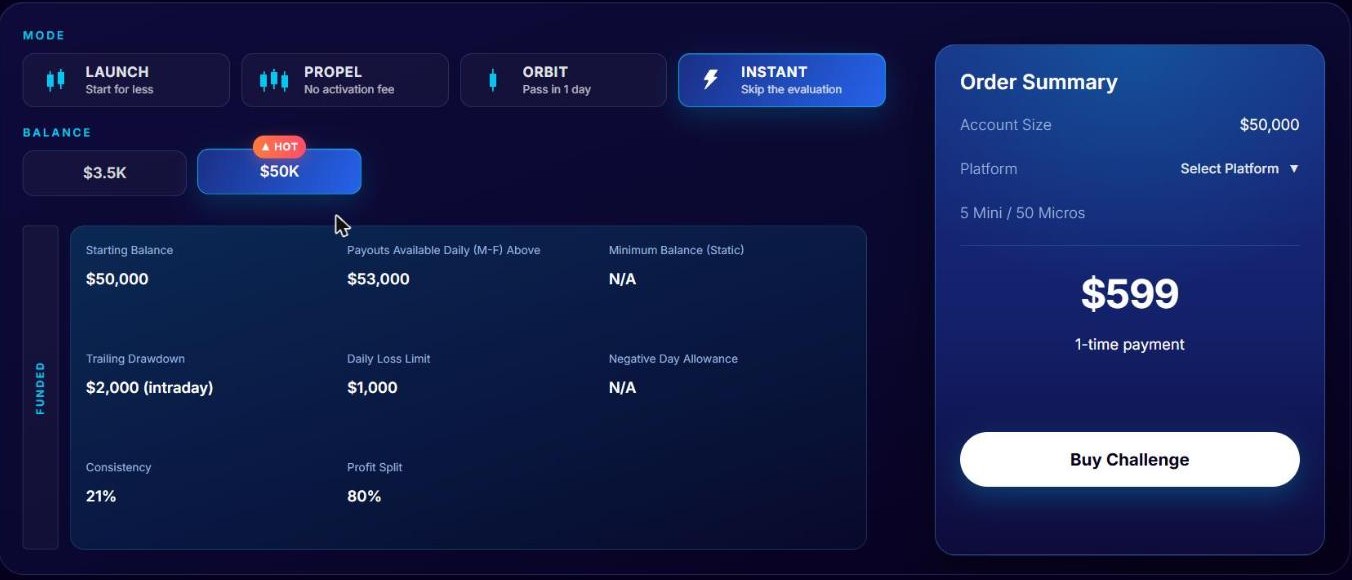
The Instant routes remove the evaluation. The 50K version costs $599 as a one-time payment and starts you at $50,000, with payouts available daily Monday to Friday above $53,000. The rule set is noticeably tighter than the evaluation plans: the $2,000 trailing drawdown is intraday rather than end-of-day, there is a $1,000 daily loss limit, consistency is 21%, and the profit split is 80%, not 90%.
| Instant route | Price | Starting balance | Daily loss limit | Consistency | Split |
|---|---|---|---|---|---|
| Instant Sim Funded 50K | $599 | $50,000 | $1,000 | 21% | 80% |
| Direct to Funded 3.5K | $749 | $3,500 | $2,000 | 21% | 50% for 30 trading days, then 80% |
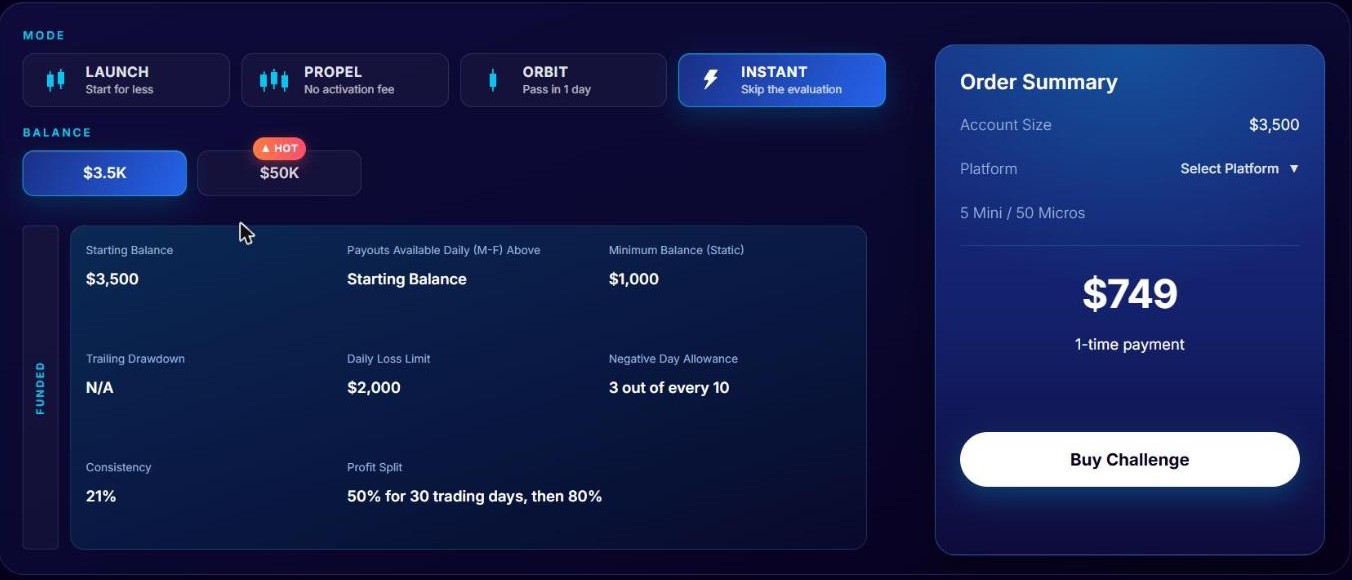
Finding three. Read that table twice. The $3,500 account costs $749. The $50,000 account costs $599. That is 14.3 times less capital for 25% more money, and it is the clearest single example on the BluSky site of why the price tag alone is a poor guide to what you are getting. The 3.5K route also runs a 50/50 split for the first 30 trading days before stepping up to 80%, and sets a static minimum balance of $1,000, leaving $2,500 of room against a daily loss limit of $2,000.
The BluSky compare page describes Direct to Funded as a different kind of product rather than a cheaper one, and that reading holds up: it is a small live-style account with a negative day allowance of 3 out of every 10 and no trailing drawdown at all. It is simply not the budget option that its position next to the 50K might suggest.
The BluSky reset ladder: you restart the stage, not the journey
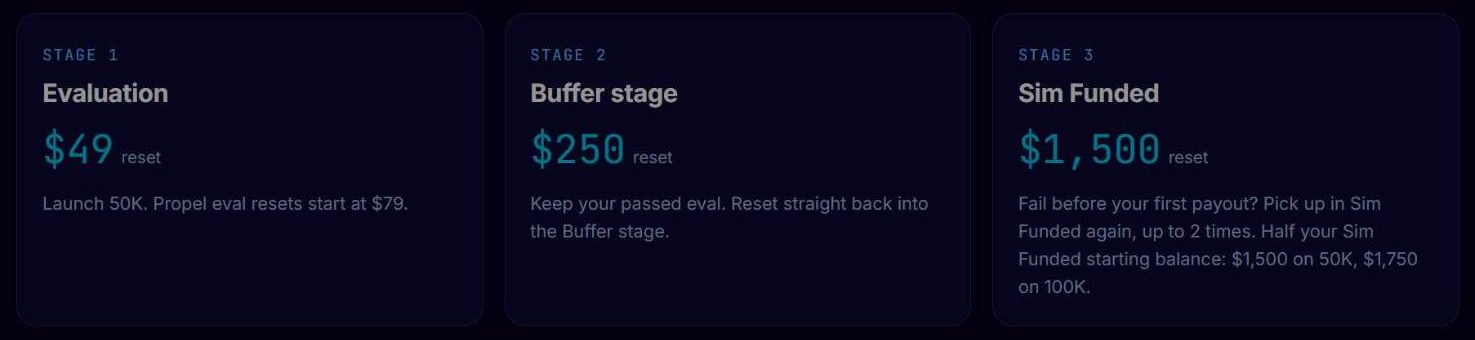
This is the piece of the BluSky product that has no equivalent in most of the prop firm reviews on this site, and it deserves to be understood properly because it cuts both ways.
Break an account and you reset to the stage you were in, not to the start line. Fail in the Buffer stage and you reset to the Buffer stage. Fail in Sim Funded before your first payout and you pick up in Sim Funded again, up to two times, at half your Sim Funded starting balance — $1,500 on a 50K, $1,750 on a 100K.
| Stage | Reset price | What the reset buys |
|---|---|---|
| 1. Evaluation | $49 (Launch 50K; Propel evaluation resets start at $79) | Another run at the evaluation |
| 2. Buffer stage | $250 | You keep your passed evaluation and go straight back into the Buffer |
| 3. Sim Funded | $1,500 | Up to two pick-ups before your first payout, at half the Sim Funded starting balance |
The upside is obvious: a trader who has already cleared an evaluation does not have to clear it again. The part to budget for is that the ladder gets expensive quickly at the top. A $1,500 Sim Funded reset is more than nine times the $158 it cost to reach funded on BluSky Launch in the first place, and it is the number most likely to be met at the exact moment a trader least wants to spend it.
What happens past 10,000 dollars in profit
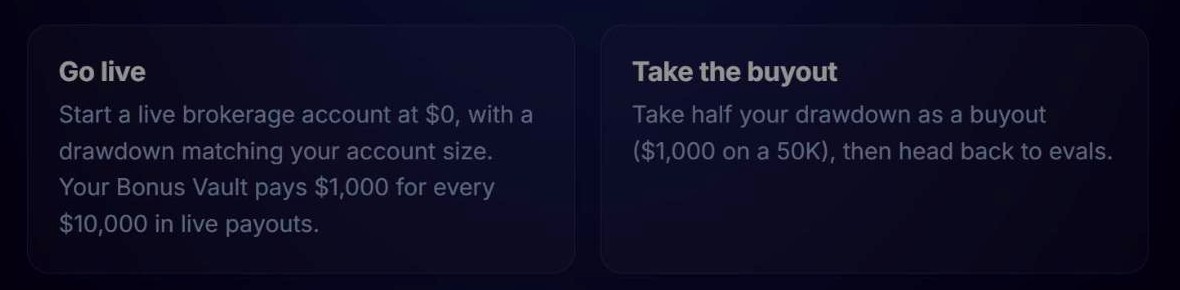
Reach $10,000 in profit and BluSky gives you a choice between two exits, which is unusual enough to be worth spelling out.
Go live. You start a live brokerage account at $0, with a drawdown matching your account size, and a Bonus Vault that pays $1,000 for every $10,000 in live payouts. This is the stage where the “no profit caps, no payout caps” line from finding two actually applies.
Take the buyout. You take half your drawdown as a cash buyout — $1,000 on a 50K account — and head back to the evaluations.
Neither option is presented by BluSky as the better one, and this review will not pick either. The buyout is a smaller, certain number; going live is an uncapped, uncertain one with a bonus structure attached. Which suits you is a question about your own risk appetite, not about the product.
Platforms, contracts and payout mechanics
The BluSky order summary lets you pick a platform before you buy. ATAS is offered with a free licence and runs on Rithmic, and the FAQ confirms TradingView works for technical analysis. Contract allocation is 5 Mini / 50 Micros on the Launch, Propel and Instant plans at 50K, and 2 Mini / 20 Micros on Orbit.
| Mechanic | Launch / Propel | Orbit | Instant Sim Funded |
|---|---|---|---|
| Payout cadence | Daily, Monday to Friday, above the Buffer | Every 3 trading days | Daily, Monday to Friday, above $53,000 |
| Minimum payout | $500 | $500 | — |
| Contracts at 50K | 5 Mini / 50 Micros | 2 Mini / 20 Micros | 5 Mini / 50 Micros |
| Drawdown type | $2,000 trailing (EOD) | $2,000 trailing (EOD) | $2,000 trailing (intraday) |
On payout frequency the BluSky FAQ is unusually plain: “Can I really request a payout every day? Yes. If you meet the criteria and your account balance is eligible, you can request a payout every day.” The criteria are the Buffer, the minimums and the rolling cap already covered above — but the cadence itself is not rationed, which is the part that differs from a lot of this category.
Around the product sits a community layer: a Discord the site puts at 10,000+ traders, and free daily coaching that the FAQ says runs on BluSky’s live YouTube streams. Those are the firm’s own descriptions of its own programme, not something this review has sat in on.
Company information and what the site does not publish
The BluSky footer names the operator plainly: BluSky Trading Company LLC, 7901 4th St N Ste 300, St. Petersburg, FL 33702. The Terms and Conditions, last modified 1 July 2026, are governed by Florida law with arbitration seated in Florida, and set one explicit eligibility rule: you must be over 18 to trade with BluSky. Payments are settled by Odeonpay ALE S.R.L. (“Paysagi”) acting as merchant of record, which the footer states is not the supplier of the goods or services.
What is not on the site is a regulator licence number, and in this corner of the market that is the normal state of affairs rather than an omission. A funded futures prop firm selling evaluations on simulated accounts is not running customer brokerage accounts, so it generally falls outside the registration regime that covers futures brokers. The practical consequence is that there is no licence number to verify — for BluSky or for the firms it competes with.
That does not leave a reader with nothing to check. Registration status for any futures firm in the United States is searchable by name on NFA BASIC, the National Futures Association register, which is free and takes a minute. Running the check and finding no registration is itself a useful result: it tells you the relationship is governed by the contract you signed and by Florida law, not by a regulator’s customer-protection rules. BluSky also does not publish a restricted-country list anywhere this review could find, on the Terms page or elsewhere, so anyone outside the United States should ask support before paying.
BluSky risk warning and the CFTC disclaimer it prints
BluSky carries two separate risk disclosures and both are worth quoting as the firm wrote them rather than paraphrasing. The first is in the site footer:
“Trading futures and other financial instruments involves substantial risk of loss and may not be suitable for all investors. The high degree of leverage in futures trading can work against you as well as for you. Past performance is not indicative of future results… Never trade with money you cannot afford to lose.”
The second sits inside the Terms and Conditions as the CFTC Required Disclaimer, and includes CFTC Rule 4.41 on simulated results: “HYPOTHETICAL OR SIMULATED PERFORMANCE RESULTS HAVE CERTAIN LIMITATIONS. UNLIKE AN ACTUAL PERFORMANCE RECORD, SIMULATED RESULTS DO NOT REPRESENT ACTUAL TRADING.” That disclaimer is directly relevant here, because the BluSky Sim Funded stage is exactly that — a simulated account — until the Brokerage stage.
For a prop firm specifically, the shape of the risk is worth restating in plain terms. You are not depositing trading capital, so the money at stake is the fees you have paid plus any profit earned but not yet withdrawn when a rule is broken. Model the worst case as the sum of your subscription, any Launch fee, every reset you buy, and the unwithdrawn balance sitting in the account. Nothing in this article is investment advice, and the right amount to spend on an evaluation is an amount you would be content to lose outright.
Who BluSky fits, and who should look elsewhere
It fits a futures trader who has already been through an evaluation somewhere and expects to need more than one attempt — the reset ladder is genuinely cheaper than starting over, and that is the clearest structural advantage BluSky has. It fits someone who wants payout cadence rather than payout size, given daily Monday-to-Friday requests on the Launch and Propel plans. And it fits a trader who likes a community layer around the product, since the Discord and the daily YouTube coaching come bundled rather than sold separately.
It is a weaker fit for someone whose plan depends on the smallest possible outlay, because the $59 headline becomes $158 at best and the resets stack from there. It is a weaker fit for a trader who dislikes consistency rules, since every BluSky route except the Orbit evaluation carries one, ranging from 21% to 55%. And it is a weaker fit for anyone outside the United States who needs certainty about eligibility before paying, given the absence of a published restricted-country list.
If you do want to walk the plan selector yourself before deciding, the BluSky plans page is where every number in this review came from, and the order summary updates live as you change mode and balance.
How this review was done
Sources: the BluSky home page plan selector (all four modes, at 50K and 3.5K), the How BluSky Compares page, the FAQ, the Subscription Terms, the Terms and Conditions, and the site footer. Everything was read on 24 November 2026. Prices move and prop firm rules move faster, so treat every figure as of that date and re-check before buying.
Deliberately excluded: the BluSky compare page sets its own numbers against nine named competitor firms, and none of that comparison is reproduced here. Reviews on this site do not rank one firm against another by name. Also excluded are the customer testimonials on the BluSky home page, which carry real names, and any claim about execution, slippage or support response time — none of which can be assessed from documentation.
Where two BluSky pages said different things, both are reported above and neither was averaged or quietly dropped.
The short version
BluSky is a well-documented futures prop firm whose rules are unusually easy to verify, which is most of the reason this review could be written at all. The reset ladder is a real structural advantage over a single-shot evaluation, the daily payout cadence is not rationed, and the company names itself and its address in the footer rather than hiding behind a brand.
The three things to carry away: the Launch price is $158 at best rather than $59; the “no caps” line belongs to the Brokerage column and not to Sim Funded, where a rolling 7-day cap of $2,500 applies on a 50K; and the $3,500 Direct to Funded account costs $150 more than the $50,000 Instant account. All three are checkable in minutes on BluSky’s own pages, which is the best thing that can be said about a prop firm’s disclosure.
Overall: 4.2 / 5. Marked up for documentation quality, the reset structure and payout cadence; marked down for headline prices that need three additions before they are true, and for the absence of a published restricted-country list. Trading futures carries substantial risk of loss, and the fees you pay a prop firm are money you can lose in full.
Ready to compare the four routes yourself? Open the BluSky plan selector here and check the order summary against the tables above.


