








Paybis review 2026: the MiCA, PSD2 and FinCEN licence numbers, how the fees are built up, what the 1,000 dollar verification badge really means, and the risk terms.
Reviews
Most places that sell you crypto with a card describe themselves as regulated and leave it there. Paybis does something less common: it prints the authorisation numbers on the home page, names the regulator in its terms, and lets you check both yourself. That alone makes it worth a careful read rather than a glance.
This is a desk review of what the company publishes. Everything here was read from its own pages on 24 November 2026 – the home page, the FAQ, the about page and the full terms and conditions – and nothing was bought, sold or withdrawn. Three things came out of that reading that the marketing copy and the small print describe differently, and they are worth knowing before the first purchase rather than after it.
One note on currency. The site served a Vietnamese storefront in VND during this review, so no local price figure is quoted here as a global one. The only money figures below are the ones the company states in US dollars itself.
What Paybis is, and what it is not
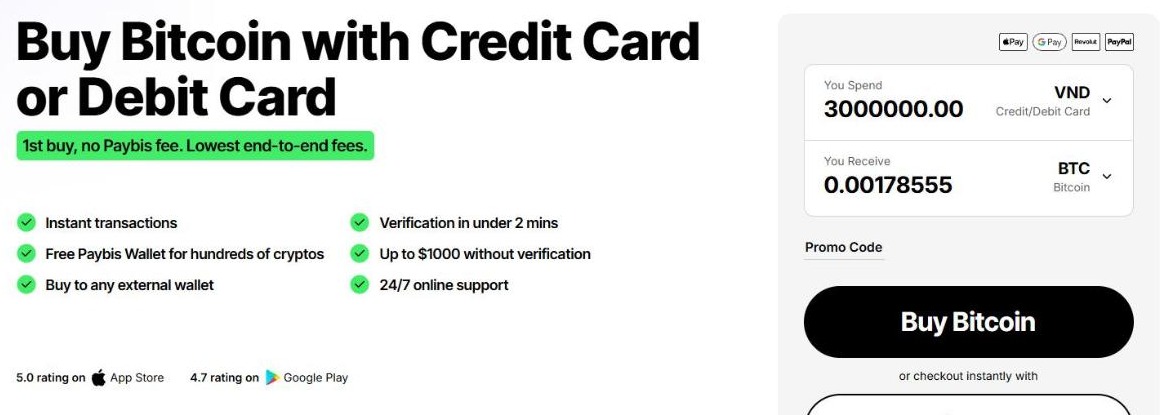
Paybis is a fiat-to-crypto gateway rather than a trading venue. You bring a card, a bank transfer or a wallet such as Apple Pay, and you leave with crypto – either into the free wallet the platform provides or straight out to an external address of your own. Selling back to fiat and swapping one coin for another work the same way.
That matters for Paybis expectations. There are no leveraged positions, no order book to work, no derivatives and no copy trading here. The company dates itself to 2014, which makes it one of the longer-running on-ramps still operating under its original name.
| What the platform states | Detail |
|---|---|
| Service type | Buy, sell and swap crypto for fiat |
| Founded | 2014 |
| Wallet | Free platform wallet, or buy direct to an external wallet |
| Verification speed | Identity check usually under two minutes |
| Support | 24/7 online |
| App store ratings | 5.0 App Store, 4.7 Google Play (as displayed on the site) |
Paybis licences: the numbers are printed, which is rare
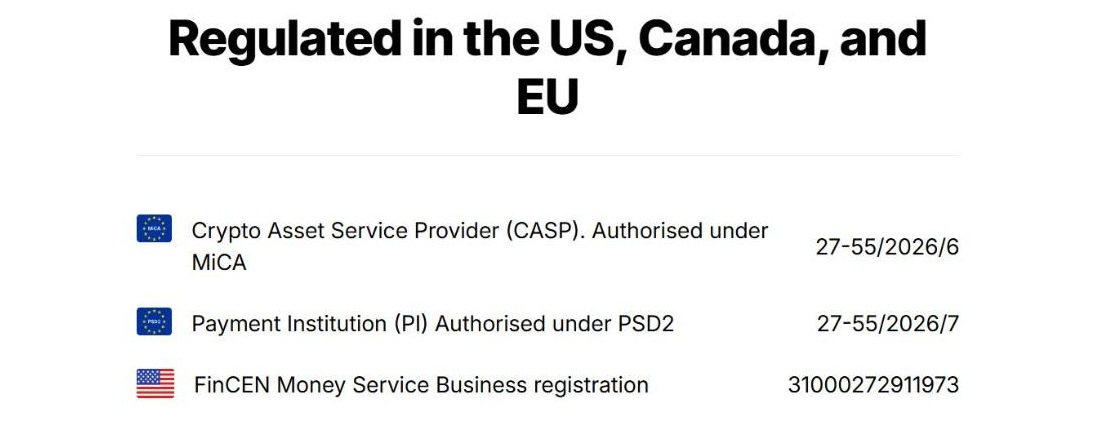
The Paybis home page carries a block headed Regulated in the US, Canada, and EU with three entries, each with its own reference. These are the figures to copy down, because they are what makes the claim checkable rather than decorative.
| Authorisation | Framework | Reference number |
|---|---|---|
| Crypto Asset Service Provider (CASP) | Authorised under MiCA | 27-55/2026/6 |
| Payment Institution (PI) | Authorised under PSD2 | 27-55/2026/7 |
| Money Service Business | FinCEN registration (US) | 31000272911973 |
The Paybis terms go further than the home page does. They name the operating entity as SIA Paybis Europe of Brivibas 171, Riga, Latvia, and state plainly that the company is supervised by the Bank of Latvia, Latvijas Banka – the authority that issued both European authorisations.
This is a European Paybis authorisation rather than an offshore registration, and the distinction is not cosmetic. A CASP authorisation is granted under Regulation (EU) 2023/1114, the MiCA text itself, which sets capital, custody, complaint-handling and disclosure obligations across the EU. Readers who want to know what the company has actually signed up to can read the regulation and the authorisation number side by side.
The services are listed by their legal definitions
One more detail from the Paybis terms is worth surfacing, because very few consumer crypto sites bother with it. The agreement does not describe the offering in marketing language; it enumerates the regulated services and points at the MiCA articles that define each one.
- Exchange services – crypto for funds, and crypto for other crypto
- Custodian wallet services – custody and administration of crypto on your behalf
- Execution of orders, transfer services and advisory services
- Payment services, under the separate payment institution authorisation
The practical consequence for a Paybis buyer is that the custody of coins left in the platform wallet sits inside a regulated custody service rather than an unregulated one. The terms also state that beneficial ownership of stored assets remains with the customer at all times.
How Paybis fees are built up
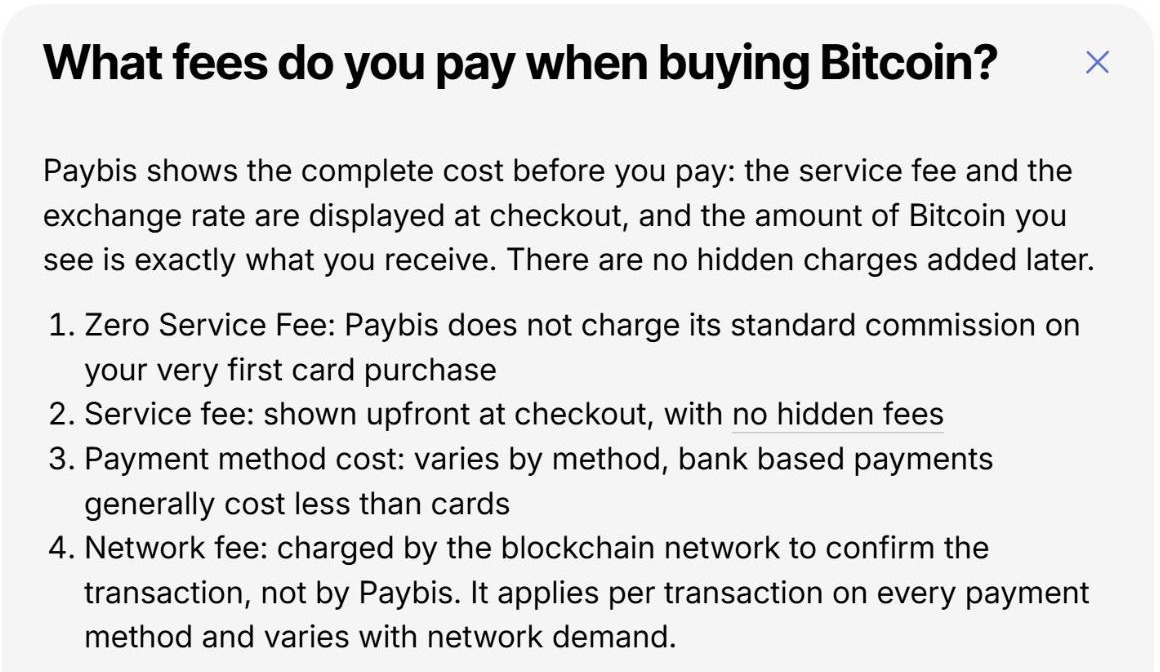
The Paybis FAQ sets out the cost in four parts rather than one headline percentage, which makes it easier to work out where the money actually goes.
| Component | What the FAQ states |
|---|---|
| First card purchase | No standard commission charged on your very first card purchase |
| Service fee | Shown upfront at checkout, described as having no hidden fees |
| Payment method cost | Varies by method; bank-based payments generally cost less than cards |
| Network fee | Charged by the blockchain, not by the platform; applies per transaction on every method |
Two of those Paybis rows are the ones that change a buying decision. The first-purchase waiver applies to card purchases specifically, so it is a one-time saving rather than a standing rate. And the line about bank payments costing less than cards is the company’s own guidance – if you are buying a meaningful amount and are not in a hurry, the payment method you pick will move the total more than anything else on this page.
Finding one: what “fees are included” covers, and what it does not
The Paybis buy widget carries the line Fees are included beneath the quoted amount, and the headline above it promises the lowest end-to-end fees. The FAQ further down the same page says something narrower.
The network fee is described as charged by the blockchain network to confirm the transaction, not by the platform, and it is stated to apply per transaction on every payment method and to vary with network demand.
Both statements are true at the same time – the quote you see does include the service fee and the rate, and the blockchain fee genuinely is not the company’s charge. But a reader who takes fees are included at face value and does not scroll to the FAQ may not expect a separate network cost on every transfer out. This review does not treat that as a contradiction so much as two levels of detail that reward reading both.
The practical answer is to look at the final figure at checkout rather than any headline, and to remember that moving coins to an external wallet is where the network fee shows up most visibly. You can see the current quote and fee breakdown on the Paybis checkout before committing to anything.
Finding two: the thousand-dollar badge needs its footnote
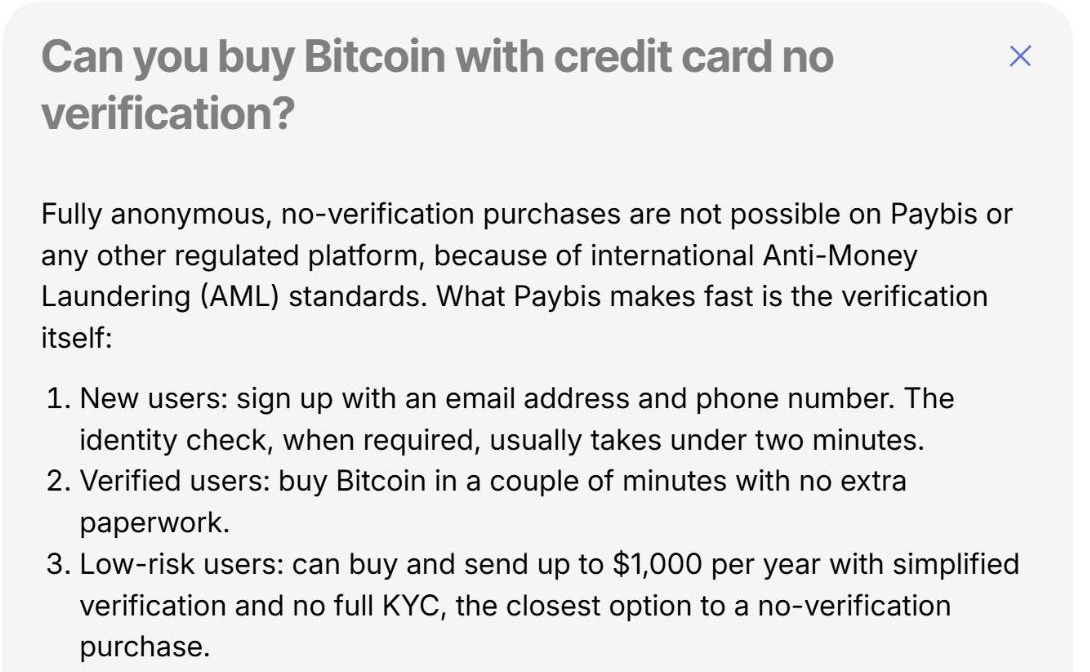
The Paybis home page lists Up to $1000 without verification as one of six headline features. The FAQ on the same page answers the matching question considerably more precisely, and the two readings differ in ways that matter.
| Where it appears | What it says |
|---|---|
| Home page feature list | Up to 1,000 dollars without verification |
| FAQ, opening line | Fully anonymous, no-verification purchases are not possible on this or any other regulated platform |
| FAQ, low-risk users | Up to 1,000 dollars per year, with simplified verification and no full KYC |
So the Paybis badge drops two qualifiers: the limit is annual rather than per transaction, and the route is reduced verification rather than none. The FAQ is candid about why – international anti-money-laundering standards leave no room for anonymous purchases at a licensed firm – and it calls the simplified route the closest option to a no-verification purchase rather than the thing itself.
Nothing is concealed; the Paybis correction sits on the same page as the claim. But if the badge is the reason you are signing up, read the FAQ answer first, because the annual cap will be reached faster than a per-transaction one.
Finding three: restricted countries are defined but never listed
The Paybis terms define a Restricted Jurisdiction as one where the company does not provide its services, and add that the definition is updated from time to time. What the document does not do is publish the list.
The Paybis sanctions definition is specific by comparison, naming EU Council regulations, the United Nations Security Council, the United States including OFAC, the United Kingdom including OFSI, and any other competent sanctions authority. So the sanctions position is clear while the ordinary country availability is not.
The company separately states coverage of 180 countries, which is broad but leaves the exclusions unnamed. In practice a prospective customer finds out where they stand at sign-up rather than before it, and anyone in a jurisdiction with unusual crypto rules should treat availability as something to confirm rather than assume.
Paybis coverage, payment methods and published numbers
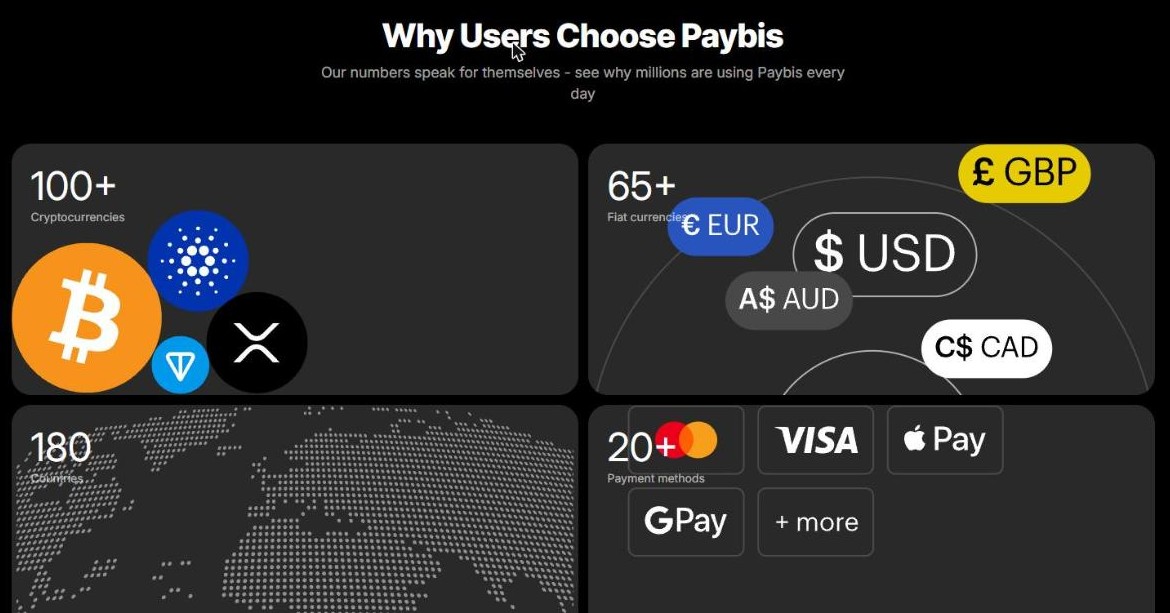
Paybis publishes its own scale figures, and they are the kind that can be checked against the product itself rather than taken on trust.
| Measure | Published figure |
|---|---|
| Cryptocurrencies | 100+ |
| Fiat currencies | 65+ |
| Countries | 180 |
| Payment methods | 20+ |
| Users | 5 million or more, as stated by the company |
The Paybis payment list covers cards from Mastercard and Visa, Apple Pay, Google Pay, Revolut Pay, PayPal and Skrill alongside bank transfers. Sixty-five fiat currencies is the figure that will matter most outside the dollar and euro, because it decides whether you convert once or twice to get where you are going.
Risk warning and what the Paybis terms disclose
The Paybis terms carry a dedicated risk schedule rather than a single disclaimer line, and its opening is worth quoting as the company wrote it:
Acquiring crypto-assets offered through the Platform carries inherent risks. In extreme cases, the full amount You pay may be lost entirely.
The Paybis schedule then itemises the risks in a way that is unusually frank for a consumer-facing page. It describes depreciation, illiquidity and extreme volatility; counterparty risk, noting that orders may be transmitted to third parties whose financial stability the company does not control and whose default could mean a full or partial loss; liquidity risk, warning that some assets may not be sellable when you want to sell; and stablecoin risk, disclaiming responsibility for assets that claim to be collateralised.
Read plainly, that means money placed with Paybis is at risk from the asset itself and from the chain of parties behind the trade, not only from price movement. Crypto is not covered by deposit guarantee schemes, and nothing in the authorisations above changes the fact that the value of what you buy can fall to a fraction of what you paid. Nothing in this review is investment advice.
Who Paybis fits, and who should look elsewhere
Paybis fits someone who wants to buy or sell crypto with a card or bank transfer and cares that the counterparty holds a named European authorisation they can verify. It fits a first-time buyer, given the waived commission on a first card purchase and a verification step measured in minutes. And it fits anyone who wants coins delivered to their own wallet rather than parked on an exchange.
Look elsewhere if you want leverage, derivatives or an order book, none of which are on offer. Look elsewhere too if your country sits outside the published coverage, since the exclusion list is not something you can check in advance, and if you intend to rely on the reduced-verification route for more than a small amount, because that ceiling is annual.
If you want to check the current rates, limits and payment methods against what is written here, the platform publishes them on its own site and every figure above can be verified there in a few minutes.
Buying, selling and swapping: the three routes
The Paybis navigation splits the product into three jobs rather than one, and each behaves differently enough to be worth separating before you start.
| Route | What it does | Worth knowing |
|---|---|---|
| Buy crypto | Fiat in, crypto out, by card or bank transfer | First card purchase carries no standard commission |
| Sell crypto | Crypto in, fiat out to a bank or card | Payment method again decides much of the cost |
| Swap crypto | One coin exchanged for another | Covered by the same exchange-services authorisation |
| Wallet | Free platform wallet, or buy straight to your own address | Custody sits under the regulated custody service |
The Paybis option to send straight to an external wallet is the one worth using if you do not want a balance sitting with any third party. It also makes the network fee from the earlier section visible, because that is the transaction being paid for. Both routes are set out on the platform itself with the current limits attached.
How this review was done
Every Paybis licence number, fee line, limit and policy statement above was read directly from paybis.com on 24 November 2026: the home page and its FAQ, the about page, and the full terms and conditions including the risk schedule. Where the marketing copy and the detailed answer differ, as the verification badge does, both versions are reproduced rather than reconciled.
No Paybis account was opened, no payment was made, no crypto was bought, sold or withdrawn, and no support request was raised. Nothing here judges execution speed, the real spread on a live quote, withdrawal reliability or how support behaves under pressure. Statements the company makes about itself, including its scale figures and its licence references, are reported as its statements; the authorisation numbers are published so that readers can check them against the regulator rather than take this review’s word for it.
The short version
Paybis is a long-running on-ramp that has done the regulatory work and, unusually, shows it: two European authorisations with numbers attached, a named supervisor, a US registration, and a terms document that defines its services by the articles of the regulation it operates under. The fee structure is explained in parts rather than hidden behind one percentage.
Overall: 4.3 out of 5. Marked up for publishing checkable authorisation references, an itemised fee breakdown and a frank risk schedule. Marked down for a headline verification badge that omits the word annual and for a restricted-country list that is defined but never published. You can check the current terms and pricing yourself before deciding.


