








Tangem wallet review: a USD 59.90 NFC card with an EAL6+ chip, keys generated on the card, immutable firmware and no recovery phrase. What the third card really buys.
Reviews

Tangem builds a hardware wallet shaped like a bank card (logo from tangem.com)
A Tangem wallet is a card. Not a card-shaped gadget with a tiny screen on it – an actual credit-card-sized piece of plastic with a chip and an antenna inside, no display, no buttons, no battery and no cable. You tap it against a phone and that is the whole interaction.
That design decision removes two things most hardware wallets treat as essential, and it is what makes a Tangem wallet worth looking at closely: the screen you confirm transactions on, and the twelve or twenty-four recovery words you write on paper. This review is about what replaces them, what it costs, and the one number on the pricing page that decides which set you should buy.
Everything below was read from tangem.com on 3 November 2026 – the product pages, the security page, the pricing page with its FAQ, and the company page. Prices are the US dollar figures the site shows. The Tangem product pages carry the current list if you want to follow along.
What a Tangem wallet actually is
The Tangem wallet card holds a certified secure element that Tangem says was developed with Samsung Semiconductors and is certified to EAL6+. Private keys are generated on the card by a hardware true random number generator, stored on the card, and used on the card to sign. The phone is a display and a network connection, nothing more.
Tangem states the card environment is built on immutable firmware principles and that the whole design is a zero-knowledge architecture: unsigned transaction data goes in, a signed payload comes out, and the company says it has no mechanism to extract or reconstruct user keys.
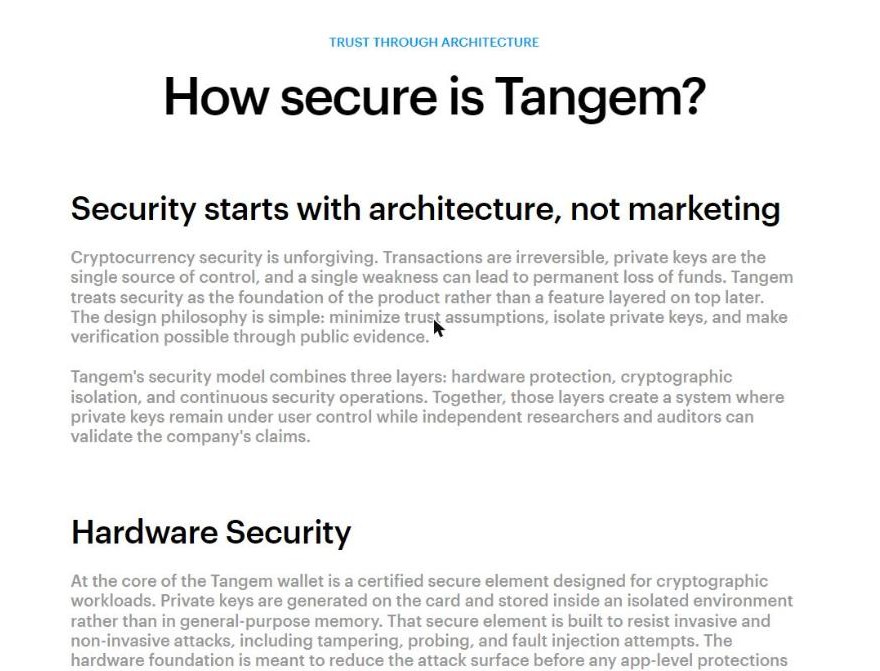
Tangem describes a three-layer model: hardware protection, cryptographic isolation and continuous security operations (screenshot from tangem.com)
In practical terms a single Tangem wallet supports more than 90 blockchains and over 14,100 tokens through the free Tangem app, activates in about two minutes, and needs no cable, charger or desktop computer at any point. Because the card draws its power from the phone over NFC, there is nothing to charge and nothing with a service life shorter than the chip itself.
Seedless by design: what replaces the recovery phrase
On a conventional hardware wallet the seed phrase is the backup. On a Tangem wallet it is not. On a Tangem wallet the other cards are the backup. Every Tangem wallet set contains at least two cards, each one a full key to the same wallet, and recovery means tapping a card you still have rather than retyping words you wrote down.
Tangem describes three key-generation options and is explicit that one of them is the recommended default:
- Hardware TRNG on the card – keys generated and stored inside the chip, with no copy existing anywhere outside your cards. Tangem marks this as recommended.
- Generate a seed phrase in the Tangem app – available if you want words as well.
- Import an existing seed phrase – for moving a wallet you already hold.
So on a Tangem wallet a seed phrase is optional, not absent. That matters in both directions and it is worth being plain about both. With no words, there is nothing to photograph, nothing to type into a phishing page, and nothing sitting in a drawer to be found. Equally, with no words there is no way to restore the wallet into a different vendor’s device, and no way to keep a backup somewhere a card cannot physically go.
Immutable firmware: the trade this Tangem wallet makes
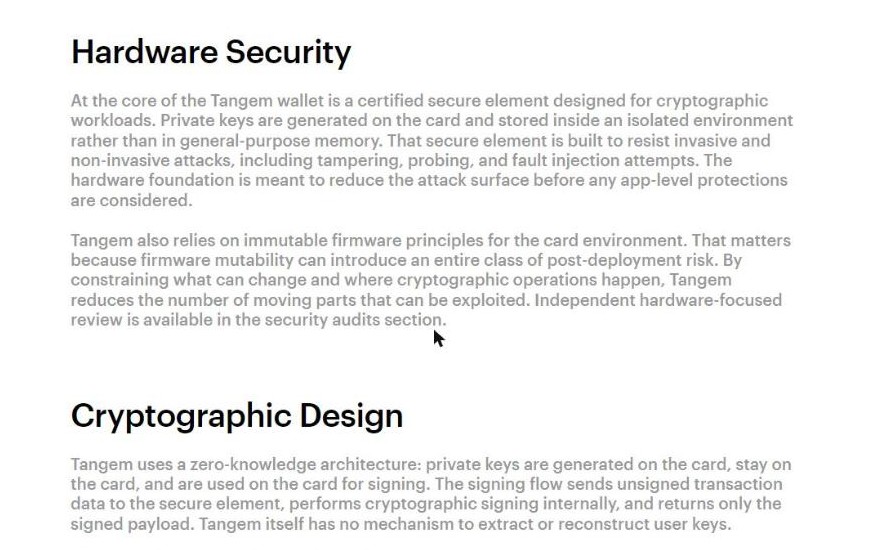
The security page states the card environment relies on immutable firmware principles (screenshot from tangem.com)
This is the most consequential sentence written about the Tangem wallet anywhere on the company site, and it deserves quoting rather than paraphrasing:
“Tangem also relies on immutable firmware principles for the card environment. That matters because firmware mutability can introduce an entire class of post-deployment risk.”
For a Tangem wallet the upside is real and easy to state. A card that cannot accept a firmware update cannot be tricked into accepting a malicious one. There is no update prompt to spoof, no downgrade attack, no window between a vulnerability disclosure and a user getting round to patching. The attack surface that most hardware wallets manage with signed updates and reproducible builds simply does not exist here.
The cost is equally plain: if a flaw is found in the card environment after shipping, it cannot be patched in the field. A fix means a new Tangem wallet card. Tangem is not hiding this – the company frames constrained changeability as the point of the design – but a buyer should understand that the security of a Tangem wallet is fixed at manufacture rather than maintained over time. Whether that is the better trade depends on how much you trust an audit versus how much you trust a patch pipeline.
Reading the audit dates properly
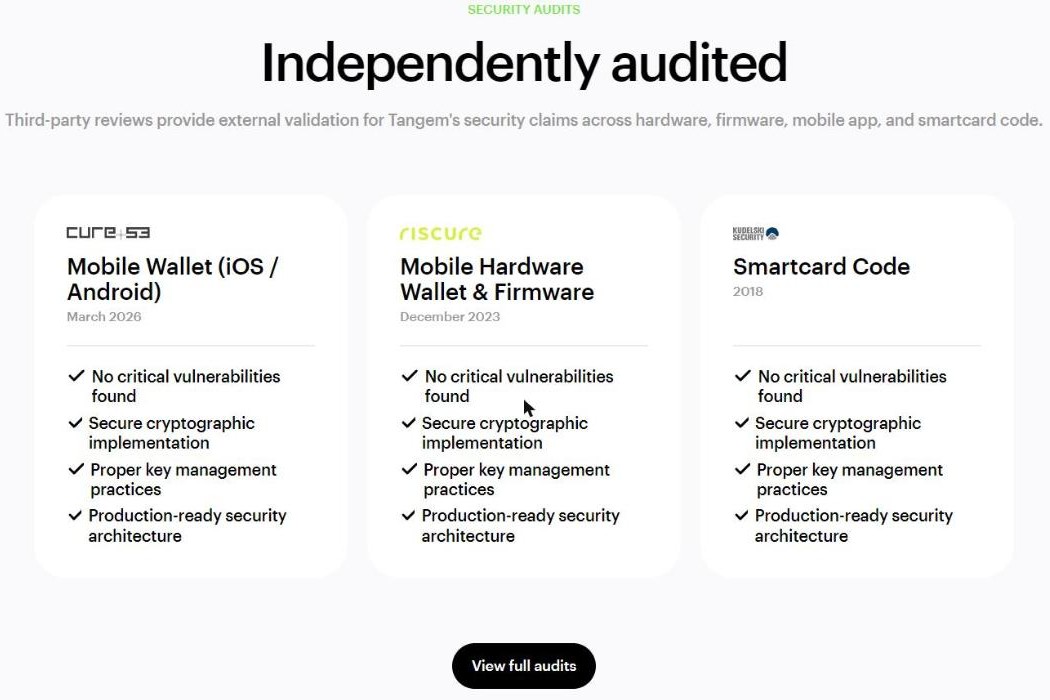
Three audits, three different dates, by Cure53, Riscure and Kudelski Security (screenshot from tangem.com)
Tangem publishes three independent Tangem wallet audits and names the firms. The dates are not the same, and under the immutable-firmware design that is worth thinking through rather than skipping:
| Scope | Auditor | Date | Headline result |
|---|---|---|---|
| Mobile Wallet (iOS / Android) | Cure53 | March 2026 | No critical vulnerabilities found |
| Mobile Hardware Wallet & Firmware | Riscure | December 2023 | No critical vulnerabilities found |
| Smartcard Code | Kudelski Security | 2018 | No critical vulnerabilities found |
The obvious reading is that the Tangem wallet card-side reviews are older than the app-side one. The fairer reading is that this is what immutable firmware looks like on an audit page: the app changes constantly and is reviewed constantly, while the card code is frozen, so a review of it does not go stale in the way a review of mutable software would. An audit of a 2018 artefact still describes the 2018 artefact if the artefact never changed.
Both readings are defensible and the site gives you the dates to judge for yourself, which is more than many vendors do. Tangem also publishes a changelog and cites a specific example – a log isolation enhancement documented on 31 December 2025 – as evidence of ongoing maintenance on the parts that can change.
Tangem wallet prices, and the ten-dollar question
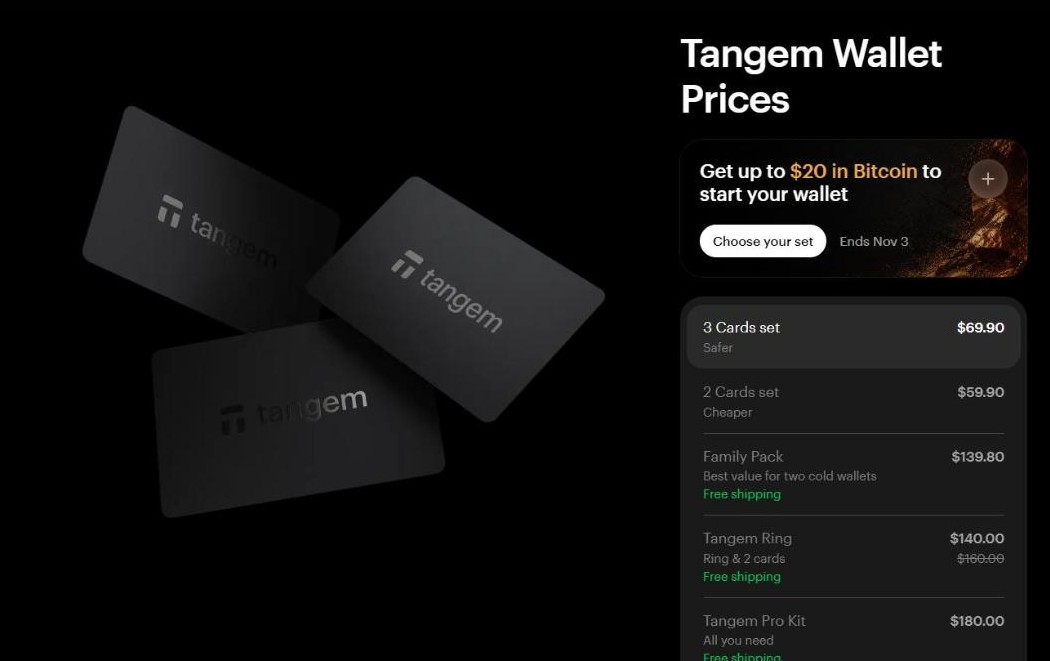
The Tangem pricing panel: two cards at USD 59.90, three at USD 69.90, and the packs above them (screenshot from tangem.com)
| Pack | Price | What is in it |
|---|---|---|
| 2 Cards set | USD 59.90 | Two cards – Tangem labels it “Cheaper” |
| 3 Cards set | USD 69.90 | Three cards – Tangem labels it “Safer” |
| Family Pack | USD 139.80 | Two cold wallets, free shipping |
| Tangem Ring | USD 140.00 (from 160.00) | Ring and 2 cards, free shipping |
| Tangem Pro Kit | USD 180.00 | Everything in one box, free shipping |
The third Tangem wallet card costs exactly USD 10.00. That is 16.7% more money for 50% more backup copies, which already looks like a reasonable trade. But the pricing FAQ and the homepage FAQ describe what that tenner buys in very different language, and the difference is the single most useful thing on either page.
The pricing FAQ puts it gently:
“A 3-card set gives you an extra backup: if one card is lost, the other two keep your access.”
The homepage FAQ puts it as a failure mode:
“However, with only two cards, losing one and forgetting your access code would leave you unable to reset or recover your wallet.”
Those two Tangem wallet pages describe the same situation with very different weight. On the two-card set, one lost card plus one forgotten access code is terminal – not inconvenient, terminal. On the three-card set the same pair of mistakes is survivable. USD 10.00 is the price of making a single compound mistake recoverable, and framed that way the cheaper set stops looking like the sensible economy. Both sets sit side by side on the Tangem pricing panel.
The free-shipping line explains the whole price list
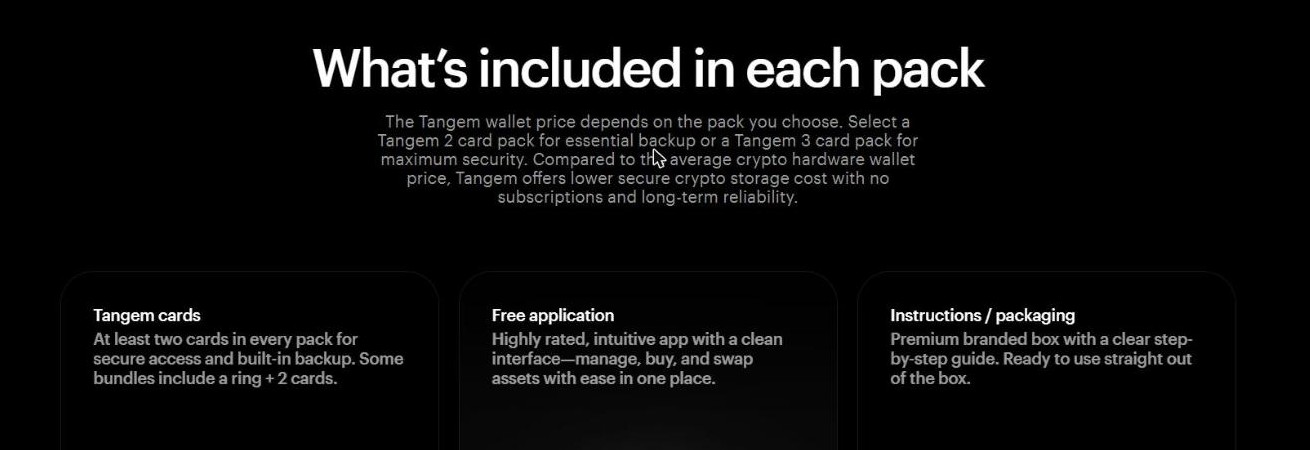
Every pack contains at least two cards, and Tangem puts its device counter beside them (screenshot from tangem.com)
The pricing panel shows “Free shipping” on the Family Pack, the Ring and the Pro Kit but not on the two single sets, which looks arbitrary until you read the shipping FAQ: standard shipping is free on orders above USD 89 or EUR 89, excluding VAT.
Every Tangem wallet pack lines up against that threshold. The 3 Cards set at USD 69.90 is USD 19.10 short of it. The 2 Cards set at USD 59.90 is USD 29.10 short. The Family Pack at USD 139.80, the Ring at USD 140.00 and the Pro Kit at USD 180.00 all clear it comfortably. Nothing is being withheld from the cheaper buyers – they are simply under the line.
Two more things from the same FAQ. The Family Pack at USD 139.80 is precisely two 3-card sets at list price (2 x 69.90), so the “best value for two cold wallets” is the free shipping and the single box rather than a discount on the cards. And prices exclude taxes and duties, so local VAT or customs may be charged on delivery depending on the destination.
On running costs, Tangem is unambiguous: you pay once, the app is free, there is no subscription or maintenance fee, and the only ongoing costs are blockchain network fees that go to the network rather than to Tangem.
What a Tangem wallet holds: 90 blockchains and 14,100 tokens
Tangem wallet asset support is handled by the free app rather than by firmware on the card, which is how a frozen card environment can still gain coverage over time. Tangem publishes the headline numbers on its homepage:
| Measure | Figure Tangem publishes |
|---|---|
| Blockchains supported | 90+ |
| Tokens supported | 14,100+ |
| Cards in every pack | At least two |
| Subscription or maintenance fees | None – one-off purchase |
| Ongoing costs | Blockchain network fees only, paid to the network |
The practical reading is that the card signs and the app understands. A new network added to the app does not require anything to change on a Tangem wallet you already own, because the card’s job – generate a key, keep it, sign with it – is the same whichever chain the transaction belongs to.
Built to outlive the phone it pairs with
With no screen, no battery and no moving parts, a Tangem wallet is unusual enough that, the durability claims are about the card body and the chip rather than about components that wear out. Tangem publishes these:
- 25-year limited hardware warranty, with the company stating the card can last at least that long with proper care
- IP69K – described as fully waterproof and pressure-resistant
- Resistant to X-rays, electromagnetic pulses and electrostatic discharge
- Operating range -25 C to 50 C
- A unitary design the company sums up as “just a chip with an antenna – no fragile components prone to failure”
The asterisk beside that list points at ISO 7816-1, the smartcard standard family that specifies the physical characteristics of chip cards. The current published standard for identification-card physical characteristics is ISO/IEC 7810, which sets out the materials, construction and dimensions a card of this format has to meet – the reason a Tangem wallet fits a wallet slot in the first place, and the reason the durability figures can be stated against something external rather than invented in-house.
One consequence of the Tangem wallet format is worth saying out loud: a card is easy to store in three different places and easy to mistake for a loyalty card. Treat the second half of that sentence as the risk it is.
What the card cannot do, and where the app takes over
A screenless Tangem wallet has one structural limitation and it is honest to name it. You confirm what you are signing on the phone screen, because the card has no display of its own. Tangem’s answer is that the signing itself happens inside the secure element, so a compromised phone narrows rather than eliminates the exposure – the company’s wording is that it “narrows the consequences of a compromised phone because the most sensitive operation – signature creation – still happens inside the secure environment”.
That is a reasonable architectural argument and it is not the same as having an independent display to verify an address on. If that specific protection is your priority, it is a real reason to look at a wallet with a screen.
The app paired with a Tangem wallet adds buying, swapping, a Yield Mode for earning, and payment features. Those are services inside the app rather than functions of the card, and several involve third-party providers; the card’s job in all of them is the same – hold the key and sign.
Tangem also places an “Ask AI whether Tangem is a good fit” prompt on its own homepage. Worth noting as a feature of the page; this review did not use it, and nothing here comes from it.
The company behind the Tangem wallet
These are figures Tangem publishes about itself and about Tangem wallet sales, and they should be read as the company’s own claims rather than independent measurements. Tangem AG was founded in 2017 in Zug, Switzerland, where it still has its home office, and says it employs 250+ people representing 43 countries. Its structured product data describes it as a Swiss hardware crypto wallet manufacturer backed by Samsung Semiconductors and SBI Holdings.
The product timeline runs from Tangem Note in 2018 – a single-asset NFC card – to the multi-currency Tangem Wallet with its three-card backup system. The pricing page shows counters of 7M+ app downloads and 6,000,000+ devices sold, and the site’s structured data carries an aggregate rating of 4.8 out of 5 from 14,974 reviews, with app store ratings of 4.9 on iOS and 4.8 on Google Play shown separately.
One answer in the homepage FAQ matters more than any of those numbers for a self-custody product, so it is worth quoting: asked whether the card still works if Tangem ceases to exist, the company says the wallet is fully autonomous, with no Tangem servers involved in transactions – “just your card/ring, smartphone, and the blockchain”. That is the right design property to insist on, and it is checkable in the sense that an autonomous design has no server to go dark.
What self-custody means for your money
A Tangem wallet is not a regulated financial product. There is no deposit protection, no regulator, no chargeback and no support desk that can restore funds. The protections are the ones you set up yourself.
With a Tangem wallet the shape of that responsibility is specific. An access code protects the cards against someone who picks them up – Tangem says this is what stops a third party using a stolen card, and that it also guards against brute force. But the cards together are the Tangem wallet. Lose every card and you lose the funds, with no words to fall back on unless you deliberately generated a seed phrase. That is the direct consequence of the seedless design, and it is why the three-card set and the habit of storing the cards in separate places are not optional extras.
This article is not investment advice and does not recommend holding any particular asset. It describes a device and the terms attached to buying one.
Who the Tangem wallet fits
It fits someone who wants cold storage they will actually use: no cable, no charging, no desktop software, an activation measured in minutes, and a backup method that does not involve guarding a piece of paper for a decade. The three-card set is the one to start from. A Tangem wallet also fits people who travel, because three cards distribute far more easily than three devices. It fits anyone who has quietly concluded that their real risk is losing a seed phrase rather than being targeted by a sophisticated attacker.
It fits less well if you want an independent screen to verify addresses on, if you want firmware you can update as the threat landscape moves, if you want the option to restore your wallet into another vendor’s hardware from words alone, or if you want a phone-free setup path. Those are genuine architectural differences, not oversights, and they point at a different kind of device.
How this review was done
This Tangem wallet review is a desk review. Nobody on this site bought, tapped or set up a Tangem wallet, and no claim here describes hands-on use. Everything above was read from tangem.com on 3 November 2026: the homepage and its FAQ, the security page with its audit and changelog sections, the pricing page with its pack list and FAQ, and the company page.
Tangem wallet prices are the US dollar figures shown on the pricing page, read with a non-EU delivery country selected, and the derived numbers – the USD 10.00 gap between sets, the USD 19.10 shortfall against the free-shipping threshold, the Family Pack arithmetic – were calculated from those published prices and are shown with their workings. Company statistics, ratings and security claims are attributed to Tangem throughout because that is what they are. Where two Tangem pages describe the same thing differently, both wordings are quoted rather than reconciled. Customer reviews naming individuals, and the marketing imagery featuring people, were deliberately not used.
The short version
The Tangem wallet is a USD 59.90 to USD 69.90 NFC card with an EAL6+ secure element, keys generated and kept on the chip, more than 90 blockchains supported through a free app, a 25-year warranty and an IP69K body. The Tangem wallet removes the screen and the seed phrase and replaces them with the phone and with spare cards.
The honest Tangem wallet limits are the ones that follow from that design: you verify on a phone screen, firmware can never be updated, and losing every card with no seed phrase generated means losing the funds. The audits are dated 2018, 2023 and 2026 and the site shows you which is which.
Overall: 4.3 / 5. Points come off for the phone-dependent confirmation step and the no-patches-ever consequence of immutable firmware, not for anything missing from the specification. Buy the three-card set – the extra USD 10.00 is the cheapest insurance in this review. Current packs and prices are on the official Tangem pricing page.


