








Reviews
GMGN BSC is the BNB Chain side of GMGN.AI, a browser-based meme trading terminal that also runs on Solana, Ethereum, Base and a long list of newer networks. Open the terminal with the chain switch set to BSC and you get a live feed of BNB Chain launches, a one-click buy panel priced in BNB, and a row of contract-safety flags printed next to every token before you commit a single wei. This review walks through the fee stack, the anti-MEV settings, the safety checks and the limits, using nothing but the public documentation and the public interface.
The short answer first: GMGN BSC is built for speed, and almost every design decision follows from that. The platform fee is flat, the network fees are pass-through, the safety checks are inline rather than buried in a sub-menu, and the whole pipeline from a token appearing to a filled order is measured in seconds. That makes GMGN BSC a strong fit for traders who already understand on-chain risk, and a demanding environment for anyone who does not.
What GMGN BSC actually is
GMGN is not a broker, an exchange or a custodian in the traditional sense. It is a front end over BNB Chain decentralised exchanges and launchpads, with a data layer bolted on top. The interface aggregates new pairs, bonding-curve progress, holder distribution and contract flags, then routes your order to the chain through its own nodes.
Three things set the platform apart from a plain DEX interface. First, discovery and execution sit on the same screen, so you never copy a contract address into a second tab. Second, it prints contract-risk data inline, at the moment you are deciding. Third, the terminal is multi-chain by default: the same account, the same layout and the same muscle memory carry over from Solana to GMGN BSC and back.
Inside the GMGN BSC Trenches pipeline
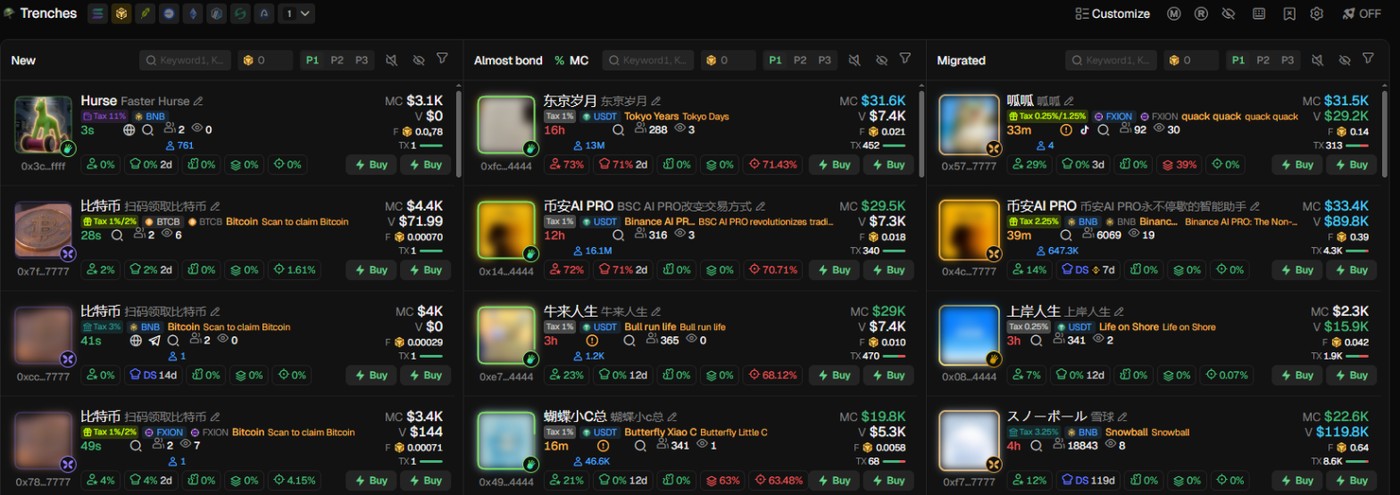
The default GMGN BSC screen is called Trenches, and it is laid out as three columns that match the life cycle of a BNB Chain meme launch. The left column, New, lists tokens that have just been created. The middle column, Almost bond, holds tokens whose bonding curve is close to completion. The right column, Migrated, carries tokens that have graduated to a live DEX pool.
Reading the three GMGN BSC columns left to right is effectively reading risk from highest to lowest. A token in New has almost no trading history; a token in Migrated has a real pool, a longer holder list and a visible chart. Each row carries the same compact badge set: market cap, volume, holder count, transaction count, the age of the contract and the buy and sell tax.
Above each column sit three preset slots labelled P1, P2 and P3. These hold saved order sizes and settings, so a user can fire a pre-configured buy from the feed without opening the token page at all. It is the single biggest time saver in the interface, and also the setting most worth double-checking before a fast session.
The GMGN BSC fee stack, line by line
GMGN publishes its fee model in the documentation, and it is refreshingly short. The platform takes a flat 1% handling fee per transaction and states that there are no additional charges on top of it. The worked example on that page is denominated in SOL, so GMGN BSC traders should confirm the number in the trade panel before a first order, but the stated model is chain-agnostic.
Everything else you pay is network cost, not platform revenue. GMGN is explicit that priority fees and tip fees are passed to validators and private nodes rather than collected by the platform. The practical fee stack for a GMGN BSC trade therefore looks like this:
| Component | Who receives it | What GMGN documents |
| Platform fee | GMGN | 1% per transaction, stated as the only platform charge |
| Gas | Network validators | Standard on-chain cost; BNB on GMGN BSC, gwei-denominated on EVM chains |
| Priority fee | Validators | Minimum 0.0001 SOL on Solana; not collected by GMGN |
| Tip fee | Private nodes | Minimum 0.0001 SOL on Solana; not collected by GMGN |
| Launchpad fee | Token issuance platform | Charged separately by the launchpad, for example 1% on Pump.fun |
Two numbers are worth memorising before a GMGN BSC session. The documented ceiling on combined priority and tip fees is 2 SOL, which exists to stop a fat-finger entry from costing more than the trade itself. And the documented comfort zone for an unhurried trade is a total on-chain fee of 0.002 to 0.005 SOL, rising to 0.006 SOL or more for automated limit orders. Those figures are Solana-denominated in the docs, but the logic transfers directly to GMGN BSC: pay for speed only when speed is what you are buying.
Anti-MEV routing and the priority settings behind every GMGN BSC trade
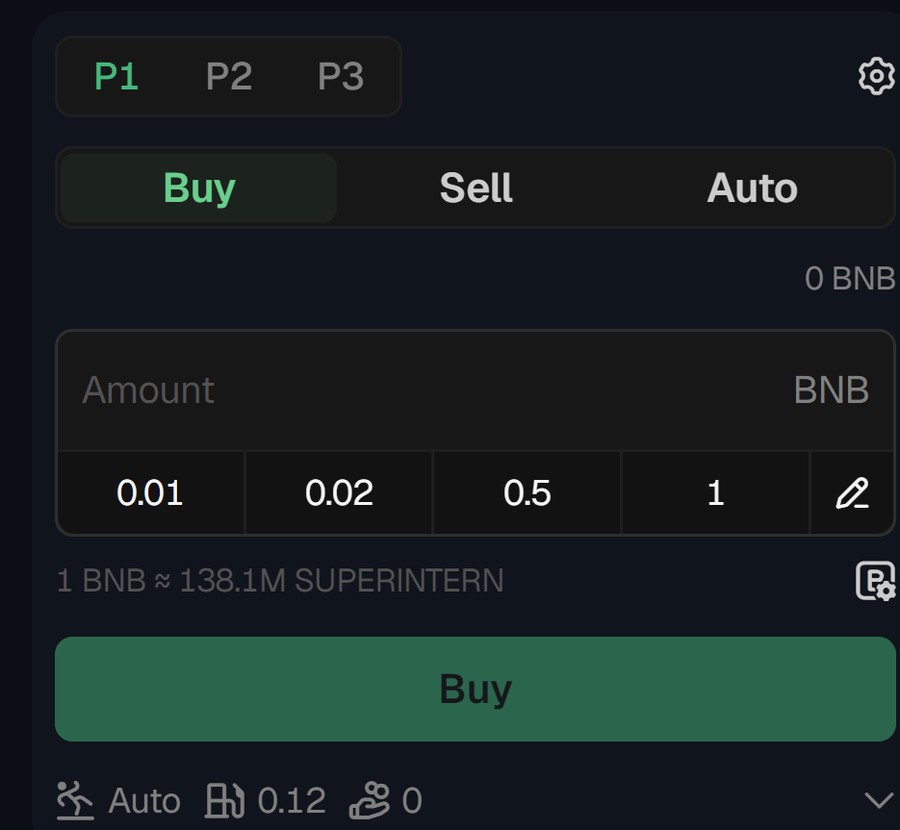
Sandwich attacks are the tax nobody budgets for, and GMGN treats them as a first-class setting rather than an advanced option. The terminal offers three submission modes. Off protection broadcasts to all nodes and is the fastest. Reduced protection broadcasts to a limited set of nodes, is still fast, and may still be front-run. Secure protection routes through safe nodes, is slightly slower, and the documentation describes it as carrying compensation.
That three-step ladder is unusually honest for this category, because it names the trade-off instead of promising protection for free. A GMGN BSC trader chasing a migration can take Off protection and accept the risk; the same trader scaling into a migrated pool can take Secure protection and accept the latency.
Here is a detail worth flagging, because it is the kind of thing that costs a failed transaction. GMGN gives two different minimum fees for anti-MEV on the same documentation page. The section describing anti-MEV mode states that the priority fee must be at least 0.002 SOL to enable it. The section describing anti-MEV RPC submission states that the minimum tip fee for anti-MEV protection is 0.0001 SOL. Both statements are published; this review does not try to resolve which one governs. GMGN BSC users who rely on anti-MEV should confirm the live minimum in the trade panel rather than from memory.
Slippage is the other setting the terminal asks you to own. The documentation recommends 30% to 35% for automatic buys, sells and pending orders, and 50% or more for new and popular tokens. It also warns that automatic slippage can lag and cannot guarantee a 100% fill rate, which is a franker statement than most terminals put in writing.
How GMGN BSC surfaces token tax, honeypots and rug history

This is where GMGN BSC visibly differs from the Solana side of the same product, and it is the most useful finding in this review. On BNB Chain, every row in the feed and every token header carries a Total Tax field, written as a buy and sell pair. Scroll the Trenches feed for thirty seconds and you will see values ranging from 0.25% to 11%, printed next to the token name before you click anything.
That field exists because EVM tokens can levy a transfer tax and Solana tokens cannot. GMGN documents two different security panels to match. The Solana panel reports MintDisable, Top 10 holder concentration, Blacklist status, the burnt share of the liquidity pool, a rug probability score and a rug history for the creator. The EVM panel, which is what the BNB Chain side uses, reports honeypot status, whether the contract is verified, whether ownership is renounced, whether liquidity is locked or burned, and the buy and sell tax.
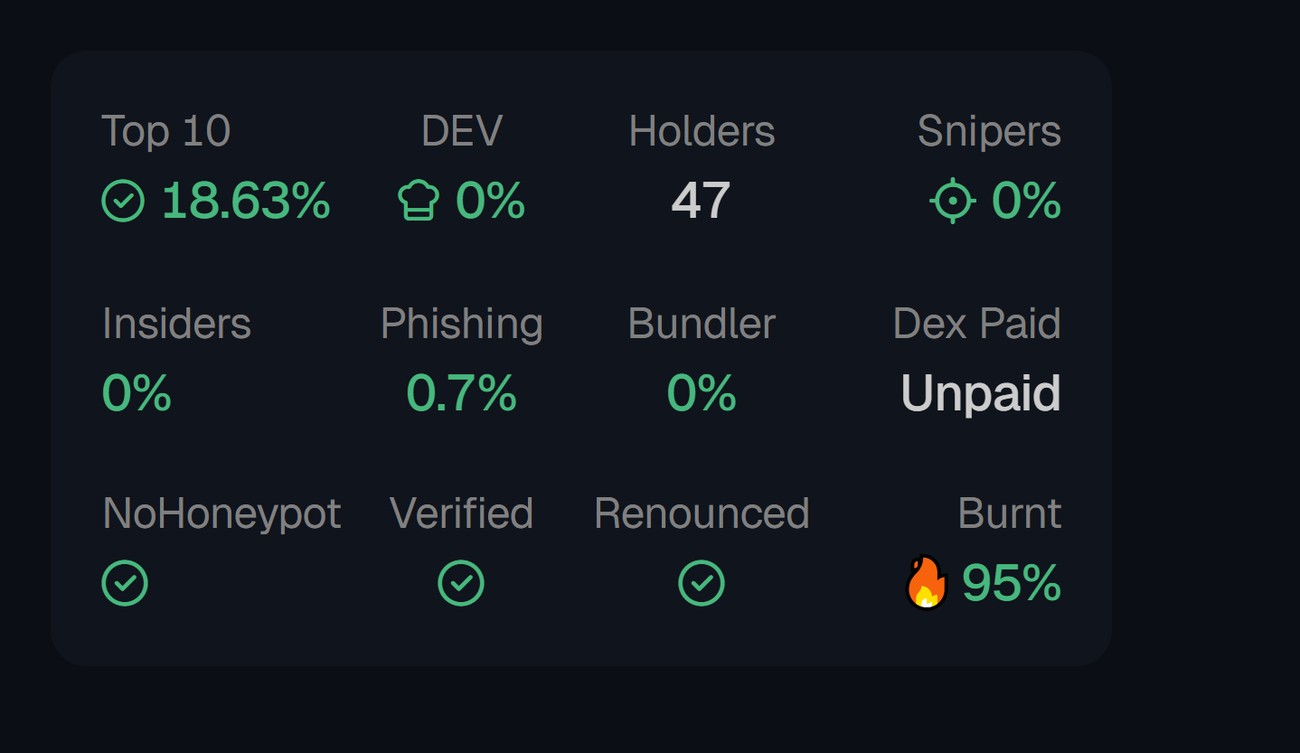
On a live GMGN BSC token page the panel reads as a grid of twelve flags: Top 10, DEV, Holders, Snipers, Insiders, Phishing, Bundler, Dex Paid, NoHoneypot, Verified, Renounced and Burnt. A green tick on NoHoneypot, Verified and Renounced with a high burnt percentage is the pattern a cautious GMGN BSC trader is looking for; the sell tax reading in the header is the pattern that most often explains a position that will not close.
GMGN is clear about the limits of all of this. The honeypot flag is sourced from third-party providers such as GoPlus, and the company states the display can lag. The documentation attaches a blunt disclaimer to the whole feature set: “Token security checks are for reference only and cannot guarantee 100% accuracy.” Treat the GMGN BSC panel as a fast first filter, not as an audit.
Copy trading, sniping and alerts
Around the core trading screen sits a layer of automation. Copy trade follows selected wallets and mirrors their entries. Wallet Radar scans several tokens at once for shared holders and consistently profitable addresses. X Tracker and SnipeX watch social activity and contract mentions, with SnipeX built to auto-buy on a new contract posted to a monitored account.
The order-management side is equally deep: auto buy and limit buy, auto sell with take-profit and stop-loss, migrated snipe and migrated sell that fire when a token graduates to a DEX, a dev-sell trigger that exits when the creator dumps, and trailing take-profit and trailing stop-loss for positions you want to let run. The GMGN BSC terminal is free to open and explore before any of this is switched on, which is the sensible way to learn the controls.
One honest limitation: GMGN documents that the multi-wallet system is available on the Solana chain, and the chain switch tells logged-out visitors that selecting multiple chains at once requires an account. Feature parity across chains is not complete, and GMGN BSC users coming from the Solana side should expect a few of these gaps.
Chains, bots and apps: how far GMGN BSC reaches
The web terminal is the widest surface. Its chain switch currently lists SOL, BSC, Robinhood, Base, ETH, Arbitrum, Stable, Arc, X Layer, HyperEVM, MegaETH, Monad and Tron. The Telegram side is narrower: the published bot list covers Solana, Ethereum, Base, BNB Chain and Tron only, with two dedicated BSC bots. So the web interface reaches thirteen networks while the bot layer reaches five, and a GMGN BSC trader who works from Telegram is choosing a smaller map than one who works from the browser.
Beyond the browser and Telegram there are iOS and Android apps, a price-chart integration for partner sites, a trading API covering Solana separately from ETH, Base and BSC, and a referral programme that pays rebates on invited volume. Opening a GMGN BSC account takes one connection step and the same login carries across every chain in the switch.
Company information and licensing
Here is the part a financial review has to state plainly rather than dress up. GMGN does not publish a licensed entity, a regulator, a registration number or a corporate address anywhere in its public documentation or interface, and this review found no terms-of-service or privacy page at the usual paths on the domain, checked on 20 October 2026. The binding language that does exist sits inside the documentation as disclaimers.
That is normal for a non-custodial on-chain terminal and abnormal for anything resembling a broker, and the distinction matters. A licensed broker holds your money and answers to a supervisor. GMGN BSC routes your transaction and never takes custody of it: the company states that it performs no operations on a user wallet and has no ability to move a user balance. That claim is GMGN describing its own architecture, not an audited finding, and it should be read as such.
What GMGN does publish is a security programme with real numbers. Its vulnerability bounty, hosted on HackenProof and covering the websites, the Android app and the iOS app, pays up to 1,000,000 USDT for an extreme-severity finding that threatens core assets or wallet keys. Below that the tiers run 3,000 to 10,000 USDT for critical, 1,000 to 3,000 for high, 300 to 1,000 for medium and 50 to 300 for low. Reports are reviewed in roughly one to two weeks and rewards are issued within two weeks of approval. A published bounty with named tiers is not a licence, but it is a verifiable commitment, and it is more than most alternatives in this category put on paper.
For readers who want the regulatory frame rather than the company frame, IOSCO published a thematic review in October 2025 assessing how its crypto and digital-asset market recommendations are being implemented, which is the clearest public picture of where on-chain trading sits with securities regulators worldwide.
Who GMGN BSC fits
GMGN BSC fits a specific trader well. If you already trade BNB Chain launches, if you read a contract-flag grid faster than you read a whitepaper, and if the difference between a two-second and a six-second fill matters to your results, this is a terminal built for exactly that. The preset slots, the inline tax field and the three-tier anti-MEV ladder all pay off at speed.
It also fits the multi-chain trader. If your attention moves between Solana launches and BNB Chain launches, running both from one GMGN BSC layout removes a whole class of copy-paste mistakes. Try the GMGN BSC interface on a small position first and keep the preset sizes conservative until the settings are familiar.
If you want custody, a regulated counterparty, a support desk that can reverse a mistake or an instrument with a defined downside, a non-custodial meme terminal is the wrong tool, and that is a statement about the category rather than about GMGN BSC in particular.
How this review was done
This is a desk review. Everything above comes from GMGN public documentation and from the public GMGN BSC interface viewed in a browser on 20 October 2026 with the chain switch set to BSC and no account connected. No deposit was made, no order was placed and no performance claim is made or implied. Figures quoted from the documentation are reproduced as published, including the two conflicting anti-MEV minimums, which are reported side by side rather than reconciled. Screenshots are unedited apart from blurring token avatars and masking social handles for privacy. Fee and feature details on a product like this change without notice, so confirm anything that matters at the live GMGN BSC terminal before you trade.
The short version
GMGN BSC is a fast, transparent and unusually well-documented meme trading terminal for BNB Chain. The fee model is a flat 1% with pass-through network costs and a documented 2 SOL ceiling on speed fees. The anti-MEV ladder names its trade-offs instead of hiding them. The EVM security panel puts honeypot, renounce, liquidity and tax data in front of you at the point of decision, with the company itself stating the checks are reference-only. The bug bounty reaches 1,000,000 USDT and is publicly tiered.
The gaps are equally clear: no licensed entity, no published terms page, no geographic restriction list, incomplete feature parity across chains, and one unresolved contradiction in the anti-MEV minimums. For an experienced on-chain trader those are known costs of the category. For everyone else they are the reason to start small.
Overall: 4.7 / 5


