








Native futures options gamma levels, 60+ quant models, QUIN AI and ten charting integrations. A full look at what a MenthorQ subscription includes in 2026 and what it costs.
Reviews
The gap between a professional trading desk and a retail screen has never really been about execution speed. It has been about data. A MenthorQ subscription is an attempt to close that gap: it takes the quantitative models desks run on options positioning, dealer gamma and volatility, and puts them in one dashboard built for individual traders.
This review walks through what MenthorQ actually contains in 2026 — the native futures options gamma levels that are its signature feature, the model library behind them, the QUIN AI layer, the ten charting integrations and what each plan costs. Every figure below comes from pages MenthorQ publishes itself, and you can check the current line-up on the official MenthorQ website while you read.
Native futures options gamma levels: what MenthorQ does differently
Most gamma dashboards available to retail traders calculate levels from equity options and then map the result onto a futures contract. This platform does not. It calculates gamma levels directly from the futures options chains themselves — ES, NQ, RTY, CL, GC and more — which is the single clearest reason a futures trader would pick this platform over a cheaper alternative.
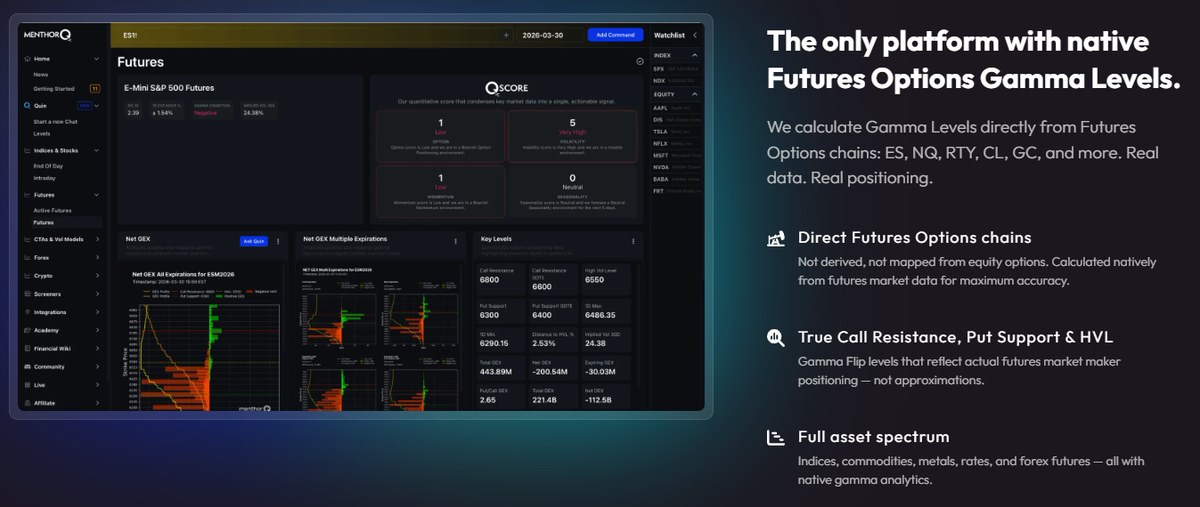
In MenthorQ own words the chains are “not derived, not mapped from equity options”, and the Call Resistance, Put Support and HVL readings are described as reflecting actual futures market-maker positioning rather than approximations. The key levels panel puts the numbers that matter — call resistance, put support, 0DTE levels, high volatility level, total and net GEX — in one block beside the chart instead of leaving you to assemble them.
The coverage goes wider than the index contracts. The same native gamma analytics are applied across indices, commodities, metals, rates and forex futures, so a trader rotating between ES and crude is not switching methodology halfway through the session.
Inside the MenthorQ quant model library
MenthorQ describes every model on the platform as quantitative — “no opinions, no narrative — pure data, math, and machine learning applied to market structure”. That framing matters, because it tells you what you are buying: a measurement layer, not a signal service.
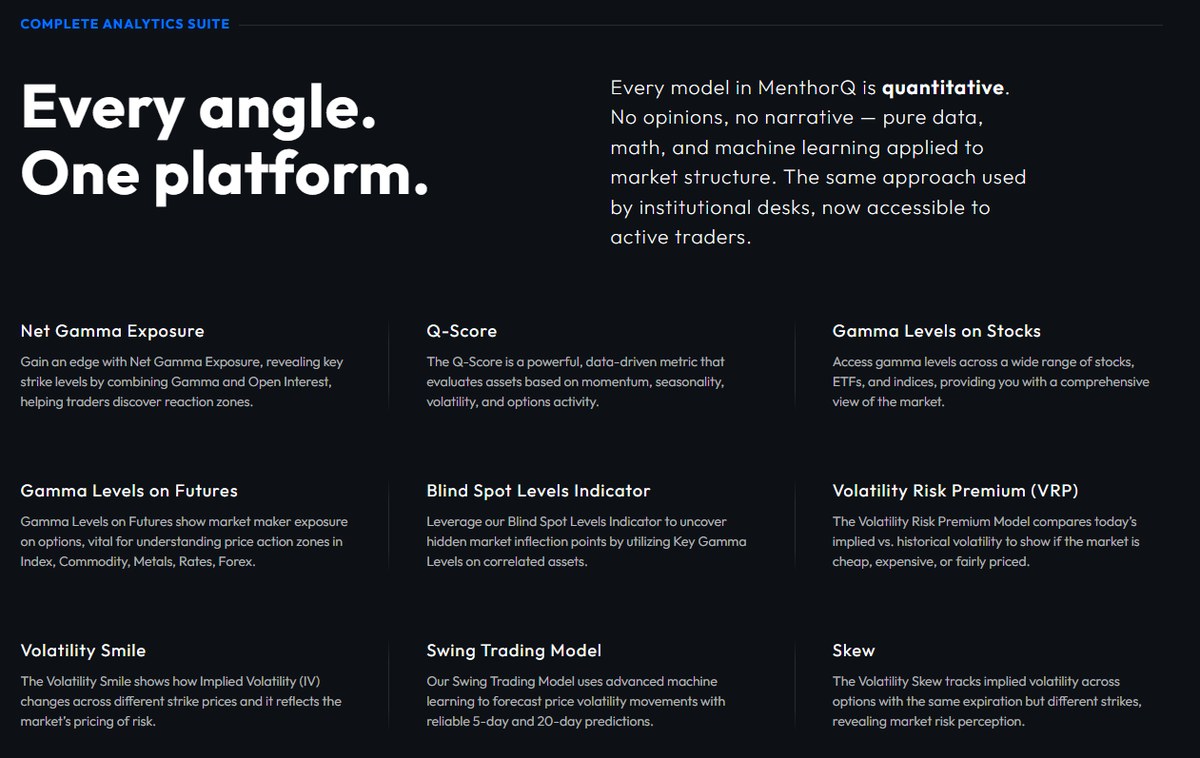
The library spans several families. On positioning there is Net Gamma Exposure, Net Delta Exposure, Volume and Open Interest, Implied Volatility per Open Interest and the 0DTE levels. On volatility there is the Volatility Risk Premium, the Volatility Smile, Skew, Term Structure and a 3D volatility surface. On direction there is the Q-Score, the Momentum models, the Options Screeners and a Swing Trading Model that the company says uses machine learning to forecast volatility movement on 5-day and 20-day horizons.
Two models are worth singling out. The Q-Score condenses momentum, seasonality, volatility and options activity into a single score, which is the fastest way to triage a watchlist. The Blind Spot Levels Indicator works the other way round, using key gamma levels on correlated assets to surface inflection points that would not show up on the instrument you are actually watching.
There is also a flow-aware group that most retail platforms leave out entirely: a Volatility Control Fund model, CTA models that track where systematic funds add or remove liquidity, Long/Short volatility positioning, and the Option Matrix, a per-ticker summary of 0DTE options with gamma and delta exposure and the key levels in one table. Crypto and forex get their own gamma and quant model sets rather than being bolted onto the equity logic.
QUIN AI: asking MenthorQ questions in plain English
QUIN is the layer that makes the rest of the library usable at speed. The company is explicit that it “is not a chatbot” but cognitive infrastructure for traders: it turns a sentence into a structured screen across any MenthorQ metric and returns a ranked set of candidates.
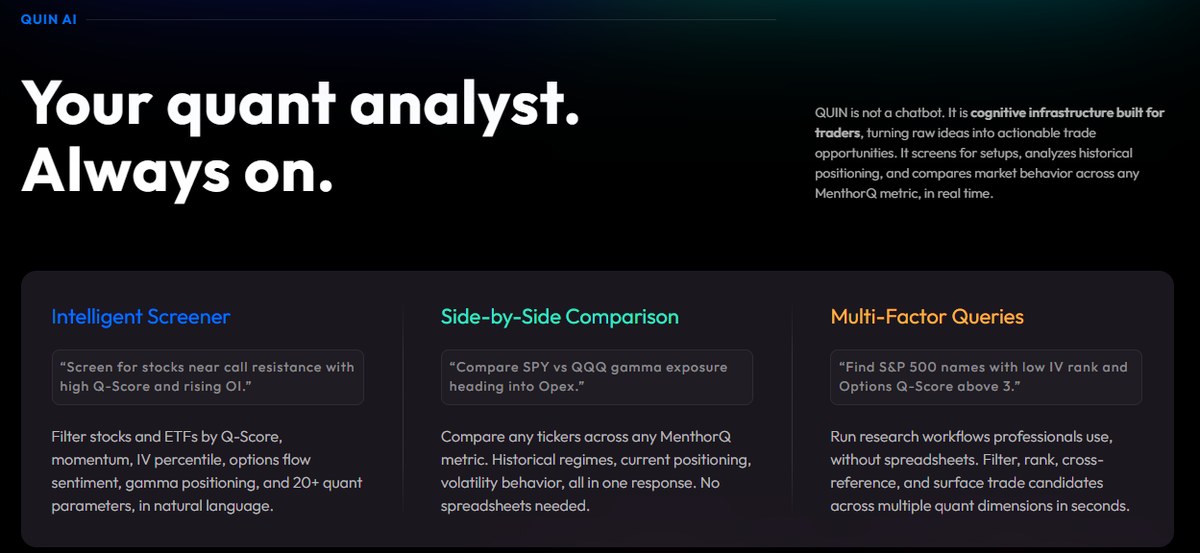
Three things it is built to do:
- Intelligent screening — filter stocks and ETFs by Q-Score, momentum, IV percentile, options flow sentiment, gamma positioning and 20+ quant parameters, asked for in natural language.
- Side-by-side comparison — compare any tickers across any MenthorQ metric, covering historical regimes, current positioning and volatility behaviour in one response.
- Multi-factor queries — run the kind of research workflow that normally lives in a spreadsheet, filtering, ranking and cross-referencing in seconds.
The example queries the company publishes give a fair sense of the resolution: “Screen for stocks near call resistance with high Q-Score and rising OI”, or “Show me the top 25 stocks with IV Rank above 70%, positive GEX, and market cap over $20B”. For a discretionary trader, that is the difference between owning a data platform and actually using one.
Asset coverage and the ten MenthorQ integrations
The platform covers futures, stocks, ETFs, indices, crypto, forex, fixed income and commodities. The number on the homepage is 1,000+ assets, which in practice means most of what an active multi-asset trader touches in a week is already modelled.
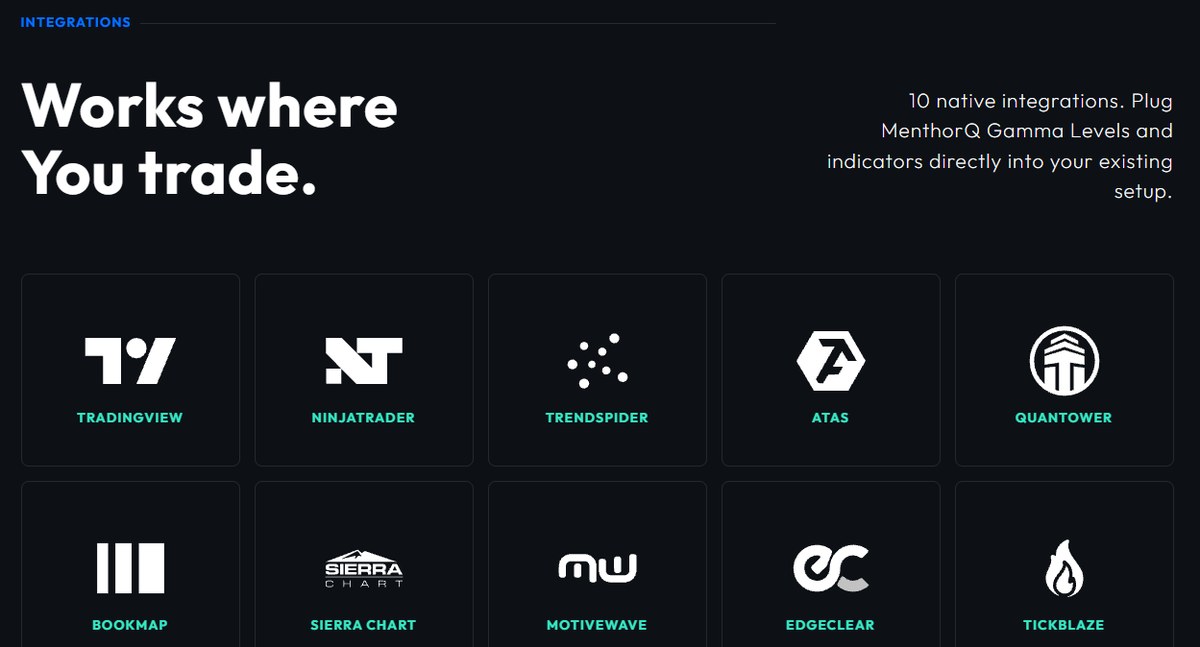
The integrations matter more than the asset count. MenthorQ lists ten native connections — TradingView, NinjaTrader, TrendSpider, ATAS, Quantower, Bookmap, Sierra Chart, MotiveWave, EdgeClear and Tickblaze — and the gamma levels and indicators plot inside the platform you already trade on. There is no separate window to watch and no manual transcription of levels before the open.
One practical note worth knowing before you subscribe: MenthorQ states that the integration indicators are available with the Premium and Pro memberships, so the charting side of the product is not part of the free tier.
MenthorQ pricing: the free tier, Premium and Pro
MenthorQ opens with a genuinely usable free account. No credit card is required, and what you get on day one is QUIN AI, a dashboard preview of the models on delayed data, the Finance Wiki guide library, the Academy lessons and daily insights. The delayed-data framing is stated openly on the sign-up page, which is the right way to describe a free tier.
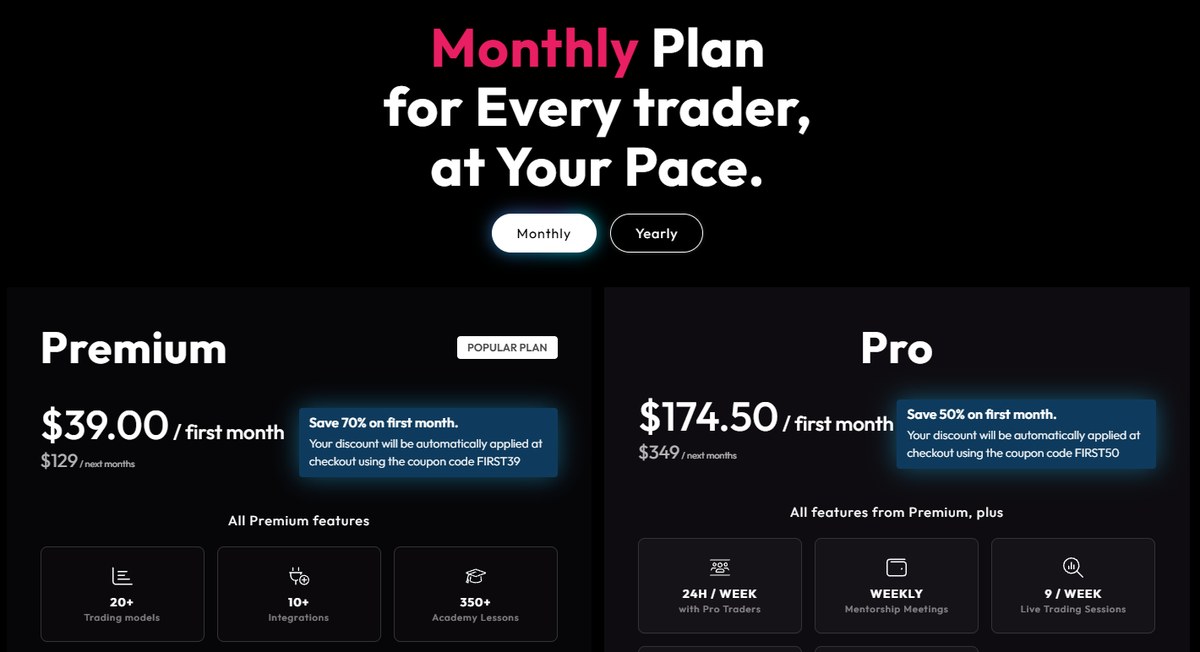
The paid plans on the monthly view are straightforward:
- Premium — $129 per month, with a first month at $39.00 using the coupon code FIRST39 that MenthorQ says is applied automatically at checkout. It carries all Premium features, the trading models, the integrations, the Academy lessons, the premium guides and the webinars.
- Pro — $349 per month, with a first month at $174.50 using the code FIRST50. It adds everything in Premium plus the live and mentored side of the service.
Checkout accepts card, Stripe and PayPal, and the pricing page states a 7-day money-back guarantee with one-click cancellation from inside the account. It is worth reading that line together with section 6 of the MenthorQ Terms of Use, which says purchases are non-refundable “unless explicitly stated in our FAQs or product-specific terms” — the 7-day guarantee on the pricing page is that explicit statement, and it is the one to keep a screenshot of.
A note on the published counts: the MenthorQ homepage advertises 64+ quant models and 500h+ of academy content, the Premium card lists 20+ trading models and 350+ academy lessons, and the free sign-up page lists 50+ models and 500+ lessons. The numbers describe different things on different pages, so treat the plan card as the figure that applies to what you are actually buying.
What the MenthorQ Pro plan adds
Pro is where MenthorQ stops being only a data product. On top of everything in Premium it includes 24 hours a week with pro traders, weekly mentorship meetings, nine live trading sessions a week, a monthly strategy session and recordings of the live sessions.
That is a meaningful amount of contact time, and it changes who the plan is for. If you already have a method and simply want better positioning data, Premium is the plan. If you are still building the method and want to watch experienced traders read gamma levels in real time before you trade them yourself, the extra $220 a month buys structured screen time rather than more data.
The MenthorQ Academy and Finance Wiki
The education side is bundled rather than sold separately, which is unusual at this price point. The Academy is a video course library covering strategy, risk, options and market structure, and the Finance Wiki is a written reference set covering methodology, the models and the trading logic behind them.
Both are reachable from the free account, and that is the sensible way to evaluate MenthorQ: read the wiki entry for a model, look at the delayed dashboard for the same model, and decide whether the way it is built matches how you trade before any money moves. A platform that puts its methodology in writing is easier to audit than one that only shows you the output.
Who MenthorQ suits
- Futures traders on ES, NQ, RTY, CL or GC. The native futures options gamma levels are the headline reason to subscribe, and nothing else in the retail tier is calculated the same way.
- Options traders who trade volatility rather than direction. VRP, skew, term structure, the volatility smile and the 3D surface are all in the same subscription.
- Discretionary traders who want a faster research loop. QUIN replaces the spreadsheet step, which is where most screening ideas quietly die.
- Traders already settled on a charting platform. With ten native integrations the levels appear where you already work.
- Newer traders willing to learn first. The free tier plus the Academy and Finance Wiki is a complete study path before any subscription starts.
If you trade long-term positions on fundamentals and never look at options positioning, this is not the tool to buy — and the free account will tell you that within an evening, at no cost. You can open the free MenthorQ account and judge it against your own instrument list.
Company information and regulatory status
MenthorQ is operated by Menthor Q LLC, a Florida limited liability company, with the address published in its footer as 701 Brickell Key Blvd, 33131, Miami, Florida. The company describes itself as a TradeTech firm building quantitative models powered by big data and artificial intelligence, with a team of data scientists, algorithmic traders and AI engineers.
The regulatory position is stated plainly in the MenthorQ Terms of Use and deserves to be read before you subscribe: “Menthor Q LLC is not registered as an investment adviser with the U.S. Securities and Exchange Commission and does not offer personalized investment advice. All content, information, and materials provided via the Website, email, social media, or related channels are intended solely for educational and informational purposes.”
That is the correct status for a product of this type — MenthorQ sells analytics and education, it does not manage money or place trades for you, and it holds no client funds. Anyone who wants to verify the registration position independently can search the adviser databases published by the U.S. Securities and Exchange Commission. The Terms also note that some services or content may not be available in every location, and the Terms list no country-by-country restrictions.
Risk warning
MenthorQ publishes this warning in the footer of every page, and it is reproduced here in full:
“Futures and forex trading contains substantial risk and is not for every investor. An investor could potentially lose all or more than the initial investment. Risk capital is money that can be lost without jeopardizing ones’ financial security or life style. Only risk capital should be used for trading and only those with sufficient risk capital should consider trading. Past performance is not necessarily indicative of future results.”
Two things follow from that. Gamma levels and quant models describe where positioning sits; they do not predict what price will do, and MenthorQ does not claim they do. And a data subscription is a cost that runs whether or not your month is profitable, so size it against your actual trading capital rather than against the hope of what it might unlock.
The verdict
MenthorQ is one of the few retail platforms where the headline feature is also the hardest thing to replicate. Calculating gamma levels natively from futures options chains rather than mapping them from equity options is a real engineering difference, and for an ES or NQ trader it is the whole argument. Around it sits a model library deep enough to cover positioning, volatility and momentum, a natural-language query layer that removes the spreadsheet step, and ten integrations that put the output on the chart you already use.
The pricing is honest about what it is. A free account with delayed data and the full education library lets you test the methodology before paying, Premium at $129 a month covers the data and the indicators, and Pro at $349 adds mentored screen time for traders who want it. The 7-day money-back guarantee and one-click cancellation remove most of the risk of trying it.
The MenthorQ Terms are equally clear that this is an educational and informational product from a firm that is not an SEC-registered investment adviser, and the platform is better for saying so. Used as a measurement layer rather than a signal feed, it is a strong addition to a serious trading setup. You can start with the free MenthorQ plan and upgrade only once the models have earned it.
Overall: 4.5 / 5
Disclaimer
This MenthorQ review is based on information published by MenthorQ on its own website in October 2026 and is provided for informational purposes only. It is not investment advice, and it is not a recommendation to trade any instrument. Prices, plan contents and model counts can change at any time — always check the MenthorQ website for the current terms before subscribing. This page contains affiliate links; if you subscribe through them we may receive a commission at no additional cost to you.


