


Zuperior Review 2026: What We Found About Its Licence

Zuperior Review 2026: What We Found About Its Licence

Min deposit:
0

Reviews

Company Name
Zuperior FX Limited
Rating
Headquarters
Gros Islet, Saint Lucia
US Traders Accepted
no
Trading Platform
MetaTrader 5, Zuperior Web Terminal
Description

Quick Verdict

Zuperior is an offshore forex and CFD broker advertising 1:2000 leverage, a $10 minimum deposit and zero commission. It holds no financial services licence anywhere. The two registration numbers in its footer are a Saint Lucia company registration and a number from something called the “Neves Licensing Authority”, which does not appear to be a national financial regulator at all. WikiFX scores it 1.87 out of 10 with a regulation score of zero; BrokersView concluded in May 2026 that it “appears to be a scam”; and Trustpilot itself displays a warning that the company “may be associated with high-risk investments.”

Rating: 1.5 / 5. We are not recommending Zuperior, and this review carries no affiliate link to it.

What Zuperior Claims to Be

Zuperior markets itself as a “next-generation trading platform” offering forex, indices, stock CFDs, commodities and crypto across more than 100 instruments. The operating entity is Zuperior FX Limited, with a registered office at Office No 24, Cap Drive, Cap Estate, Gros Islet, Saint Lucia, and a Saint Lucia phone number.

Traders can use MetaTrader 5, a proprietary Zuperior web terminal, and a TradingView integration. Two live accounts are offered.

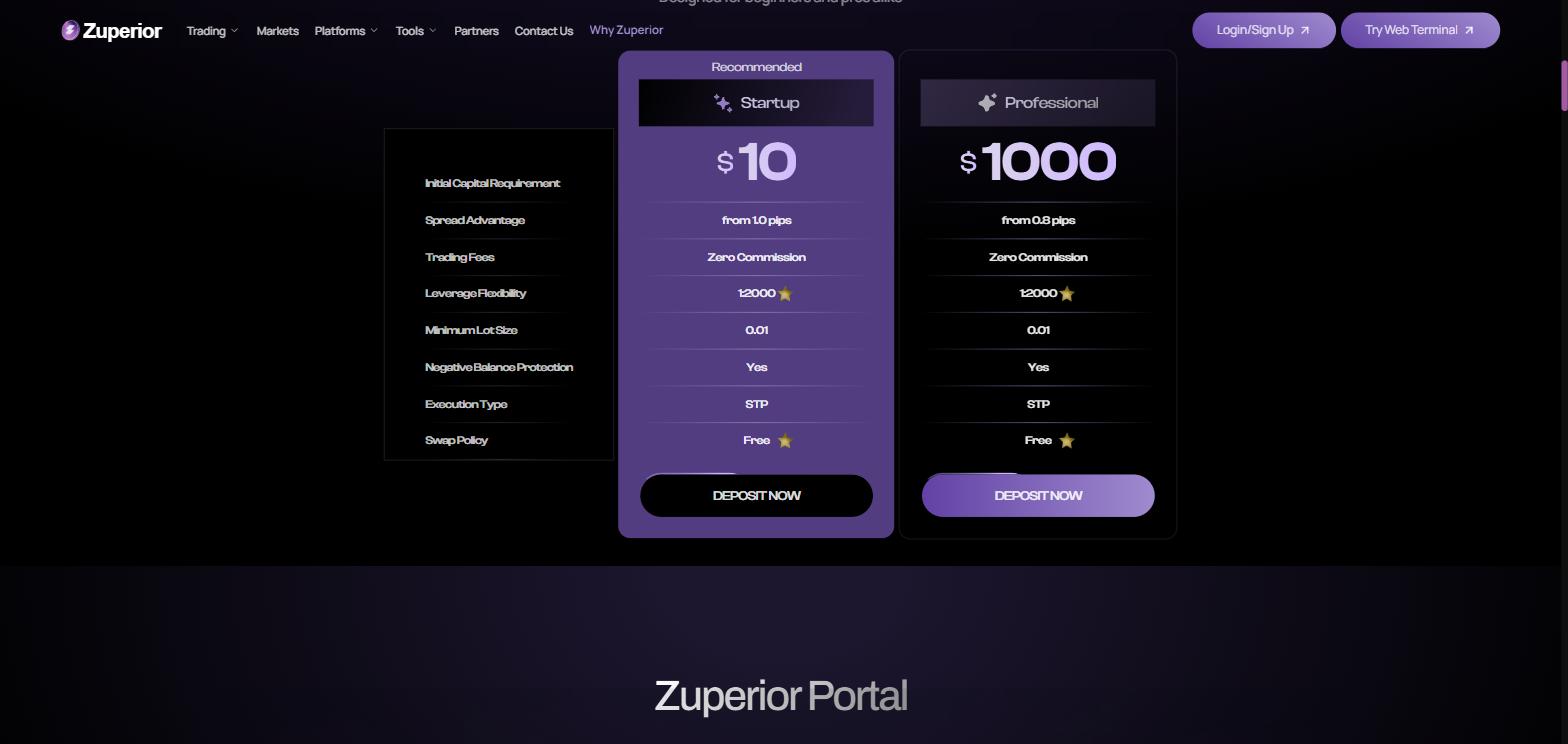
Zuperior account types showing 1:2000 leverage and $10 minimum deposit
Zuperior’s two live accounts. Note the 1:2000 leverage on both. Screenshot: zuperior.com
Account Minimum deposit Spread from Commission Leverage Swap Execution
Startup $10 1.0 pips Zero 1:2000 Free STP
Professional $1,000 0.8 pips Zero 1:2000 Free STP

Both accounts advertise negative balance protection and a 0.01 minimum lot. Elsewhere the site promises “ultra-low spreads, instant withdrawals” and, more remarkably, “Guaranteed No Slippage”.

One practical note before anything else: Zuperior states it does not offer services to residents of the United States, United Arab Emirates, North Korea, Myanmar, Iraq or Sudan. Its largest market, according to WikiFX’s influence index, is India.

The Licence Question

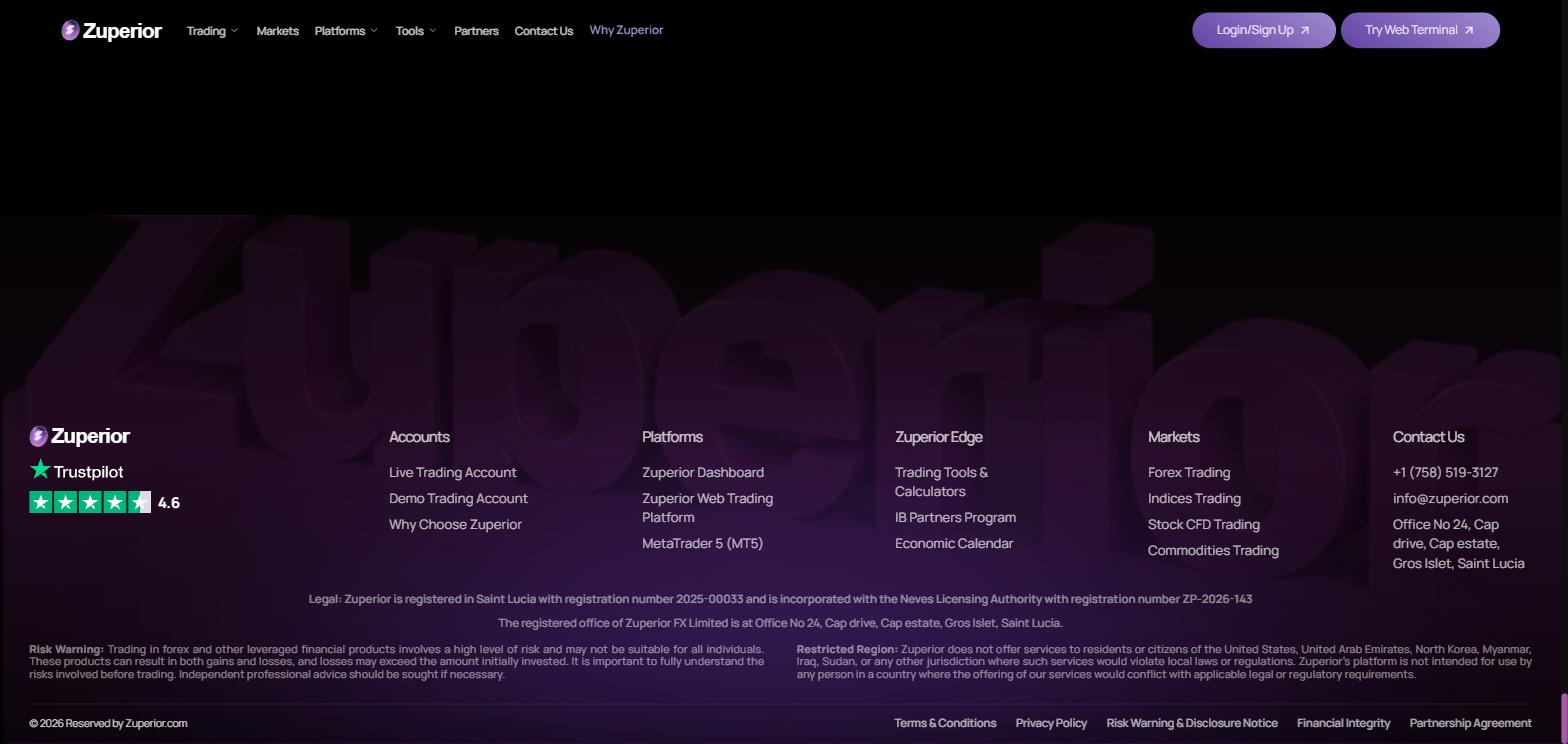
This is the part of the Zuperior review that matters more than spreads or platforms, so it is worth reading the company’s own words carefully. The legal line in the site footer reads:

“Zuperior is registered in Saint Lucia with registration number 2025-00033 and is incorporated with the Neves Licensing Authority with registration number ZP-2026-143.”

Zuperior footer stating registration in Saint Lucia and the Neves Licensing Authority
The full legal disclosure from Zuperior’s footer. Screenshot: zuperior.com

Notice what that sentence does not say. It never claims to be licensed, authorised or regulated by anyone. It says “registered” and “incorporated”. Those are company-formation words, not supervision words, and the distinction is the whole story.

The Saint Lucia number

Saint Lucia registration 2025-00033 is an International Business Company registration. Saint Lucia does not operate a forex broker licensing regime, and an IBC number confers no financial oversight whatsoever. When TraderKnows checked the Saint Lucia Financial Services Regulatory Authority register in July 2025, it found no financial regulatory record for Zuperior at all.

The “Neves Licensing Authority”

The second number is the one worth pausing on. Searching for the Neves Licensing Authority turns up a cluster of self-published websites and press-release wire posts, and nothing else. It describes itself as operating from São Tomé and Príncipe — but the actual financial regulator of São Tomé and Príncipe is the Banco Central de São Tomé e Príncipe. There is no statutory body called the Neves Licensing Authority. Neves is a town on the island.

Its own website makes no mention of investor protection, a compensation scheme, or supervision of the firms it “licenses”, and it carries a disclaimer that its portal “does not replace independent professional advice or official determinations.” The name is also one letter away from Nevis, a genuine offshore jurisdiction — a coincidence that works in the issuer’s favour.

What “unregulated” actually costs you

This is not a technicality. With a licensed broker, three things exist that do not exist here:

  • Segregated client money. A regulated broker must hold your deposit separately from its own operating funds, so the business failing does not mean your balance disappears.
  • A compensation scheme. In the UK, FSCS covers up to £85,000 per client if the firm collapses. In Cyprus the ICF covers €20,000. Saint Lucia and Neves offer nothing.
  • Somewhere to complain. With a regulator there is an ombudsman and an enforcement process. Without one, a refused withdrawal is a private dispute with a company on another continent, and there is no authority you can escalate to.

If money goes into an unregulated offshore broker and does not come out, the realistic recovery path is close to nonexistent. That is the risk being taken, whatever the trading conditions look like.

What Independent Broker Watchdogs Say

WikiFX rating Zuperior 1.87 out of 10 with no forex trading licence found
WikiFX rates Zuperior 1.87/10 with a regulation score of 0.00. Screenshot: wikifx.com

Three independent broker-monitoring services have looked at Zuperior, and none of them reached a favourable conclusion.

WikiFX scores it 1.87 out of 10 and stamps the profile “Not Regulated” and “No License”. Its rating breakdown is instructive: Regulation 0.00, Risk Control 0.49, Reputation 4.45 — the technology score of 8.35 is the only decent number, which tells you the platform works fine and the governance does not. The page carries a red banner reading “Warning: Low score, please stay away!” and, under Forex License, simply: “No forex trading license found. Please be aware of the risks.”

BrokersView published its assessment on 28 May 2026, marking Zuperior “High-Risk Active” and “Unregulated”. Its conclusion was blunt: “Zuperior appears to be a scam,” adding that “we strongly urge you to refrain from any form of trading or interaction with Zuperior.” It also noted precisely what we noted above — that Zuperior “does not claim to be licensed by any regulator; it only claims to be registered in Saint Lucia,” and that IBC status “does not constitute a valid financial licence.”

TraderKnows classifies the broker as suspected fraud, and adds two operational observations from its own review: parts of the site, including the registration form and the education section, did not function, and the zuperior.com domain was registered in 2015 but sat parked and offered for sale until shortly before the current business launched. A recycled domain is not proof of anything on its own, but combined with a company registration dated 2025, it means the brand has far less history than a 2015 domain age might suggest.

The Trustpilot Score, and Why 4.6 Is Misleading

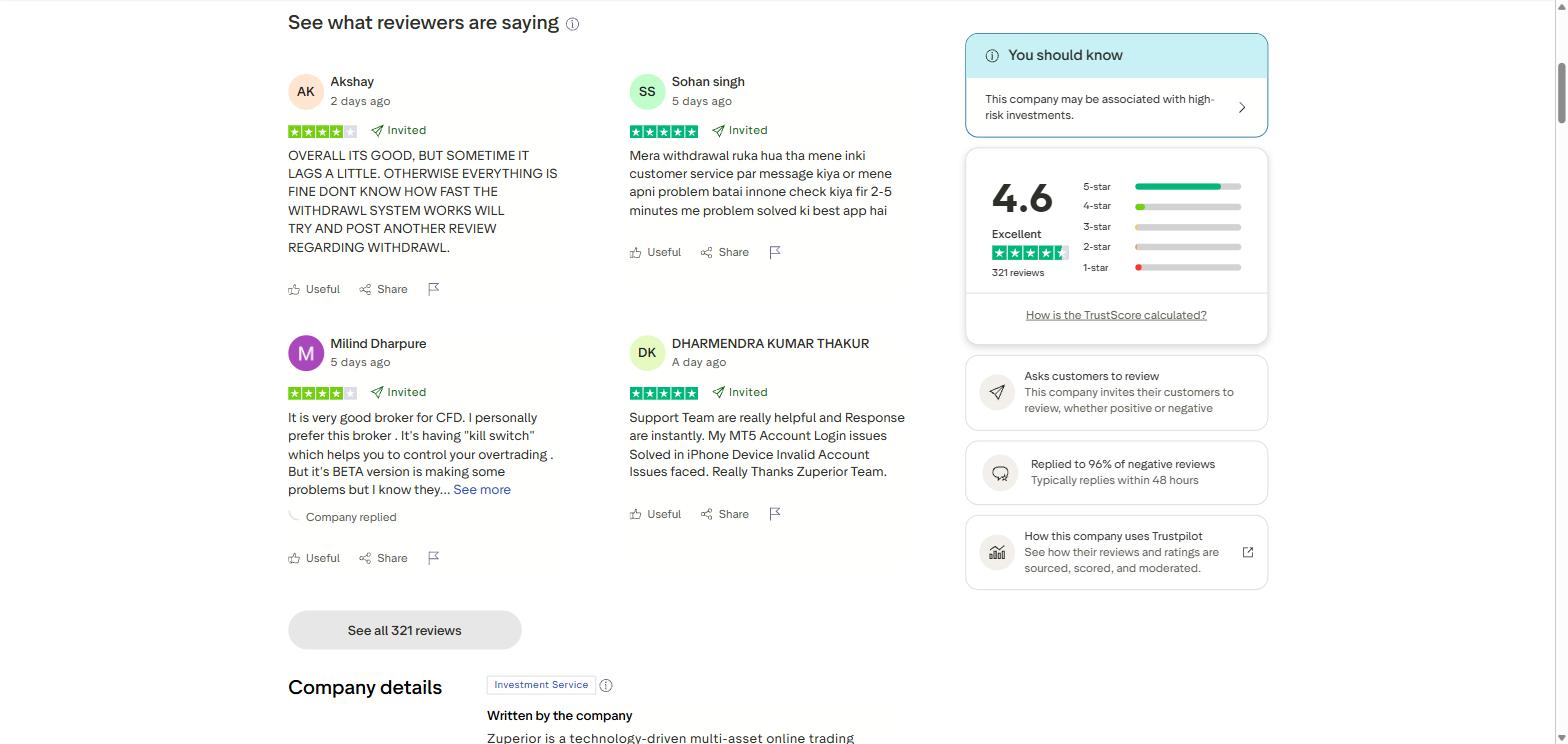
Zuperior Trustpilot page showing a high-risk investment warning and invited reviews
Trustpilot’s own notice sits directly above the 4.6 score. Screenshot: trustpilot.com

Zuperior holds 4.6 out of 5 on Trustpilot from 321 reviews, and displays that badge prominently in its own footer. Taken at face value it looks like a strong endorsement. It should not be taken at face value, for three reasons.

First, Trustpilot itself warns about the company. Directly above the score sits a notice reading: “You should know — This company may be associated with high-risk investments.” Trustpilot does not attach that to ordinary brokers.

Second, essentially every review is solicited. The profile was claimed in November 2025 and runs a paid Trustpilot subscription. Of the 24 reviews visible when we checked, 23 were tagged “Invited” and none were unprompted. Trustpilot notes that the company “asks customers to review”. A 4.6 built almost entirely from invited reviews measures how effectively a company solicits feedback, not how it behaves when a customer wants money back.

Third, read what the positive reviews actually praise. They are short, mostly from India, and almost all about how quickly a support agent replied — not about withdrawals. One four-star review states plainly: “DONT KNOW HOW FAST THE WITHDRAWL SYSTEM WORKS WILL TRY AND POST ANOTHER REVIEW REGARDING WITHDRAWL.” A five-star review opens, in Hindi, by saying the writer’s withdrawal had been stuck before support unblocked it. When five-star reviews begin with a blocked withdrawal, the score is not measuring what a prospective depositor needs to know.

For contrast, our QT Funded review looks at a firm rated 3.7 where the majority of reviews are unprompted — a lower headline number built on far more honest foundations.

The Trading Offer, and Why the Numbers Do Not Add Up

Set the licence question aside for a moment and look only at what is advertised. Several of the headline figures are not commercially coherent.

1:2000 leverage

No regulated jurisdiction permits anything close to this. The FCA and ESMA cap retail forex leverage at 1:30, ASIC at 1:30, and even permissive offshore regulators rarely go beyond 1:500. At 1:2000, a 0.05% move against a fully-margined position wipes out the account. Extreme leverage is not a feature for the trader; it is the fastest way for a broker to convert deposits into closed positions.

“Guaranteed No Slippage”

This one is simply not possible. Slippage happens when the price moves between order and execution, which is a property of live markets, not of a broker’s software. A firm that could genuinely eliminate it would be absorbing unlimited risk on every fill. Reputable brokers advertise low slippage or guaranteed stop-losses on specific instruments for a fee. A blanket guarantee of no slippage is a marketing claim that cannot survive contact with a volatile session.

Zero commission, free swaps and STP together

STP means the broker passes your order to a liquidity provider and earns from the spread or a commission. Zuperior advertises zero commission, swap-free on both accounts, and spreads from 0.8 pips. Those three things together leave very little visible revenue for a genuine STP operation. Either the execution is not really STP, or the money is made somewhere the marketing does not mention.

The missing information

Just as telling is what is absent. Across the site we could not find any published list of deposit or withdrawal methods, processing times, or fees. For a broker asking for money, that is a basic transparency failure — and given that withdrawal terms are the single thing most likely to matter later, an odd thing to leave out.

Pros and Cons

What is genuinely there

  • A working MT5 setup and a reasonably polished proprietary web platform
  • Very low entry barrier at $10, and a demo account available
  • Over 100 instruments across forex, indices, stock CFDs, commodities and crypto
  • Support is responsive — this is the one thing reviewers consistently confirm
  • The site does display a proper risk warning and a restricted-jurisdictions notice

What should stop you

  • No financial services licence anywhere. The Saint Lucia number is a company registration; the Neves number is from a body that does not appear to be a national regulator
  • No segregated client funds, no compensation scheme, no ombudsman
  • WikiFX 1.87/10 with a regulation score of 0.00 and a “please stay away” warning
  • BrokersView (May 2026): “Zuperior appears to be a scam”
  • Trustpilot displays its own high-risk-investment warning on the profile
  • A 4.6 rating built from reviews that are almost entirely company-invited
  • 1:2000 leverage and a “Guaranteed No Slippage” claim that cannot be honoured
  • No published deposit or withdrawal methods, fees or processing times
  • Company registered in 2025 with 1–2 years of operating history

How to Check Any Broker Before You Deposit

The useful thing to take from this Zuperior review is the method, because the same three checks would have flagged it in about ten minutes.

  • Find the licence number, then look it up on the regulator’s own website. Not the broker’s site — the regulator’s. The FCA, ASIC and CySEC all publish free public registers. If the number does not appear there, it is not a licence.
  • Check the regulator itself exists. If you have never heard of the authority named, search for it independently. A real financial regulator is a government body with a statutory basis, an enforcement record and a complaints process — not a cluster of recently-built websites.
  • Read the leverage. Anything above 1:500 tells you immediately that no major regulator is supervising the firm, before you check anything else.

For comparison, our XM review covers a broker whose licence numbers can be verified on regulator registers, and our TradeNation review looks at another established option. Neither is perfect — every broker has trade-offs — but both can be checked.

Verdict

We are not recommending Zuperior, and we have deliberately published this review without an affiliate link to it.

The platform itself appears to work; the support team appears to answer. Those are the two things the invited reviews measure, and they are real. But they are also the two cheapest things for any operation to get right, and they tell you nothing about what happens when you ask for your money back.

What we can verify is that Zuperior holds no financial licence, that the authority it names does not appear to be a genuine regulator, that WikiFX and BrokersView both class it as high-risk or worse, and that Trustpilot has attached its own warning to the profile. Against that, a $10 minimum deposit and a tidy interface do not weigh very much.

If you have already deposited: request a withdrawal now rather than building a balance, take dated screenshots of your account and every support exchange, and be aware that a demand for an unexpected “tax”, “fee” or “verification deposit” before a withdrawal is released is a well-known pattern and not something you should pay. If you funded by card, ask your bank about a chargeback promptly — those windows close.

Frequently Asked Questions

Is Zuperior regulated? No. It holds a Saint Lucia company registration (2025-00033), which is not a financial licence, and a number from the “Neves Licensing Authority”, which does not appear to be a national financial regulator. WikiFX records “No forex trading license found.”

Is Zuperior a scam? BrokersView concluded in May 2026 that it “appears to be a scam”, and TraderKnows classifies it as suspected fraud. We can confirm independently that it is unregulated, that its cited authority is not a recognised regulator, and that Trustpilot warns the company may be associated with high-risk investments. Readers should draw their own conclusion from those verified facts.

Can you withdraw money from Zuperior? Some users say yes and describe support resolving delays. Zuperior publishes no withdrawal methods, fees or processing times anywhere on its site, and because it is unregulated there is no authority to appeal to if a withdrawal is refused.

Is the 4.6 Trustpilot rating reliable? Treat it with caution. Of the 24 reviews visible when we checked, 23 were company-invited and none were unprompted, on a paid Trustpilot subscription. Trustpilot also displays a high-risk-investment warning on the profile.

Is 1:2000 leverage normal? No. The FCA, ESMA and ASIC cap retail forex leverage at 1:30. Leverage of 1:2000 is only offered by firms outside any meaningful supervision, and it makes an account extremely easy to lose.

This review is independent and contains no affiliate or referral links to Zuperior. It is general information about a company’s regulatory status, not financial advice, and it reflects what was published and verifiable at the time of writing.

Category: